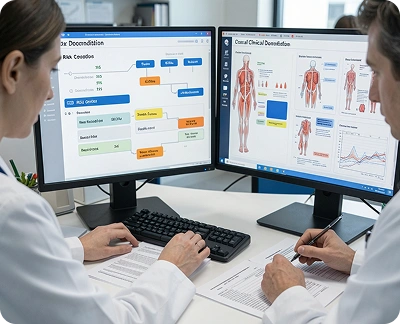
Discover the pros and cons of AI-augmented risk adjustment and how tech + expertise drive results.

Improving Accuracy & Data Integrity

Defensible, Audit-Ready Records

Automating Clinical Documentation

Precise Coding Across Care Settings

Complete Coding for Ancillary Services

Optimized Codes for Proper Reimbursement

Protecting Revenue Through Coding

Optimizing RAF for Population Health

Analytics-Driven Risk Adjustment

Improving Risk Capture Accuracy

Real-Time Coding for Better Outcomes

Accurate Data From First Touch

Preventing Delays Before Care

Recovering Revenue From Denials

Accelerating Payer Responses

Capturing Charges Without Leakage

Reducing Claim Errors Early

Resolving Credits With Precision

Accurate Payments, Faster Close

Strengthening Payer Appeals

Improving Accuracy Through Expert Audits

Compliance & Risk-Based Training

Risk-Focused Documentation Compliance

Compliance & Risk-Based Training

Risk-Focused Documentation Compliance

Is Your HCC Coding Accurately Reflecting the True Complexity of Your Patient Population?

A structured HCC risk adjustment coding analysis that benchmarks your chronic condition capture performance, surfaces documentation and coding gaps, and delivers a prioritized action plan to improve RAF accuracy and strengthen audit readiness across Medicare Advantage and value-based programs.

Start your assessment

Missed Chronic Condition Capture

Without a structured analysis, chronic conditions are frequently missed or not recaptured annually, leaving HCC coding incomplete and RAF scores inaccurate relative to the true disease burden of your population.

Documentation & Coding Disconnect

Clinical documentation often lacks the specificity required for compliant HCC coding, creating persistent gaps between provider intent, coding accuracy, and risk adjustment outcomes that only a structured analysis can surface and quantify.


Growing Audit & RADV Exposure

Without benchmarking current HCC coding practices against CMS standards, organizations cannot determine whether their documentation and coding workflows would withstand RADV scrutiny or evolving Medicare Advantage compliance requirements.

22%

RAF Scope Increase Across Reviewed Populations

+1 HCC

Net New HCC Reported Per Reviewed Member

34%

Annual Wellness Visit Capture Rate Increase

69%

Transitional Care Management Reporting Increase

What Happens During the HCC Coding analysis?

A structured, clinically validated evaluation of your HCC risk adjustment coding performance that benchmarks chronic condition capture, surfaces documentation gaps, and delivers a clear RAF improvement and compliance roadmap.

Submit Your Encounter & Claims Data

Share encounter records and claims data across your patient population, no PHI required, to establish a baseline view of your current HCC coding accuracy, chronic condition capture rates, and RAF performance.


Benchmark, Analyze & Quantify HCC Gaps

Our CMS-aligned coding specialists conduct a detailed review of your HCC medical coding performance, comparing chronic condition capture rates and RAF scores against national benchmarks to identify gaps and quantify recoverable RAF opportunity across your population.


Receive Your analysis Findings & Action Plan

Get a structured HCC coding analysis report covering RAF accuracy, missed condition categories, and documentation gaps, paired with prioritized recommendations and a guided expert walkthrough to help your team strengthen HCC capture and audit readiness immediately.

Know Your HCC Gaps. Strengthen Your RAF. Protect Your Compliance.

A Clear Picture of Where Chronic Conditions Are Being Missed

Your analysis maps HCC capture gaps across your patient population using clinically validated reviews, giving leadership a precise, evidence-based view of where chronic conditions are underdocumented, not recaptured, or missing entirely from risk adjustment coding.



Benchmarked Against CMS and National HCC Standards

Every finding is measured against CMS risk adjustment model specifications and national HCC coding benchmarks so your team understands the true RAF and financial impact of each documentation and coding gap relative to peer organizations.


A Prioritized Plan to Improve RAF Accuracy and Audit Readiness

Your HCC coding analysis delivers ranked recommendations by RAF impact and compliance risk, so leadership knows exactly which documentation improvements, recapture workflows, and coding practices to prioritize first for the most measurable gains.

7–22%

Organizations that complete a structured HCC coding analysis consistently identify between 7 and 22 percent improvement opportunity in chronic condition capture and RAF score accuracy within their existing coding and documentation workflows. 

Most organizations have a clear HCC improvement roadmap and measurable RAF targets within one structured analysis cycle.

Please enter your email address to download the White Paper.