



















The Definitive Executive Guide to Coding Benchmark Analysis for Fee-for-Service and Value-Based Care
Purpose of This Executive Guide
Healthcare organizations are under pressure to improve reimbursement accuracy, manage compliance risk, and perform competitively across both Fee-for-Service and Value-Based Care, often without a reliable external context.
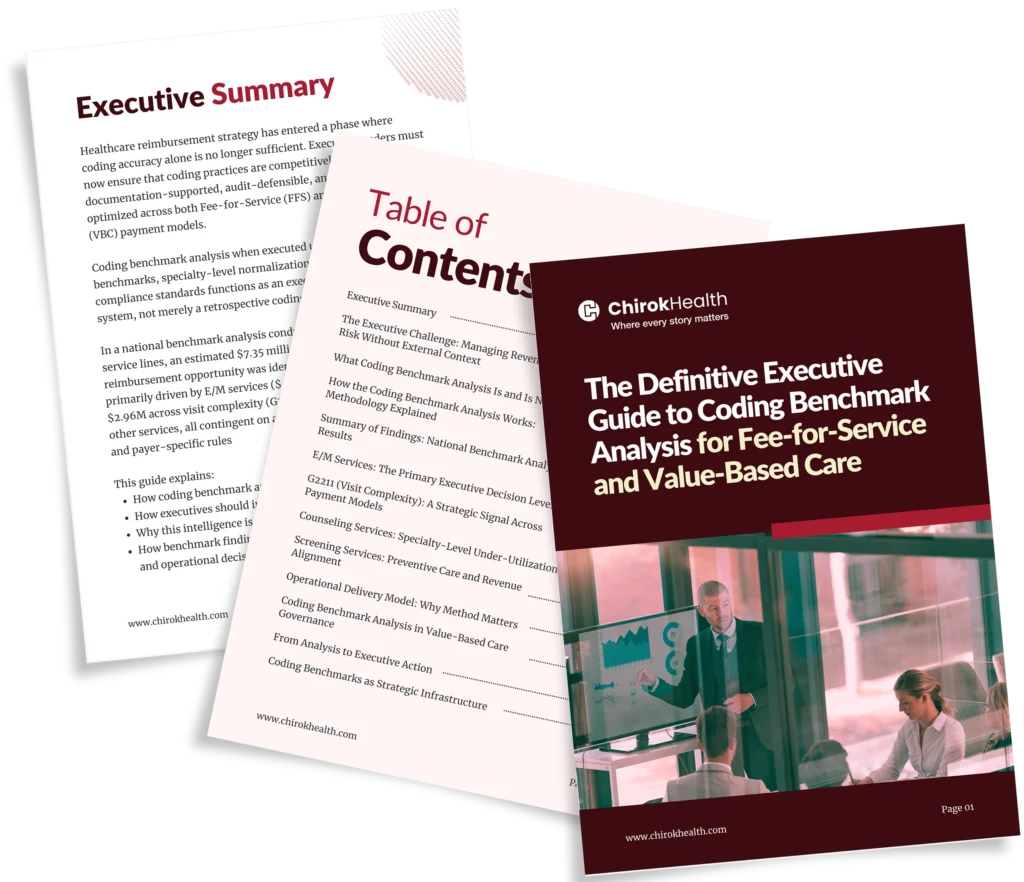
This guide exists to give executive leaders a nationally benchmarked view of coding performance, helping them understand where their organization may be under-representing clinical complexity, missing compliant revenue, or misinterpreting performance metrics. It reframes coding data as decision intelligence, not operational noise.
What’s Inside This Guide?
- How national coding benchmarks are constructed and normalized by specialty
- How to interpret utilization variance without increasing audit exposure
- Where compliant reimbursement opportunities typically concentrate
- How E/M services, visit complexity (G2211), counseling, and screenings influence revenue and risk
- How benchmark insights translate into financial, compliance, and governance decisions
Who This Guide Is For?
- Chief Medical Officers (CMOs) aligning clinical complexity with organizational performance
- Vice Presidents of Revenue Cycle managing reimbursement, denials, and payer dynamics
- Directors of HIM overseeing coding accuracy, audit readiness, and data integrity
- CDI Directors prioritizing documentation improvement efforts with measurable ROI
Why This Guide Matters?
Internal metrics alone no longer provide sufficient insight into coding performance, revenue integrity, or Value-Based Care outcomes. Without a national benchmark context, organizations risk underestimating both opportunity and exposure.
This guide equips leaders with the intelligence needed to benchmark confidently, act compliantly, and govern proactively, across evolving payment models and increasing regulatory scrutiny.
Enterprise-Grade Compliance



Download the Sample Now!
Got Questions?
We’ve Got Answers!
This guide focuses on benchmark intelligence, not audit findings. It compares your coding utilization against national, specialty-adjusted benchmarks to surface under-representation, without asserting improper billing or replacing clinical judgment.
No. All insights are framed within documentation-supported, payer-aligned, and audit-defensible standards. The guide explicitly separates benchmark variance from billing compliance, emphasizing governance-first decision-making.
Yes. The framework is designed to apply across FFS reimbursement, risk adjustment, and VBC performance governance, helping leaders understand how coding variance impacts revenue, risk scores, and quality metrics simultaneously.
The guide is written for senior leaders, not coders. It explains methodology, interpretation, and executive implications, without requiring day-to-day coding expertise or operational deep dives.
The guide is most effective when reviewed by CMOs, Revenue Cycle leadership, HIM leaders, and CDI directors, as it connects clinical documentation, financial outcomes, and compliance oversight into a single decision framework.
Yes. One of the core outcomes of coding benchmark analysis is identifying where documentation improvement yields the highest strategic and financial return, rather than spreading effort evenly across service lines.