






















Time-Based E/M Coding in Primary Care and Why Skipping It Leads to Undercoding
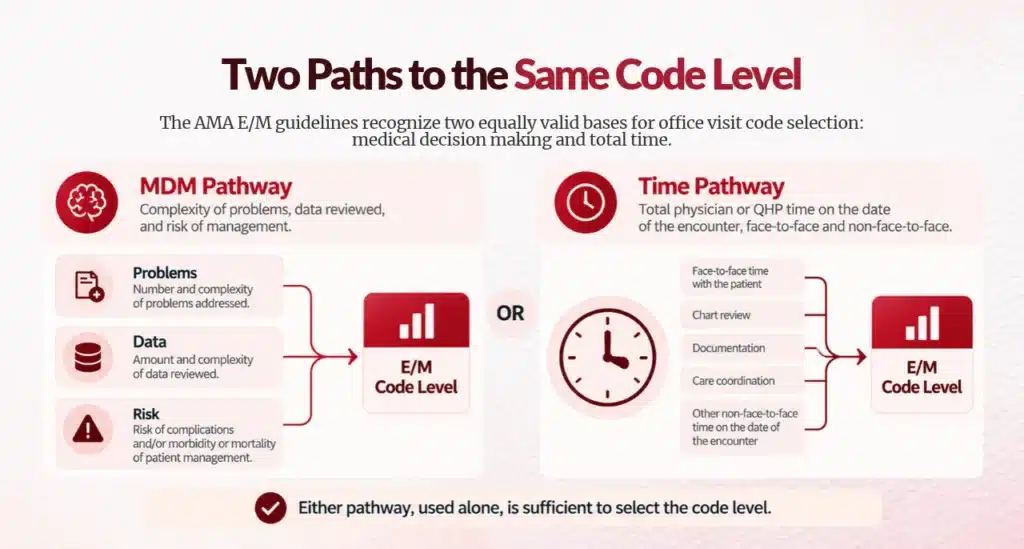
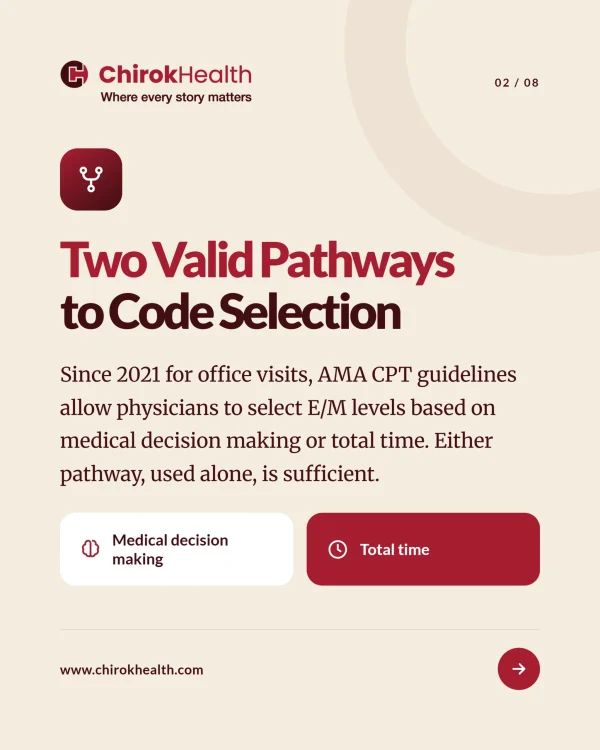
Most primary care physicians select E/M codes using medical decision making. That is one valid method. Since 2021 for office and outpatient visits, the AMA CPT E/M guidelines recognize a second, equally valid pathway: total time on the date of the encounter. Primary care practices with complex Medicare Advantage panels see the kind of long, multi-condition visits that often meet the time thresholds, yet many of their notes never record time.
Chirok Health’s Concurrent CDI Coding Review looks at both pathways on every encounter, inside the provider’s existing workflow.
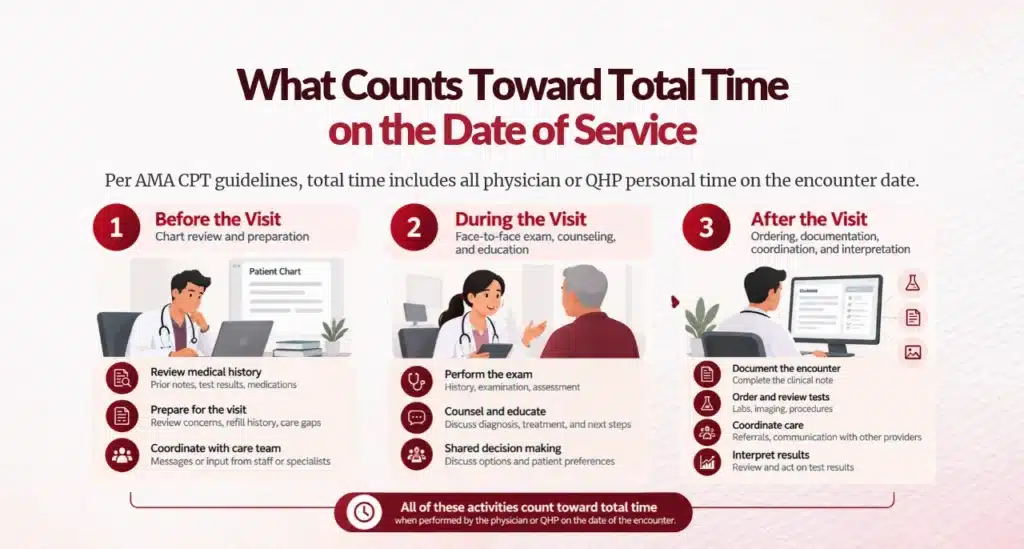
What Total Time Includes
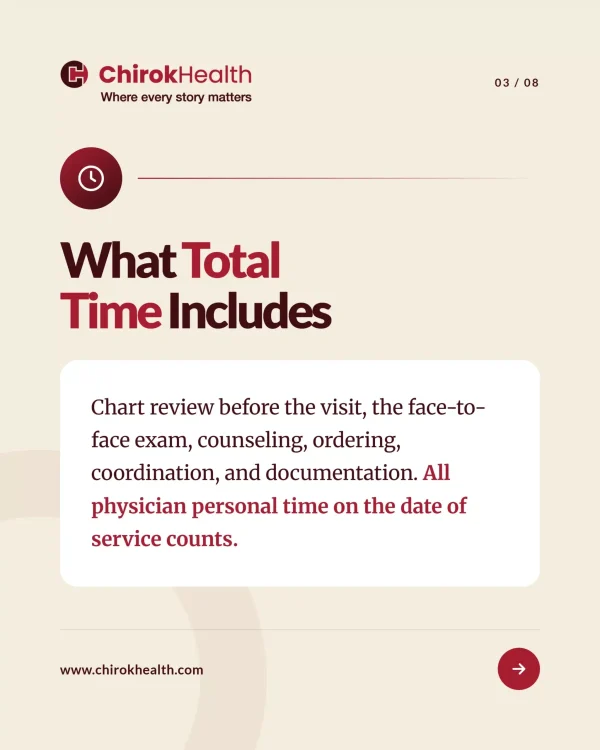
The AMA defines total time as all time personally spent by the physician or other qualified health care professional (such as an NP or PA) on the date of the encounter, face-to-face and non-face-to-face. Per AMA guidance, this includes preparing to see the patient, reviewing records and tests, performing the exam, counseling, ordering medications and tests, communicating with other providers, coordinating care, and completing documentation. All of it counts, as long as the activity is not separately reported. Time spent by clinical staff, and work done on a different date, does not count.
A primary care physician managing a Medicare Advantage patient with diabetes, heart failure, and chronic kidney disease routinely touches many of these activities in a single encounter. The total time on that date can exceed what the MDM documentation alone reflects.
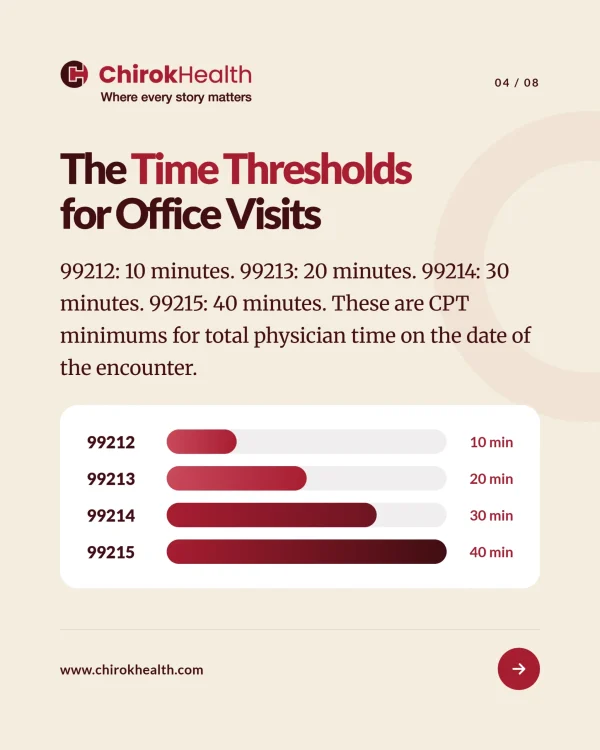
The Time Thresholds for Office Visits
CPT sets a minimum total time for each established patient office visit level. Since 2024, each descriptor lists a single threshold that must be met or exceeded, replacing the earlier time ranges:
- 99212: at least 10 minutes
- 99213: at least 20 minutes
- 99214: at least 30 minutes
- 99215: at least 40 minutes
Documenting time does not require a breakdown of each activity. The note needs the total minutes the physician personally spent on that date, excluding time for separately reported services. That can be one sentence. For visits that run long, prolonged service rules differ by payer: the CPT add-on 99417 begins at 55 minutes with 99215, while Medicare’s G2212 begins at 69 minutes. Confirm which one each Medicare Advantage plan follows.
One more code belongs in this conversation. For Medicare patients, the G2211 add-on recognizes the ongoing, longitudinal relationship at the center of primary care. It is reported in addition to the office visit code, whichever pathway set the level, and it has its own documentation expectations. Medicare Advantage plan policies on G2211 vary, so confirm coverage plan by plan.
Where the Gap Appears
A physician who spends 35 minutes on a complex established patient visit but documents only MDM must make sure the MDM elements clearly support 99214. When MDM documentation is thin, the visit codes at 99213. The same visit, with 35 minutes of total time accurately documented, supports 99214 on the time pathway.
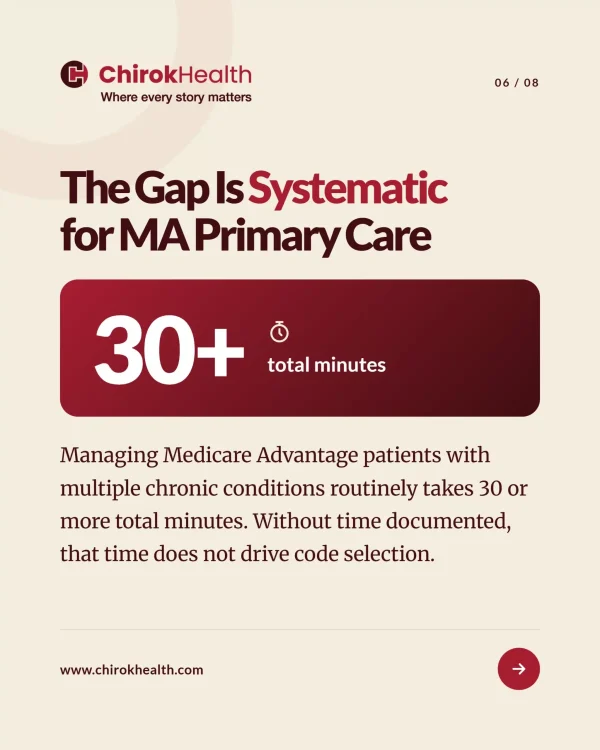
Primary care practices managing Medicare Advantage panels see some of the most complex patients in the outpatient setting, and that complexity often means longer encounters. Without time documented, the time pathway is unavailable. Code selection then rests entirely on MDM documentation, and when that documentation does not fully capture the clinical picture, the visit codes lower than the care delivered.
Why Physicians Skip Time Documentation
Two patterns come up often. First, many physicians learned to code under the pre-2021 guidelines, when history, exam, and MDM drove the level and time applied only when counseling or care coordination dominated the visit. Recording total time on every visit never became a habit. Second is audit anxiety: a perception that documenting time invites scrutiny. CPT treats both pathways as equally valid. What draws scrutiny is documentation that does not support the code, whichever pathway was used. For time, that means minutes that are accurate, recorded at the time of the visit, and plausible against the physician’s schedule that day.
For practices with complex Medicare Advantage panels, the effect of not documenting time is systematic, not occasional. Every encounter where accurately recorded time would have supported a higher level than the MDM documentation is an encounter coded below the work performed. For practices paid under capitation, where the visit level may not change payment directly, the same thorough documentation still matters: it supports the chronic conditions managed at each visit, which drive accurate risk adjustment.


Does Your Practice Know Where Its Time Is Going?
Chirok Health’s clinical coders, more than 90% of whom are physicians and pharmacists, review every encounter for MDM accuracy and time documentation, working inside the provider’s existing workflow. When a complex visit has no time recorded and the MDM documentation does not reflect the full clinical picture, the coder points to what the record shows. The physician draws the conclusion. The same review checks support for G2211 and modifier 25. Over time, that feedback shows each physician their own documentation patterns, with no new technology or added workflow.
For Medicare Advantage primary care practices, reviewing both pathways in a single concurrent pass closes gaps that MDM-only audits miss.
Request a Documentation Gap Assessment
The assessment covers time documentation patterns, visit level distribution, MDM accuracy, and HCC capture across your Medicare Advantage panel.
The Time Pathway Has Been Available Since 2021
Many primary care physicians with complex Medicare Advantage panels spend 30 or more total minutes on established patient visits. CPT provides a clear pathway to code that time accurately, yet many practices do not use it consistently. The documentation required can be a single sentence.
Frequently Asked Questions
1. What Counts as Total Time for E/M Coding?
Per the AMA CPT E/M guidelines, total time includes all time personally spent by the physician or other qualified health care professional on the date of the encounter: preparing to see the patient, the face-to-face visit, counseling, ordering medications and tests, interpreting results, communicating with other providers, coordinating care, and completing documentation. Time for separately reported services, time spent by clinical staff, and work done on a different date are excluded.
2. Do I Have to Document Each Activity Separately?
No. CPT does not require an itemized breakdown of how the time was spent. The note should state the total minutes the physician personally spent on the date of the encounter, excluding separately reported services. One sentence is sufficient, though some payers and compliance teams prefer a brief summary of the activities.
3. Can I Use Both MDM and Time to Select a Code for the Same Visit?
The physician picks one. The level may be selected using either MDM or total time, whichever better supports the visit, and only one pathway is needed to justify the code. There is no requirement to document both, but recording time on complex visits keeps the time pathway available when the MDM documentation falls short.
4. Does Documenting Time Make a Visit More Likely to Be Audited?
Not inherently. CPT treats time and MDM as equally valid bases for code selection, and the audit standard is the same for both: the documentation must support the code. For time, reviewers may compare documented minutes against the physician's total visits that day, so time should be accurate, specific, and recorded at the time of the visit.
5. What Time Threshold Qualifies for 99214?
Since 2024, 99214 requires at least 30 minutes of total time on the date of the encounter when the time pathway is used. Earlier CPT editions listed a range of 30 to 39 minutes. The time includes face-to-face and non-face-to-face work personally performed by the physician or other qualified health care professional, excluding separately reported services.
6. Does the Time Pathway Apply to Medicare Advantage Visits?
Generally, yes. Medicare adopted the 2021 office visit E/M framework, and Medicare Advantage plans typically follow the same E/M coding guidelines as traditional Medicare. Plan-specific policies can differ, especially for prolonged services, so confirm each plan's rules. Primary care practices managing Medicare Advantage panels with high chronic disease burden are well positioned to use the time pathway consistently.
Author Bio:

Brandy Kerby
CGO - Chirok Health
Brandy Kerby is Chief Growth Officer at Chirok Health, a clinician-led medical coding, CDI, and revenue cycle organization. She works with health systems, providers, plans, and risk-bearing organization leaders on a question most are now facing: not whether to adopt coding automation, but how to govern it. Her work centers on the operational evidence behind that decision, including the encounter-level analysis presented in this briefing.