





















10 Ways Payors Lose Risk Adjustment Revenue Without Retrospective Coding Reviews
Risk adjustment revenue is rarely lost because providers fail to deliver care.
It is lost because clinical reality is not fully translated into compliant, validated risk data.
For Medicare Advantage and other risk-based payors, retrospective coding reviews serve as the final checkpoint between care delivery and revenue recognition. When that checkpoint is missing, revenue leakage does not appear as a single failure. It shows up gradually in suppressed RAF scores, unexplained year-over-year drift, and increasing audit exposure.
For Directors and VPs overseeing Risk Adjustment and Provider Network Management, understanding how revenue is lost without retrospective reviews is now a governance issue, not an operational one.
Below are 10 structurally common, financially material ways payors lose legitimate risk adjustment revenue when retrospective coding reviews are absent or insufficient.
1. Chronic Conditions Are Treated Clinically but Never Fully Captured
One of the most persistent sources of RAF underperformance occurs when chronic conditions are actively managed but never fully captured for risk adjustment.
In many encounters, providers:
- Adjust medications
- Review disease progression
- Order monitoring labs
- Address complications
Yet the condition itself may only appear in the problem list or past medical history, without explicit assessment or plan language.
Without retrospective review, these encounters are often assumed to be “complete.” Claims process. Quality metrics pass. But the diagnosis does not qualify for HCC capture.
Retrospective coding reviews identify:
- Clinically managed conditions that lack compliant documentation
- Diagnoses implied through treatment but never formally assessed
- Patterns of under-capture by provider, specialty, or practice type
Without this visibility, payors systematically under-report member acuity not because care was absent, but because validation was incomplete.
2. Documentation Does Not Meet Risk Adjustment Validation Standards
Risk adjustment does not reward diagnosis presence alone. It requires documentation that meets validation criteria.
Many providers document conditions in ways that are clinically acceptable but insufficient for risk adjustment defensibility. Common gaps include:
- Diagnoses listed without assessment language
- Conditions mentioned without linkage to management decisions
- Vague phrasing that does not demonstrate monitoring or evaluation
Without retrospective coding review, these diagnoses may be submitted and counted—until they are challenged during audit.
Retrospective reviews function as a pre-audit validation layer, assessing whether documentation:
- Meets CMS risk adjustment requirements
- Demonstrates active management (not historical relevance)
- Can withstand RADV scrutiny
Without this layer, payors face a dual risk: lost revenue from conservative under-capture or financial exposure from unsupported submissions.
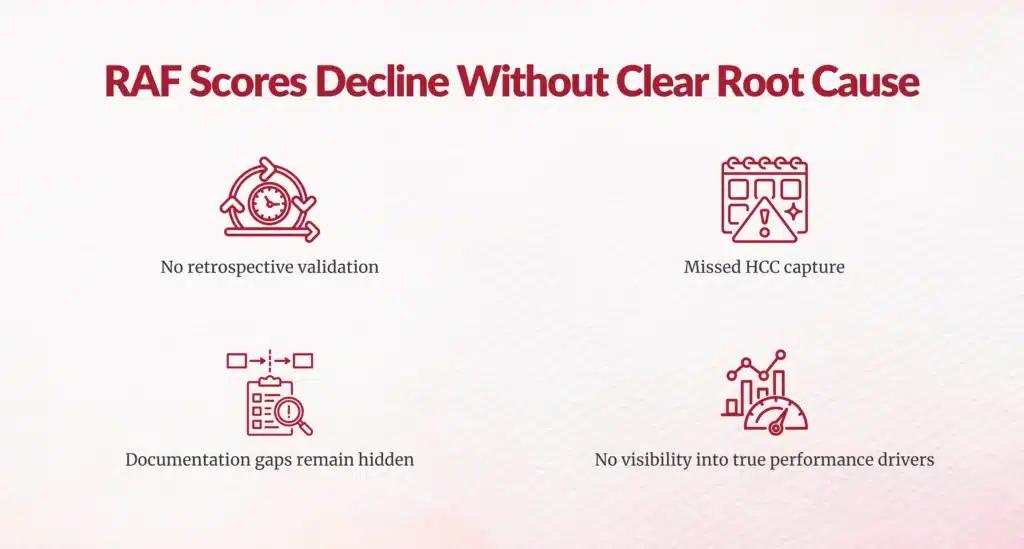
3. RAF Scores Decline Without Clear Root Cause Analysis
Many payors observe year-over-year RAF stagnation or decline without a clear explanation.
Absent retrospective review, leadership often cannot determine whether RAF movement reflects:
- True population health improvement
- Provider documentation changes
- Coding process breakdowns
- Network composition shifts
Retrospective coding reviews provide the forensic insight needed to distinguish between clinical reality and documentation failure.
They enable analysis of:
- Expected versus actual HCC capture
- Missed opportunities by encounter type
- Systemic documentation degradation
Without this insight, RAF trends are interpreted reactively and strategic decisions are made with incomplete information.
4. Over-Reliance on Prospective Risk Identification Alone
Prospective risk programs—suspecting tools, analytics, and pre-visit prompts—play an important role, but they operate on assumptions, not outcomes.
Prospective models can suggest what should be captured. They cannot confirm:
- What actually occurred during the visit
- Whether the provider documented compliantly
- Whether diagnoses were validated correctly
Without retrospective review, there is no closed loop.
Retrospective coding reviews:
- Reconcile suspected conditions against actual documentation
- Quantify gaps between expectation and reality
- Improve future predictive accuracy
Without reconciliation, prospective programs become aspirational rather than corrective—and revenue leakage persists unnoticed.
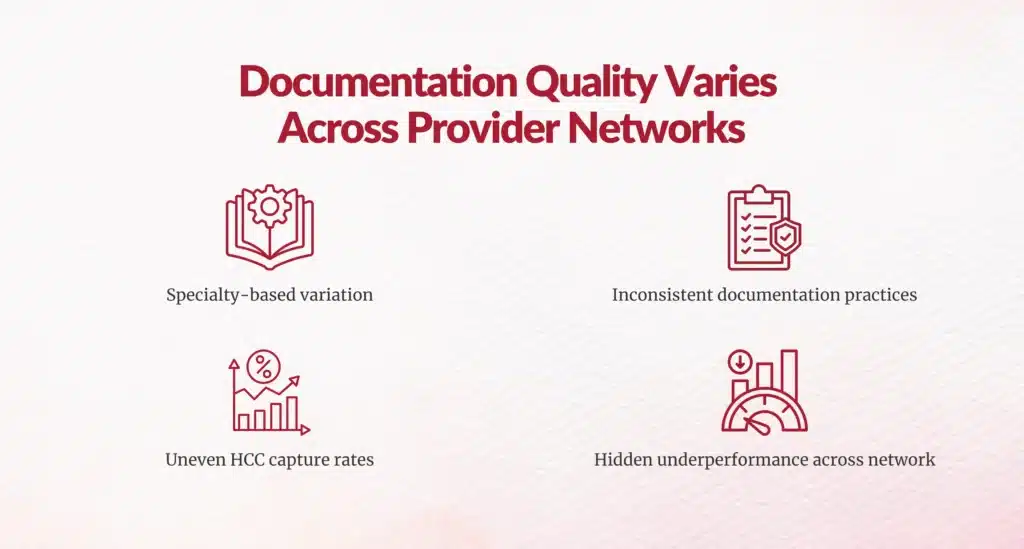
5. Network-Wide Documentation Variability Goes Unmeasured
Provider networks are inherently heterogeneous. Documentation practices vary widely by:
- Specialty
- Practice maturity
- EMR configuration
- Risk adjustment familiarity
Without retrospective review, payors often assume uniform documentation quality across the network.
This assumption is rarely accurate.
Retrospective reviews surface:
- High-performing versus underperforming providers
- Specialty-specific documentation weaknesses
- Training needs with the highest revenue impact
Without this data, network management strategies remain broad, generic, and inefficient—failing to address the providers driving the majority of RAF leakage.
6. Conditions Managed Outside Primary Care Are Missed
Risk adjustment is frequently operationalized as a primary care responsibility, yet many high-impact HCCs are managed by:
- Specialists
- Behavioral health providers
- Hospital outpatient departments
- Transitional and post-acute care settings
When retrospective reviews are absent, diagnoses documented outside primary care are often:
- Never evaluated for HCC eligibility
- Not validated for compliance
- Excluded from RAF calculation
Retrospective coding reviews expand visibility across the continuum of care, ensuring that member complexity is captured wherever it is addressed, not just where it is expected.
7. “Almost Compliant” Documentation Quietly Suppresses Revenue
Some of the most expensive revenue leakage comes from documentation that is nearly sufficient.
Examples include:
- Chronic conditions assessed but not explicitly linked to management
- Diagnoses documented without specificity
- Conditions captured once but not monitored annually
These encounters often pass internal review because they appear reasonable. However, under risk adjustment standards, they fail validation.
Retrospective coding reviews identify:
- Documentation that narrowly misses requirements
- Recurring near-miss patterns
- Education opportunities grounded in real examples
Without this feedback loop, small documentation gaps compound across thousands of encounters.
8. Audit Defensibility Is Assumed Rather Than Proven
Audit readiness is not achieved by intention. It is achieved through systematic validation.
Without retrospective review, payors often lack confidence that:
- Submitted diagnoses are fully supported
- Coding decisions align with regulatory guidance
- High-risk conditions can withstand RADV extrapolation
The expansion of RADV extrapolation authority by the Centers for Medicare & Medicaid Services increases the financial consequences of unsupported diagnoses across entire contracts.
Retrospective coding reviews act as a preemptive defense, identifying risk before it becomes liability.
9. Provider Incentives Remain Misaligned With Risk Accuracy
Providers are often incentivized around productivity, quality scores, or utilization—not documentation precision.
Without retrospective insights, payors struggle to:
- Demonstrate the financial impact of documentation gaps
- Target education based on evidence
- Align incentives with risk accuracy outcomes
Retrospective coding reviews provide the data needed to move conversations from abstract guidance to measurable impact, strengthening provider engagement and accountability.
10. Risk Adjustment Is Treated as an Event, Not a Discipline
Perhaps the most fundamental issue is treating risk adjustment as an annual project rather than a continuous governance function.
Without retrospective review:
- Errors are discovered too late
- Learning does not compound
- Process improvement stalls
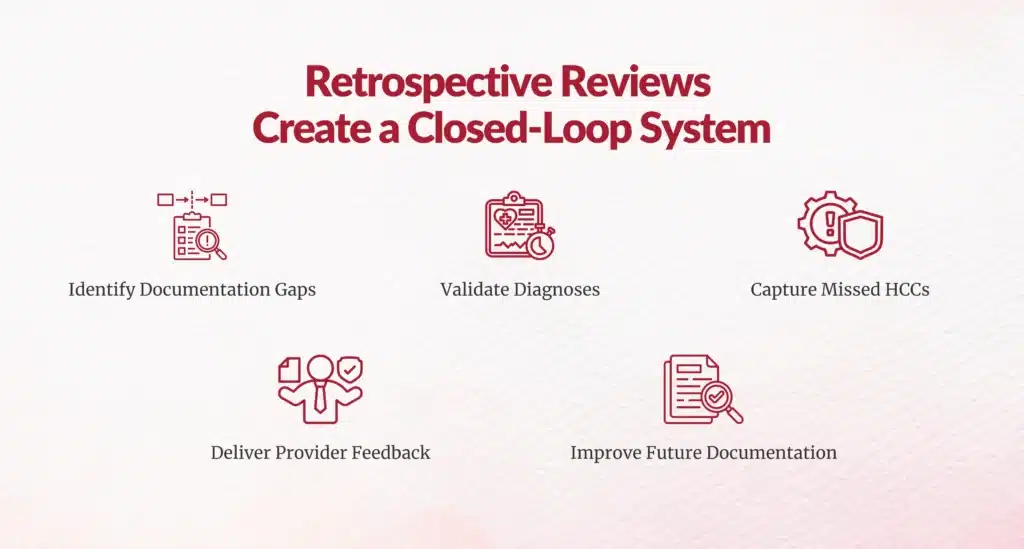
Retrospective coding reviews transform risk adjustment into a closed-loop system:
- Identify gaps
- Deliver feedback
- Improve future performance
Organizations that lack this loop rarely capture their true risk potential.
Final Thoughts for Risk Adjustment and Network Leaders
Risk adjustment revenue loss without retrospective coding reviews is rarely dramatic but it is almost always present.
For Directors and VPs responsible for RAF performance, provider networks, and audit exposure, retrospective review is not a “nice-to-have.” It is the mechanism that ensures clinical reality, documentation integrity, and financial recognition remain aligned.
The question is no longer whether retrospective reviews add value.
The question is how much revenue remains invisible without them.

FAQs
1. Why can’t prospective risk programs replace retrospective coding reviews?
Prospective programs predict what should be captured. Retrospective reviews confirm what was actually documented and validated. Both are necessary, but they serve different functions.
2. Does retrospective review increase audit risk? ide benchmark?
When governed properly, it reduces audit risk by identifying unsupported diagnoses before submission and strengthening documentation defensibility.
3. Are retrospective reviews only relevant for Medicare Advantage?
They are most mature in MA but increasingly relevant across other risk-based and value-based contracts where reimbursement depends on accurate acuity capture.
4. How quickly does revenue impact appear?
While results vary, most organizations see measurable RAF improvement within one performance year when retrospective insights inform documentation practices.
5. What is the biggest risk of operating without retrospective review?
Inaccurate RAF calibration either under-capturing legitimate risk or submitting unsupported diagnoses both of which create financial and regulatory exposure.
Author Bio:

Kanar Kokoy
CEO - Chirok Health
Healthcare CEO & CDI/RCM innovator. I help orgs boost accuracy, integrity & revenue via truthful clinical docs. Led transformations in CDI, coding, AI solutions, audits & VBC for health systems, ACOs & more. Let’s connect to modernize workflows.