






















How Payors Measure ROI and Compliance Impact of Retrospective Review
How Payors Can Measure ROI and Compliance Impact of Retrospective Review
Retrospective review programs have become foundational to financial governance for payors operating in risk-adjusted reimbursement environments. What was once treated as a back-end coding validation process is now a strategic control function one that directly influences revenue integrity, audit exposure, and executive accountability.
Increased oversight from the Centers for Medicare & Medicaid Services (CMS), coupled with enforcement authority under the Risk Adjustment Data Validation (RADV) framework, has fundamentally reshaped how payors must evaluate documentation accuracy. Under RADV extrapolation methodology, even modest unsupported diagnosis rates can result in scaled repayment obligations across entire member populations. In this environment, retrospective review cannot be evaluated solely by the incremental revenue it generates.
Leadership must ask broader, more strategic questions:
- Are we capturing legitimate, supported revenue?
- Are we proactively reducing audit exposure?
- Are we stabilizing risk scores?
- Are we strengthening documentation defensibility?
- Are we building operational maturity that sustains compliance?
To answer these questions, payors need a structured framework for measuring both financial ROI and compliance impact. This article provides that framework in depth.
Retrospective review programs have become foundational to financial governance for payors operating in risk-adjusted reimbursement environments. What was once treated as a back-end coding validation process is now a strategic control function one that directly influences revenue integrity, audit exposure, and executive accountability.
Understanding the Strategic Role of Retrospective Review
Before defining metrics, it is critical to clarify the strategic objectives of retrospective review in risk-adjusted models.
Retrospective review serves three primary functions:
- Revenue Accuracy: Ensuring that all clinically supported diagnoses are appropriately coded and reflected in risk scores.
- Revenue Protection: Identifying and removing unsupported diagnoses before they become audit findings.
- Documentation Integrity: Creating feedback loops that improve provider documentation quality over time.
Each objective contributes differently to organizational value. Measuring only incremental revenue provides an incomplete picture. Measuring only compliance exposure ignores financial opportunity. True ROI is the combination of both.
Financial ROI: Measuring Revenue Recapture with Discipline
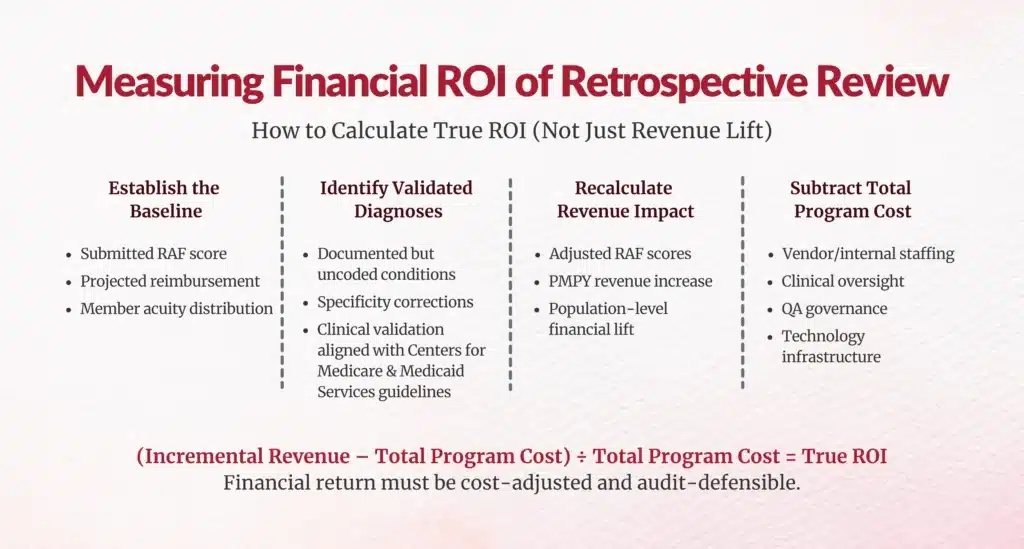
Establishing a Baseline
The first step in measuring financial ROI is defining a clear baseline:
- Original submitted Risk Adjustment Factor (RAF) scores
- Projected reimbursement based on submitted diagnoses
- Member population acuity distribution
Without a baseline, post-review comparisons lack credibility.
Validating Supported Diagnoses
Retrospective review identifies diagnoses that may have been:
- Documented but not coded
- Lacking specificity (e.g., stage, severity, complication)
- Incorrectly sequenced
- Underrepresented relative to patient acuity
Each addition must meet strict documentation standards consistent with CMS risk adjustment guidance. Clinical validation must confirm:
- Clear documentation of the condition
- Evidence of monitoring, evaluation, assessment, or treatment
- Alignment with risk adjustment rules
Revenue recapture should never include speculative or borderline diagnoses. Audit defensibility must remain paramount.
Recalculating Risk Scores and Projected Revenue
Once validated diagnoses are confirmed:
- Recalculate RAF scores at individual and population levels.
- Model projected reimbursement impact across the contract period.
- Quantify incremental revenue per member per year (PMPY).
This generates gross revenue recapture.
Calculating Net ROI
Gross revenue does not equal ROI.
True financial return must subtract total program costs, including:
- Vendor or internal staffing expenses
- Clinical validation oversight
- Quality assurance infrastructure
- Technology platforms
- Administrative coordination
- Compliance governance
Net ROI should be calculated using:
(Incremental Revenue – Total Program Cost) ÷ Total Program Cost
Cost-adjusted ROI ensures transparency and strengthens executive confidence.
Revenue Protection: The Often Underestimated Value
While revenue recapture is visible, revenue protection is often more strategic.
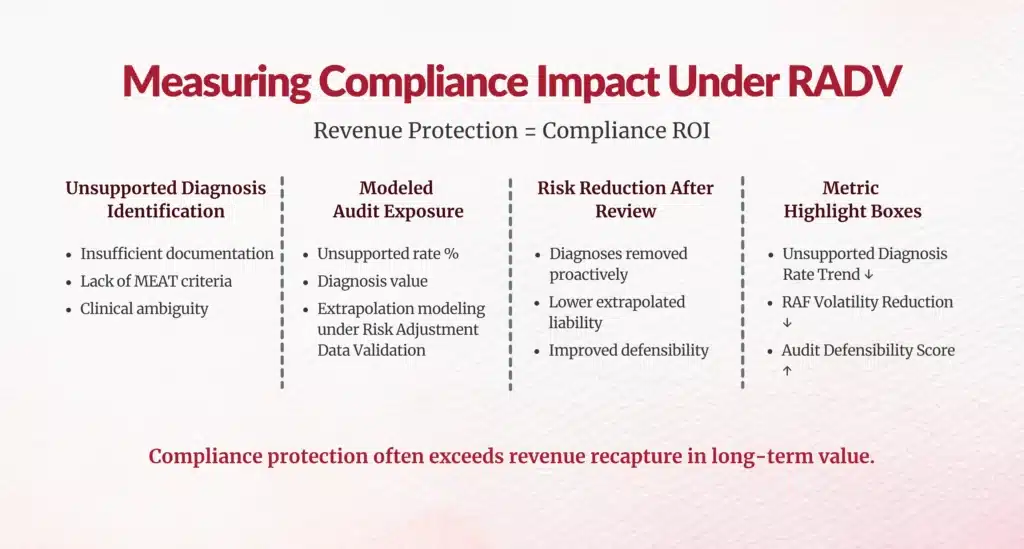
Retrospective review frequently identifies diagnoses that lack sufficient documentation support. Removing these diagnoses proactively reduces exposure under RADV extrapolation rules.
Under RADV methodology:
- Unsupported diagnoses trigger repayment.
- Repayment may be extrapolated across large populations.
- Small documentation errors can scale significantly.
Measuring Revenue Protection
To quantify revenue protection:
- Calculate the financial value associated with unsupported diagnoses identified during review.
- Model potential repayment exposure under extrapolation scenarios.
- Compare projected liability before and after retrospective correction.
The difference represents avoided financial risk. In many mature programs, avoided exposure equals or exceeds incremental revenue recapture. This is compliance-driven ROI.
RAF Stability: A Critical Indicator of Governance Strength
Risk score volatility attracts regulatory attention. Large year-over-year swings may signal inconsistent documentation practices or coding variability.
Retrospective review improves RAF stability by:
- Validating legitimate diagnoses
- Removing unsupported conditions
- Standardizing interpretation of documentation guidelines
Measuring RAF Stability
Track:
- Variance between submitted and validated RAF
- Year-over-year population-level RAF fluctuation
- Distribution of high-acuity outliers
Improved stability enhances actuarial forecasting and reduces audit curiosity. RAF precision is not just a financial metric; it is a regulatory signal.
Denial Reduction and Administrative Savings
Documentation-related denials represent measurable cost. Each denial requires chart retrieval, review, appeal drafting, and administrative follow-up. Retrospective review strengthens documentation integrity upstream, reducing downstream denials.
Measuring RAF Stability
- Establish baseline documentation-related denial rates.
- Calculate average administrative cost per denial.
- Measure post-implementation reduction.
- Multiply volume reduction by per-case cost.
Additionally, improved documentation reduces rework cycles and accelerates cash realization.
Operational savings contribute directly to ROI.
Measuring Compliance Impact with Structured Metrics
Financial return without compliance stability creates long-term vulnerability.
Compliance metrics must be tracked consistently and rigorously.
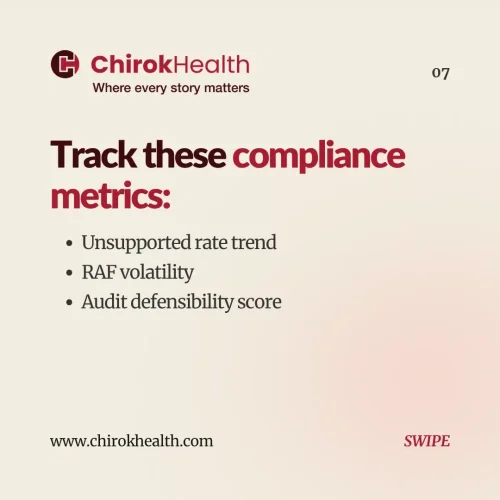
Unsupported Diagnosis Rate Trend
The unsupported diagnosis rate reflects documentation maturity.
Track:
- Percentage of diagnoses lacking sufficient documentation
- Quarterly and annual trend direction
- Specialty-specific concentrations
A declining unsupported rate indicates improved documentation behavior and reduced audit exposure. Flat or rising rates require intervention.
Audit Defensibility Index
Audit defensibility measures whether retrospective review decisions can withstand external scrutiny.
Develop a scoring framework assessing:
- Clarity of clinical documentation
- Evidence of monitoring, evaluation, assessment, or treatment
- Alignment with CMS guidance
- Transparent decision logic
- Proper query documentation
Aggregate results into a defensibility index.
Improvement over time demonstrates compliance maturity.
RADV Exposure Modeling
Given CMS extrapolation authority under RADV, exposure modeling is essential.
Modeling Steps
- Determine unsupported error rate.
- Identify revenue associated with affected diagnoses.
- Apply extrapolation multipliers across the population.
- Model conservative, moderate, and high-risk scenarios.
Compare projected exposure before and after retrospective review.
The reduction in modeled liability represents measurable compliance ROI.
Presenting exposure reduction in financial terms strengthens board-level reporting.
Operational Metrics That Sustain ROI
Financial and compliance gains are sustainable only if supported by operational discipline.
Query Turnaround Time
Delayed provider responses slow revenue correction cycles.
Track:
- Average response time
- Percentage of unresolved queries
- Escalation frequency
Improvement accelerates financial realization and strengthens provider alignment.
- Average response time
Inter-Rater Reliability (IRR)
Consistency across reviewers reduces variability risk.
Measure:
- Quarterly IRR percentage
- Discrepancy themes
- QA correction frequency
High IRR signals standardized interpretation and governance strength.
- Quarterly IRR percentage
Reviewer Productivity and Yield
Balance speed with quality.
Track:
- Charts reviewed per FTE
- Validated additions per chart
- Unsupported deletions per chart
- Revenue impact per reviewer
Sustained productivity without QA erosion demonstrates scalable maturity.
- Charts reviewed per FTE
Long-Term Strategic Impact
The greatest ROI often emerges over time.
As documentation practices improve:
- Unsupported rates decline permanently
- RAF stability strengthens
- Audit vulnerability decreases
- Rework cycles shrink
- Actuarial forecasting becomes more reliable
Retrospective review compounds value across multiple contract years. Strategic ROI extends beyond immediate revenue lift.
Conclusion: Measuring What Truly Matters
- Retrospective review must be evaluated through a comprehensive lens.
True ROI includes:
- Net incremental revenue
- Revenue protection from unsupported diagnoses
- RAF stabilization
- Audit defensibility
- Reduced RADV exposure
- Operational efficiency
- Long-term compliance maturity
In a regulatory environment shaped by CMS oversight and RADV extrapolation authority, retrospective review is not merely a coding initiative. It is a governance function. When measured correctly, it strengthens financial integrity, protects organizational credibility, and reduces executive risk. And that is how payors should define its true impact.









FAQs
1. How should payors measure ROI from retrospective review?
Payors should calculate net incremental revenue after program costs and model avoided RADV repayment exposure. ROI must reflect both revenue gain and compliance-driven risk reduction.
2. Why is revenue protection as important as revenue recapture?
Revenue protection prevents extrapolated repayment liability by removing unsupported diagnoses before audits. Under RADV, small error rates can scale significantly, making protection strategically critical.
3. What compliance metrics matter most?
Unsupported diagnosis rate trends, audit defensibility scoring, RAF stability, and modeled RADV exposure reduction are key compliance indicators.
4. How often should ROI be evaluated?
Quarterly monitoring of financial and compliance metrics is recommended, with annual comprehensive exposure modeling and governance assessment.
5. Why is RAF stability important?
Stable RAF scores signal documentation integrity and reduce regulatory scrutiny, improving both financial predictability and compliance posture.
Author Bio:

Kanar Kokoy
CEO - Chirok Health
Healthcare CEO & CDI/RCM innovator. I help orgs boost accuracy, integrity & revenue via truthful clinical docs. I've led transformations in CDI, coding, AI solutions, audits & VBC for health systems, ACOs & more. Let's connect to modernize workflows.