





















CMS Expected 58% G2211 Adoption. Physicians Reached 27%. What Happened?
CMS Built a Way to Pay Physicians More. Most Aren’t Using It.
When CMS introduced G2211 in the 2024 Physician Fee Schedule, the goal was clear: finally pay physicians for the complexity of managing patients over time.
The code was designed to reimburse the invisible work behind longitudinal care, chronic disease management, medication adjustments, specialist coordination, and the ongoing accountability that comes with being the physician patients rely on most.
CMS expected widespread adoption.
It projected G2211 would be billed with nearly 58% of eligible office and outpatient evaluation and management (E/M) visits overall, with some specialties expected to reach as high as 90%.
That did not happen.
A 2026 retrospective study published in the Annals of Internal Medicine found that by mid-2025, G2211 was being used in only 27% of outpatient Medicare E/M visits. Utilization started at just 5% in early 2024 and gradually increased before leveling off.
That gap is not just a coding issue.
It represents millions in missed physician reimbursement and a deeper problem inside Medicare payment policy.
Because Medicare operates under budget neutrality rules, CMS reduced the Physician Fee Schedule conversion factor to account for projected G2211 spending. In simple terms, physician payments were cut, assuming broad G2211 use.
The cut happened.
The billing often did not.
Many practices absorbed the reimbursement reduction without ever capturing the intended offsetting revenue.
Where G2211 Is Actually Being Used?
Adoption is strongest in specialties built around chronic, high-complexity care.
The study found:
- Endocrinology: 46.6%
- Internal Medicine: 39.7%
- Primary Care: 30–40%
- Hematology/Oncology: 30–40%
- Dermatology: less than 20%
Endocrinology leads because diabetes management and endocrine disorders naturally require continuous physician oversight.
Dermatology remains lowest, which aligns with its more episodic and procedure-focused care model.
The bigger concern is primary care.
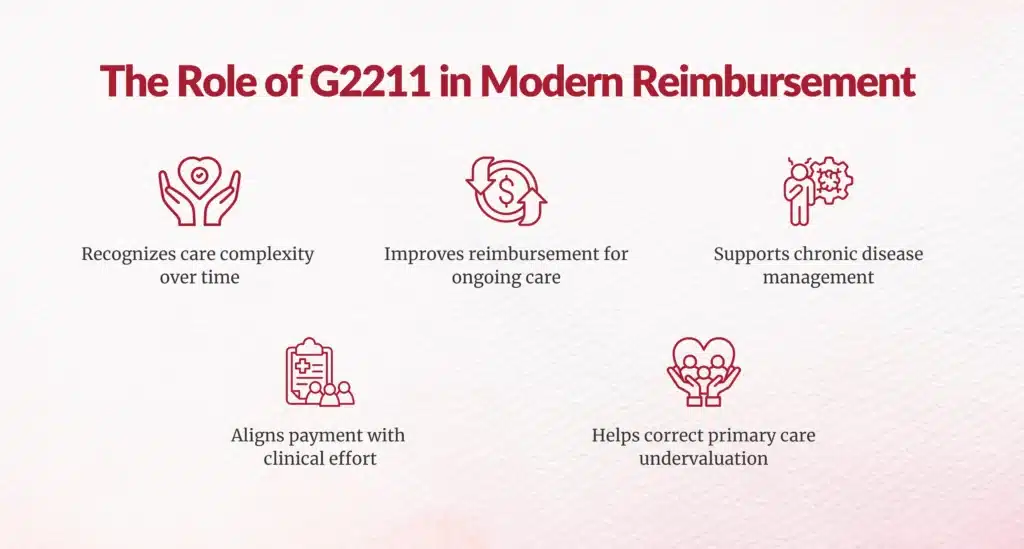
G2211 was designed in part to correct the longstanding undervaluation of primary care, yet adoption there does not meaningfully exceed many specialist groups.
As the study authors noted, this “may perpetuate the undervaluation of primary care, especially for complex patients.”
Why G2211 Adoption Is Still So Low
The problem is rarely physician resistance. It is usually an operational failure.
Documentation uncertainty
Many physicians are still not confident about when G2211 qualifies. When the rules feel subjective, providers default to not billing.
EHR workflow gaps
In many organizations, G2211 is not built into charge capture workflows. No prompt. No template. No trigger.
If physicians must remember it manually, adoption drops fast.
Compliance fear
Audit concerns create hesitation. Many providers worry more about overbilling than underbilling, even when the greater financial risk is missed reimbursement.
This Is Not a Coding Problem
It is a leadership problem.
High-performing organizations do not treat G2211 as a billing footnote. They treat it as a revenue cycle initiative.
They:
- build G2211 prompts into the EHR
- standardize documentation language
- train physicians by specialty
- track utilization by provider monthly
Without ownership, G2211 gets lost between physicians, coders, and billing teams.
What Healthcare Leaders Should Ask
Are we tracking G2211 utilization today?
If the answer is no, revenue is almost certainly being left behind.
Start with three numbers:
- percentage of eligible E/M visits billed with G2211
- provider-level variation across specialties
- denials tied to documentation gaps
The work is already happening. The question is whether it is being reimbursed.
Author Bio:

Kanar Kokoy
CEO - Chirok Health
Healthcare CEO & CDI/RCM innovator. I help orgs boost accuracy, integrity & revenue via truthful clinical docs. I've led transformations in CDI, coding, AI solutions, audits & VBC for health systems, ACOs & more. Let's connect to modernize workflows.