






















The E/M Documentation Traps Family Medicine Keeps Falling Into
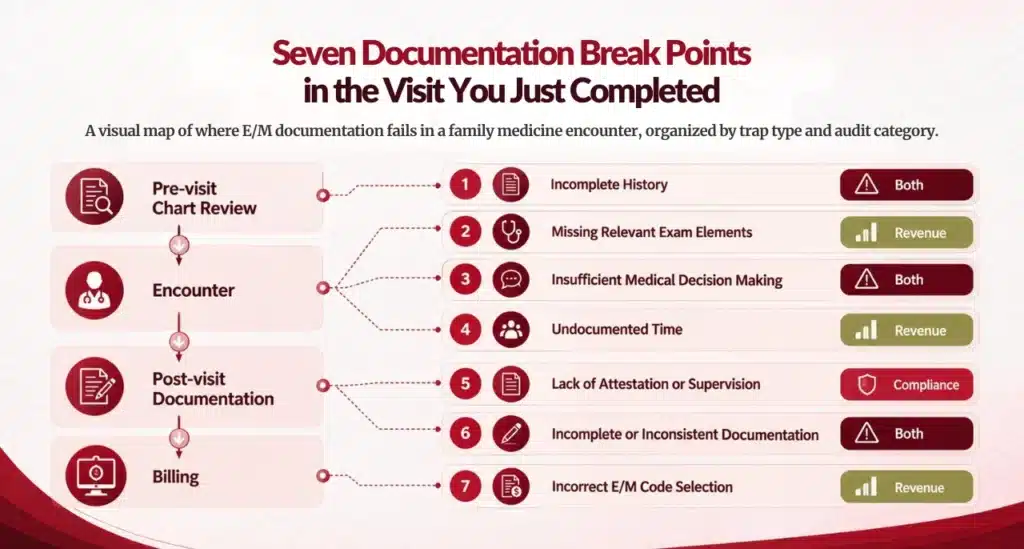
Family medicine runs on office visits, which makes E/M coding the single largest lever on both revenue and audit risk in a primary care practice. The 2021 rules were supposed to simplify it: level by medical decision making or total time, and stop counting history and exam. Five years in, the traps have not gone away. They have moved.
Trap 1: Defaulting to one leveling method
Every visit can be leveled by MDM or by time. Most practices pick one and never revisit it. A 20-minute visit with two uncontrolled chronic conditions and a prescription change is a moderate MDM visit regardless of the clock. A 45-minute visit spent mostly on counseling may earn more by time. The trap is not choosing wrong once. It is having no habit of asking which method the visit actually supports.
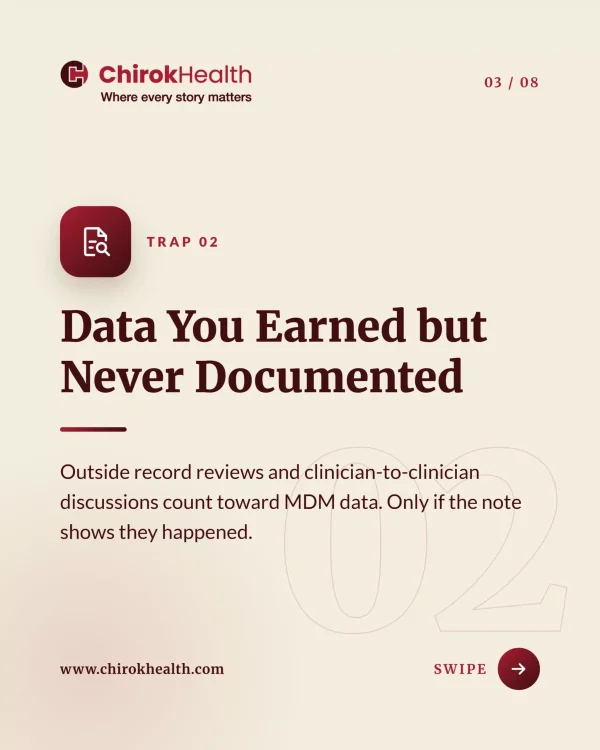
Trap 2: Data that was never documented
MDM rests on problems, data, and risk. Data is where family physicians most often sell themselves short. Reviewing outside records, ordering tests, and discussing management with another clinician all count, but only if the note shows they happened. “Labs ordered, records reviewed” documents one data point where the work supported several. The reverse trap: a result the same physician ordered last visit was already credited then and cannot count again.
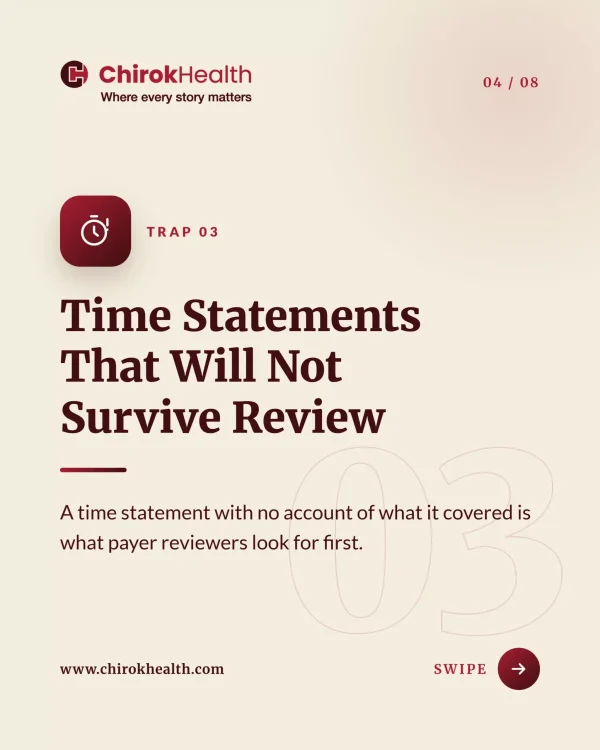
Trap 3: Time statements that do not survive an audit
Total time can include same-day chart review, documentation, and care coordination. It cannot include separately billable services, clinical staff time, or work on another day. “40 minutes spent,” with no account of what the time covered, is the first thing a payer reviewer flags.
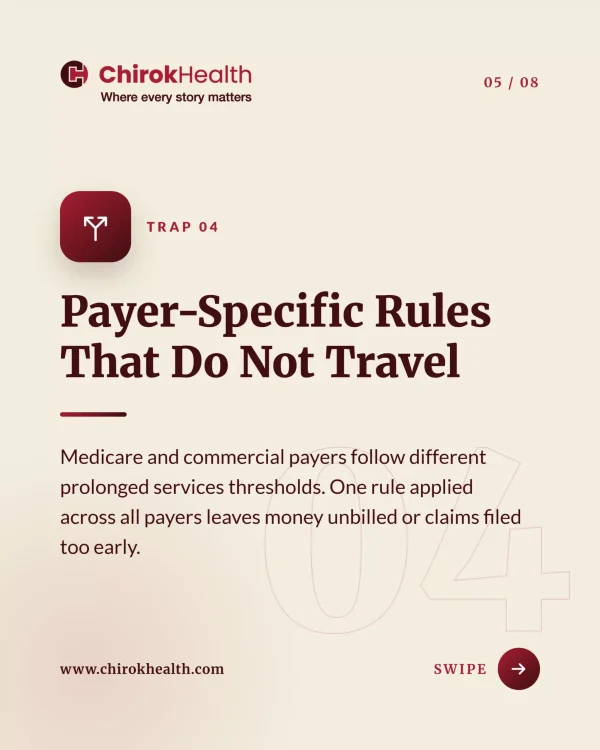
Trap 4: One prolonged services rule for every payer
Medicare uses its own prolonged services code and time threshold for office visits. Many commercial payers follow the CPT code and threshold. Practices that apply one rule to every payer are either leaving prolonged time unbilled or reporting it too early.
Trap 5: Split and shared visits with no substantive portion
In facility settings, a visit shared by a physician and an advanced practice provider is billed under whoever performed the substantive portion, and the record has to show who that was. Billing under the physician by default is exposure on every shared visit.
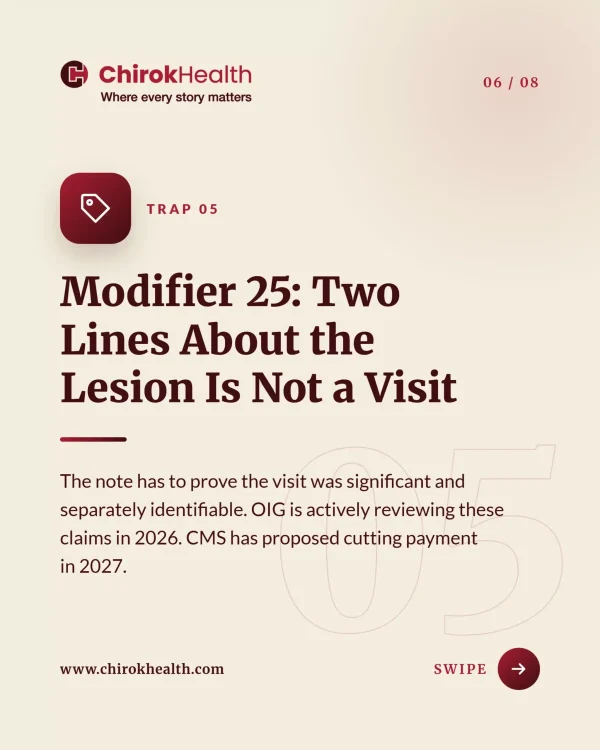
Trap 6: Modifier 25 without a separately identifiable visit
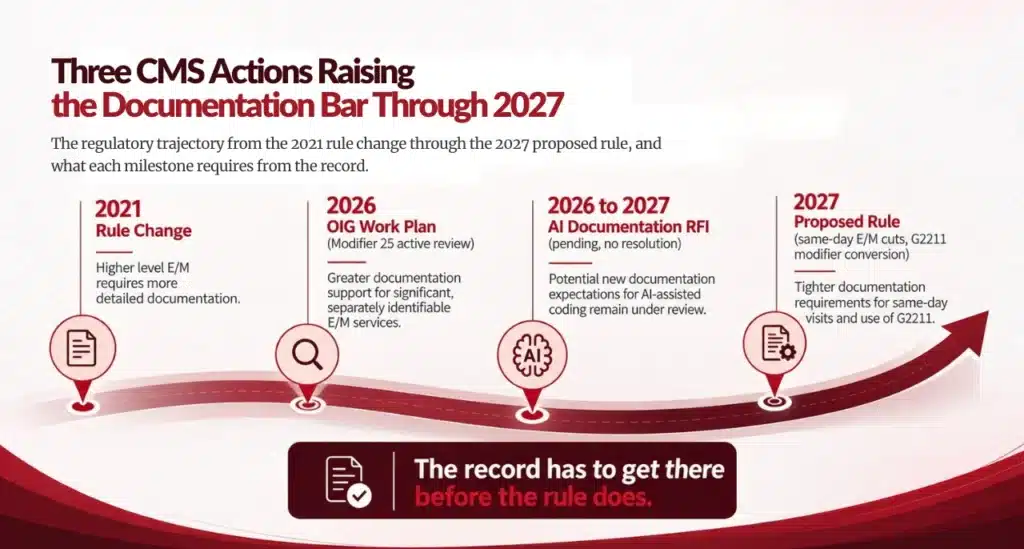
A same-day visit and minor procedure earns a separate E/M only if the visit is significant and separately identifiable, and the note has to prove it. A lesion removal with two lines about the lesion does not qualify. The OIG’s 2026 Work Plan lists these claims as an active review area, and CMS has proposed cutting payment for same-day E/M with global-period procedures in 2027. The bar is about to matter more, not less.
Trap 7: Templates that undercut the level earned
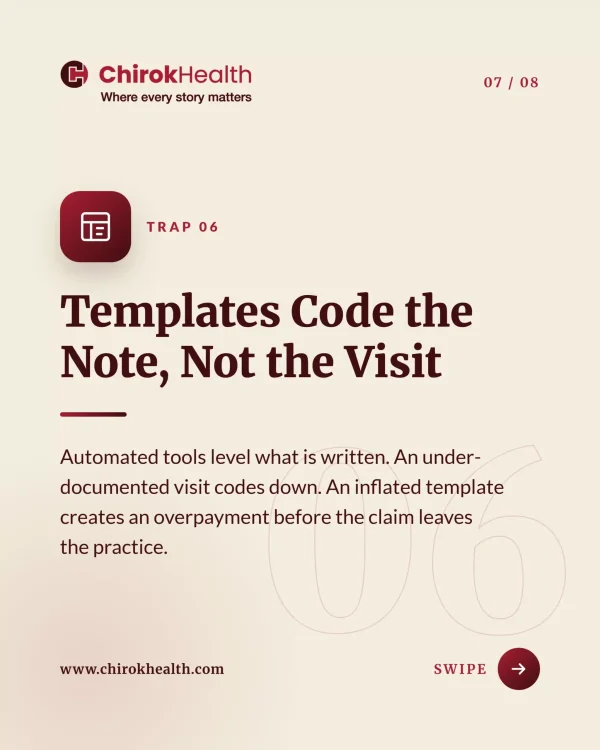
Cloned text makes every note look like every other note, which undermines medical necessity for the level billed. EHR default levels and automated coding tools compound it: they level the note as written. An under-documented visit codes down. An inflated template codes up.
What is changing next
CMS has proposed converting the G2211 complexity add-on into a modifier for 2027, with a larger payment for ACO participants. Whatever the final rule says in November, the record will still have to show the longitudinal relationship that justifies it. CMS has also opened a request for information on AI-enabled documentation and what a software-produced note is worth. Practices using ambient documentation or automated coding should expect scrutiny of whether the output reflects the visit or the template.
What actually fixes this
Clinical coders. When the coding reviewer is a clinician, the feedback is not “your documentation did not support 99214.” It is a conversation about what the record shows: the medication list changed, two problems were assessed, and the note does not reflect the decision making that connects them. The physician draws the conclusion. The reviewer’s job is to make sure the question gets asked, in language a physician recognizes as clinical rather than clerical.
That distinction is the whole difference. A coder working from a rule set reads a note and reports whether the code is supported. A clinician reads the same note as a record of a patient encounter and can see where the documentation under-represents or over-represents the care delivered. Only the second reading catches an under-leveled visit, because an under-leveled visit looks correct to anyone who cannot see what the physician was actually managing.
Timing matters as much as who reads. Most practices have tried the alternatives: templates standardize the note, ambient scribes generate it, and quarterly coder audits grade it months after the claim went out. None of them changes what the physician understood the visit to be, and none of them intervenes before the claim drops. A clinical coder review that happens before billing does both. The question reaches the physician while the encounter is still fresh, and the correction happens before the code becomes an overpayment, a denial, or an audit finding.
The compliance safeguard is built into the method. The reviewer identifies clinical indicators already in the record and asks. The reviewer never supplies the diagnosis, the level, or the language.
This is why Chirok built its review around provider support, and placed it before the bill rather than after. The output is not a longer error report. It is a physician who documents the visit accurately the first time, a level that is defensible in both directions, and a query volume that goes down over time instead of resetting after every audit.
Author Bio:

Brandy Kerby
CGO - Chirok Health
Brandy Kerby is Chief Growth Officer at Chirok Health, a clinician-led medical coding, CDI, and revenue cycle organization. She works with health systems, providers, plans, and risk-bearing organization leaders on a question most are now facing: not whether to adopt coding automation, but how to govern it. Her work centers on the operational evidence behind that decision, including the encounter-level analysis presented in this briefing.