






















How Concurrent HCC Coding and Risk Adjustment Reviews Capture What Separate Audits Miss
When practices identify a documentation gap, the typical response is two separate reviews: one team audits E/M coding accuracy, another reviews HCC capture for risk adjustment. The problem is that both teams are reading the same chart, addressing the same underlying documentation gap, and finding only part of the picture. Chirok Health’s concurrent review addresses both in one pass.
Concurrent review changes the timing. Clinical coders review the chart for E/M accuracy and risk adjustment together, before the claim is submitted. The visit is still fresh, so the physician can clarify documentation while the clinical details are top of mind.
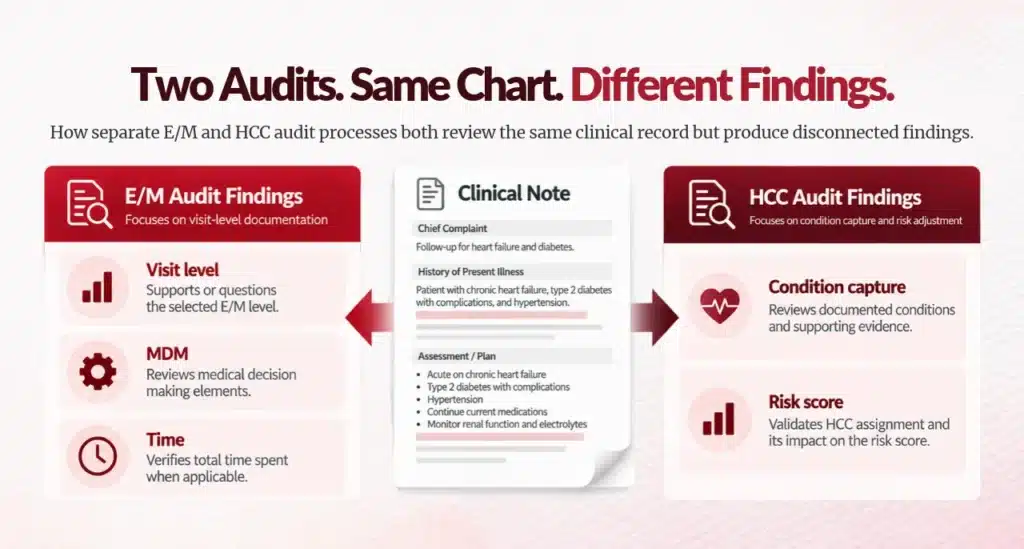
Why Separate Reviews Miss the Same Problem Twice
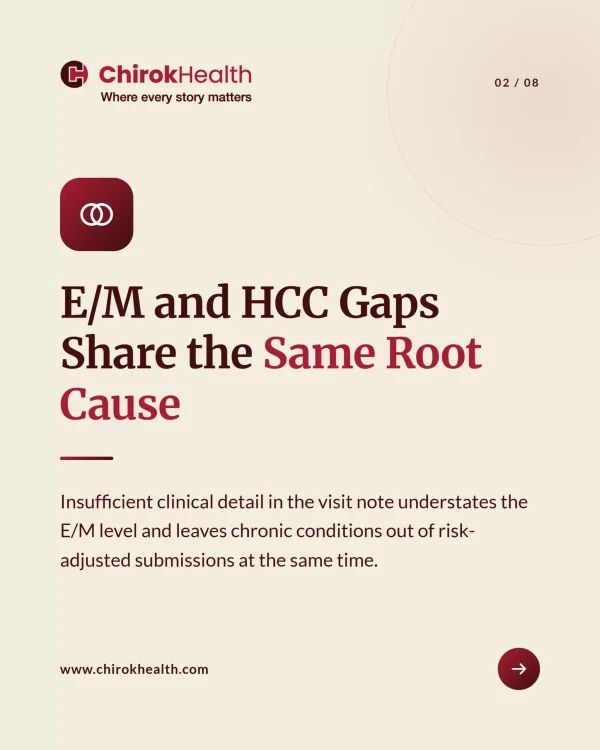
E/M coding gaps and HCC capture gaps share a root cause: insufficient clinical detail in the visit note. When a physician manages multiple chronic conditions but the note primarily addresses the presenting complaint, two problems appear simultaneously. The visit level may understate what was managed, and those same conditions may not generate HCC submissions because the note doesn’t address them. Two different audit teams can flag the same chart and still not see the combined financial impact.
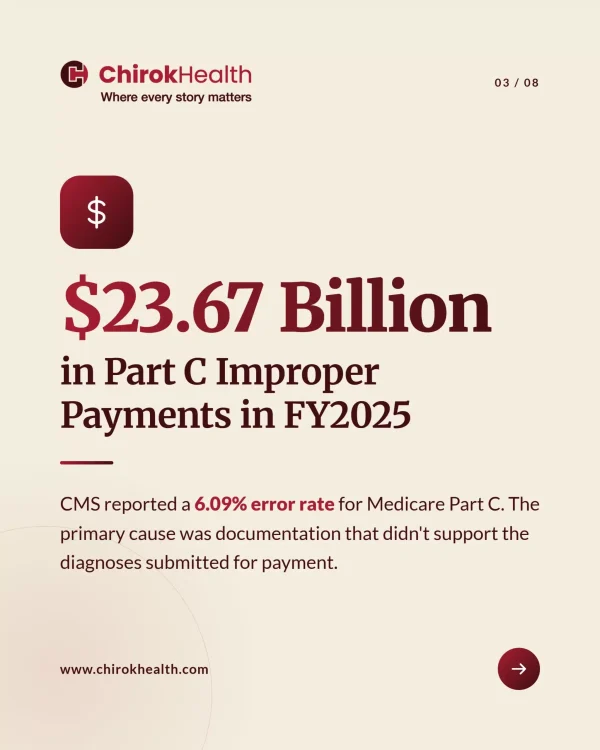
CMS’s fiscal year 2025 data shows that most Part C improper payments, totaling $23.67 billion at a 6.09% error rate, stem from documentation that didn’t support the diagnoses submitted for payment. The OIG’s series of 11 targeted risk adjustment audits, completed in March 2026, repeatedly found diagnosis codes that the medical records did not support.
What Concurrent CDI Review Covers That Retrospective Audits Don't
A retrospective review catches gaps after the claim is billed. A concurrent, pre-bill review surfaces gaps while the physician can still address them. That timing matters: a question about an underdocumented chronic condition that reaches a physician while the encounter is fresh is easier to resolve than one sent weeks later. Starting with payment year 2027, CMS also stopped counting diagnoses from chart reviews that aren’t linked to an actual encounter, which makes capturing them at the encounter more important.
Under the joint AHIMA and ACDIS guidelines for compliant query practice, documentation queries must use non-leading language and be grounded in clinical evidence already present in the chart. A concurrent review that follows this standard gives physicians a factual picture of what the record shows. They draw their own clinical conclusions.
The E/M and Risk Adjustment HCC Coding Connection
Since 2021 for office visits, and 2023 for most other settings, the AMA CPT E/M guidelines base code selection on medical decision making or total time. Under MDM-based coding, the complexity of conditions being addressed during the visit is a key factor. A visit where a physician manages multiple chronic conditions can support a higher-level E/M code when the documentation reflects that clinical work.
A review that covers only E/M accuracy may confirm that a code selection was appropriate but miss that a patient’s congestive heart failure wasn’t addressed in the note. A review that covers only HCC capture may identify missing conditions but not recognize that underdocumented clinical reasoning is limiting the E/M level. Concurrent coverage of both sees the full chart.
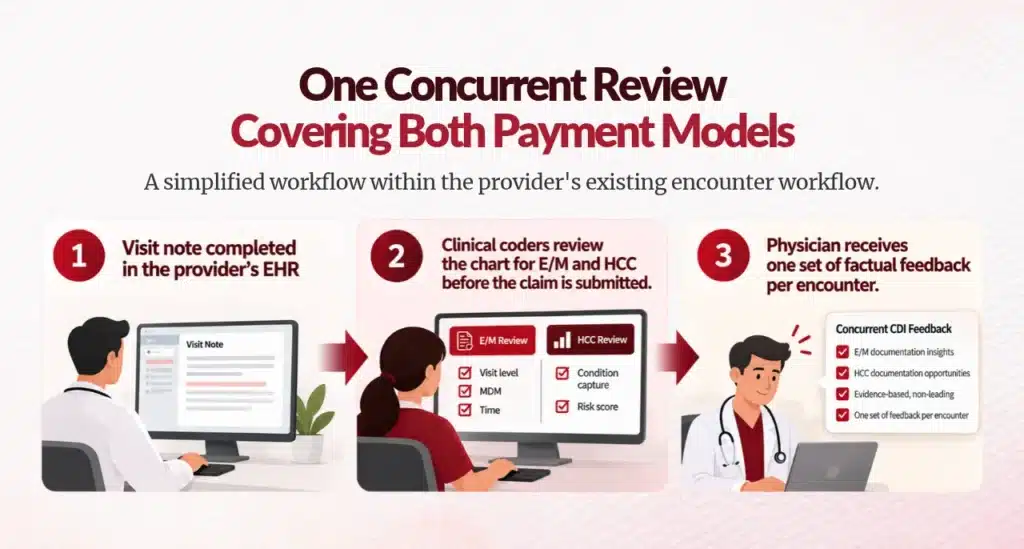
One Team, One Review, One Physician Touchpoint
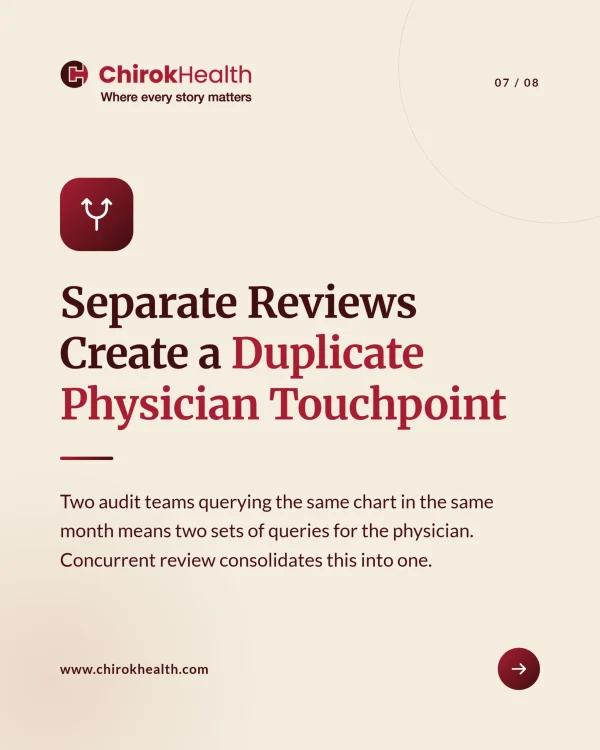
When E/M and risk adjustment reviews run separately, physicians receive queries from different sources, sometimes reviewing the same chart within weeks of each other. Each touchpoint takes time. Each set of findings exists in a silo, making it harder to see how documentation patterns across fee-for-service and value-based care connect.
A concurrent approach consolidates this into one review per encounter. The physician receives one set of feedback. The review team sees the full chart. The practice gets a combined view of documentation accuracy across both payment models.
Chirok Health’s Concurrent Review Approach
Chirok Health’s clinical coders review each chart inside the provider’s existing workflow, covering both E/M accuracy and HCC capture in a single pass. Feedback reflects what the record shows. Physicians draw their own clinical conclusions. Learn more about Chirok Health’s clinical documentation integrity services and how the concurrent model works.
What Would a Single Review Covering Both Look Like for Your Practice
If your practice currently runs separate E/M and risk adjustment reviews, or if your CDI program covers only one, a concurrent approach may close the gaps you’re seeing in visit level distribution and risk score accuracy.
Chirok Health works with academic medical centers, health systems, and risk-bearing medical groups to review charts concurrently inside existing workflows, covering both fee-for-service and value-based care in one pass.
Schedule a CDI Program Review
In the review, Chirok Health examines your current documentation workflow, identifies where E/M and HCC gaps overlap, and shows what concurrent coverage would look like for your value-based patient population.
Assessment covers:
- Current documentation review process (E/M and HCC, separate or combined)
- Visit level distribution relative to patient complexity
- HCC capture rate and gap categories
- Physician query workflow and current response rate
- Fit for concurrent review implementation
One Review That Sees Both Fee-for-Service and Value-Based Accuracy
The charts where E/M levels are understated are often the same charts where chronic conditions aren’t captured for risk adjustment. They’re the same documentation gap, expressed in two different payment systems. A concurrent review that covers both sees what separate audits miss.
Frequently Asked Questions
1. What Is Concurrent HCC Coding Review?
Concurrent HCC coding review is a clinical documentation integrity process that takes place before the claim is submitted, rather than after billing. In the context of HCC coding, it means reviewing the chart for risk adjustment accuracy while the physician can still address documentation gaps.
2. How Does Risk Adjustment HCC Coding Differ from E/M Coding?
E/M coding determines the level of a fee-for-service visit based on medical decision making or time. HCC coding maps patient diagnoses to Hierarchical Condition Categories that influence a Medicare Advantage plan's risk-adjusted payment for that enrollee. E/M codes appear on the claim. HCC submissions feed into the risk score calculation. Both draw from the same visit documentation, which is why gaps in one often signal gaps in the other.
3. Why Do Separate E/M and HCC Reviews Create Gaps?
Separate reviews address the same chart from different angles without a combined view of the findings. An E/M audit may confirm a visit level was appropriate without identifying that the conditions driving that level weren't submitted for HCC. An HCC review may find missing conditions without seeing that the same documentation gaps are limiting the E/M level. A concurrent approach reviews both simultaneously, from the same chart, at the same time.
4. What Do AHIMA and ACDIS Guidelines Require for Compliant Queries?
The joint AHIMA and ACDIS guidelines for compliant query practice require that queries use non-leading language, be grounded in clinical evidence already present in the chart, be clear and concise, and be relevant to the current encounter. A compliant query presents the physician with what the record shows and asks for clinical clarification, without directing the physician toward a specific diagnosis or code.
5. What Documentation Does CMS Require to Support an HCC?
For a diagnosis to support a risk-adjusted HCC payment in Medicare Advantage, the medical record must show that the condition was assessed or addressed during the visit, documented by a qualified provider, and supported by clinical evidence. A condition carried forward on a problem list without an assessment in the visit note may not meet CMS evidentiary standards in a RADV audit.
6. How Does a Concurrent Review Reduce Physician Query Burden?
When E/M and HCC reviews run as separate processes, physicians may receive queries from two different teams about the same chart within the same period. A concurrent review consolidates this into one touchpoint per encounter, with one set of feedback covering both fee-for-service and risk adjustment. Physicians spend less time responding to queries and more time in the clinical workflow.
Author Bio:

Brandy Kerby
CGO - Chirok Health
Brandy Kerby is Chief Growth Officer at Chirok Health, a clinician-led medical coding, CDI, and revenue cycle organization. She works with health systems, providers, plans, and risk-bearing organization leaders on a question most are now facing: not whether to adopt coding automation, but how to govern it. Her work centers on the operational evidence behind that decision, including the encounter-level analysis presented in this briefing.