

















How Concurrent Coding Works for Daily Provider Queries Without Burnout
How can concurrent coding support daily provider queries without overwhelming clinicians?
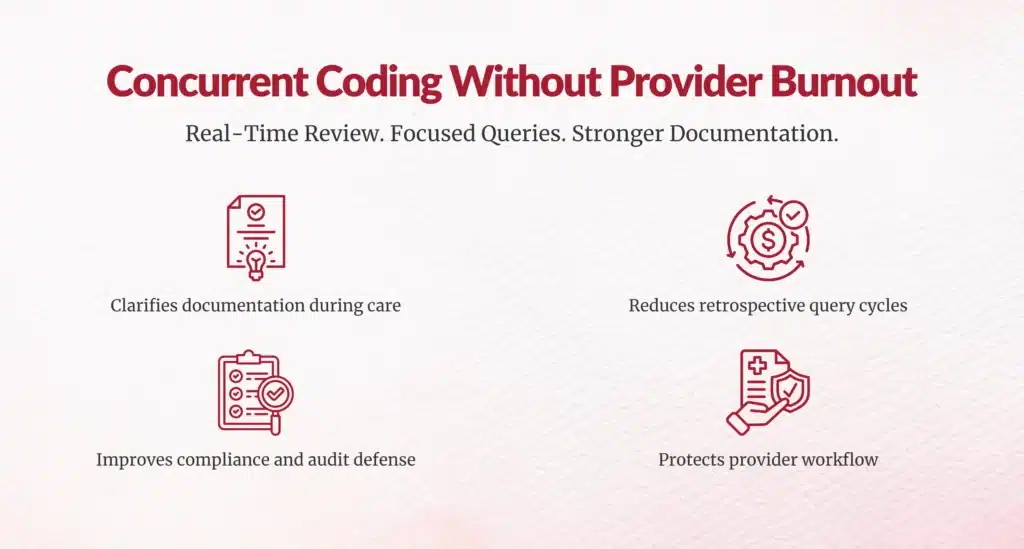
Concurrent coding works by reviewing documentation in real time while the patient is still receiving care rather than waiting until after discharge. When structured correctly, it allows coding teams to identify documentation gaps early and communicate focused, compliant queries to providers before billing begins.
The key difference is timing and clarity.
Instead of retrospective queries that arrive weeks later when providers no longer remember the clinical context concurrent coding integrates documentation review into the active care cycle. That reduces rework, limits clarification delays, and improves claim accuracy.
For healthcare leaders, the real question isn’t whether concurrent coding works. It’s whether it can scale without:
- Increasing provider fatigue
- Flooding clinicians with unnecessary queries
- Creating compliance exposure
- Overloading coding teams
When designed correctly, concurrent coding reduces downstream stress rather than adding to it.
Why daily provider queries are increasing across healthcare systems
Healthcare documentation requirements have expanded significantly over the past decade. Risk adjustment models, value-based reimbursement programs, hierarchical condition category (HCC) capture, and payer scrutiny have all intensified the need for precise clinical documentation.
According to the Centers for Medicare & Medicaid Services (CMS), documentation must support medical necessity, diagnosis specificity, and risk-adjusted payment structures. Unsupported or vague documentation contributes directly to improper payments and audit findings.
At the same time, physicians face:
- Higher patient volumes
- Expanding EHR documentation fields
- Quality reporting requirements
- Regulatory scrutiny
This intersection creates daily provider query pressure. Without structured workflows, queries can become reactive, excessive, and disruptive.
Concurrent coding addresses this by shifting from correction to prevention.
What is concurrent coding in practical terms?
Concurrent coding is the process of reviewing clinical documentation during the patient encounter or hospital stay, rather than after discharge.
It typically involves:
- Real-time chart review
- Identification of incomplete, unclear, or conflicting documentation
- Issuing compliant, non-leading queries
- Collaborating with CDI and clinical teams
- Resolving documentation gaps before final coding and billing
The American Health Information Management Association (AHIMA) emphasizes that compliant queries must be clear, concise, and clinically supported. Concurrent coding enhances compliance because questions are asked while documentation is fresh and clinical reasoning is accessible.
Instead of reopening charts later, coding clarity happens upstream.
How concurrent coding reduces provider burnout
Burnout doesn’t come from documentation alone. It comes from disruption, redundancy, and unclear communication.
When concurrent coding is poorly implemented, it can overwhelm providers with:
- Multiple daily interruptions
- Duplicative CDI and coding queries
- Poorly structured clarification requests
- Queries lacking clinical context
However, mature concurrent coding models reduce burnout by:
- Consolidating queries into structured communication channels
- Prioritizing high-impact clarifications only
- Eliminating retrospective query cycles
- Reducing repeated documentation corrections
- Aligning CDI and coding teams to avoid overlap
By addressing gaps early, providers avoid weeks-later queries tied to memory recall. That alone reduces frustration and time spent revisiting past encounters.
Why timing matters more than volume
The number of queries is not the sole driver of burnout. Timing and clarity are.
A well-timed concurrent query that:
- Explains clinical rationale
- References documented findings
- Provides compliant response options
- Respects provider workflow
feels collaborative rather than corrective.
When queries arrive after discharge, the burden increases. Providers must mentally reconstruct the encounter. Concurrent coding removes that cognitive load.
What does an effective concurrent coding workflow look like?
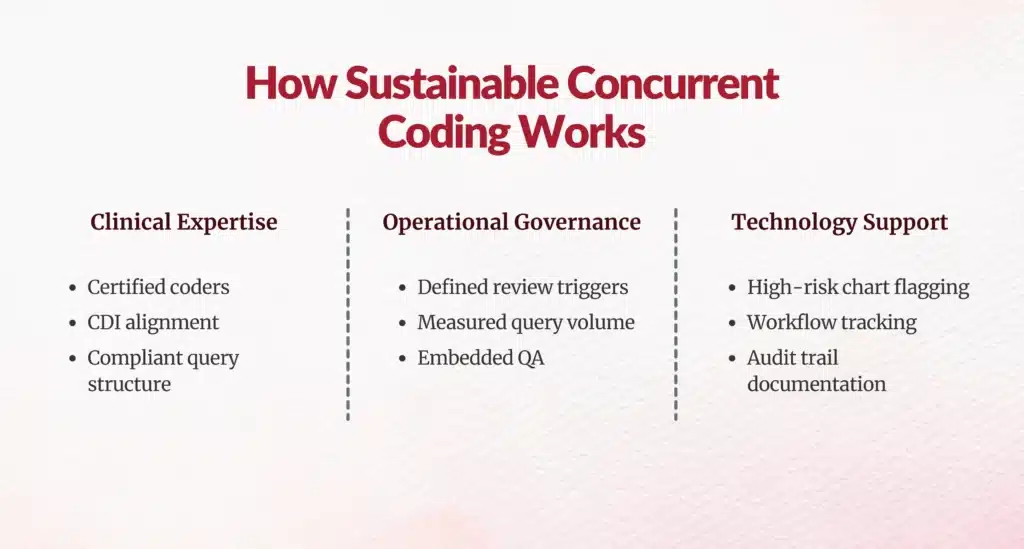
Sustainable concurrent coding depends on structured governance. Without clear processes, it becomes chaotic.
An effective workflow includes:
1. Defined Review Triggers
High-risk diagnoses, severity indicators, procedure documentation gaps, and medical necessity thresholds should guide review focus.
2. Clear Query Standards
Queries must follow compliant formats consistent with CMS and AHIMA guidance.
3. Interdisciplinary Alignment
CDI, coding, case management, and compliance teams must coordinate rather than operate in silos.
4. Escalation Pathways
Unresolved or complex cases require structured review, not repeated query cycles.
5. Measured Query Volume
Not every documentation imperfection warrants a query. Prioritization protects providers.
Concurrent coding works best when it is selective and risk-focused not volume-driven.
How concurrent coding strengthens revenue integrity
Revenue integrity depends on three pillars:
- Accurate documentation
- Accurate coding
- Defensible claims
When documentation gaps are identified after discharge, correction opportunities narrow. Denials increase. Appeals expand. Audit exposure rises.
According to CMS improper payment reporting, documentation insufficiencies remain one of the primary drivers of payment errors across federal healthcare programs.
Concurrent coding mitigates this by:
- Ensuring diagnosis specificity
- Supporting medical necessity
- Clarifying severity of illness
- Strengthening risk adjustment capture
- Reducing post-bill corrections
From a leadership perspective, this protects:
- Revenue stability
- Audit defensibility
- Organizational credibility
What role does technology play in concurrent coding?
Technology should support clinical judgment not replace it.
Effective concurrent coding programs use technology to:
- Flag documentation inconsistencies
- Identify high-risk charts
- Track query turnaround times
- Measure inter-rater reliability
- Monitor provider query trends
However, automation without clinical oversight can increase unnecessary queries.
Strong programs ensure technology:
- Prioritizes risk
- Reduces manual navigation
- Tracks documentation outcomes
- Produces audit trails
The goal is clarity, not noise.
How do you prevent concurrent coding from overwhelming coding teams?
Burnout affects coders as well as providers.
To prevent coding team fatigue, concurrent coding models should include:
- Dedicated concurrent coding specialists
- Realistic productivity standards
- Structured QA processes
- Cross-training with CDI
- Clear case prioritization rules
If productivity expectations mirror retrospective coding quotas, quality declines.
Concurrent coding requires clinical judgment and communication skill. It cannot be treated as transactional processing.
How concurrent coding improves audit readiness
Audit defensibility depends on documentation integrity at the time of service.
Concurrent coding strengthens audit positioning by ensuring:
- Clinical indicators support diagnoses
- Conditions are clearly documented
- Procedures align with medical necessity
- Severity and complexity are fully captured
When external audits occur whether payer-driven, RAC reviews, or internal compliance audits contemporaneous documentation strengthens defense.
Retrospective corrections are harder to defend than real-time documentation clarity.
What measurable outcomes should leaders expect?
Concurrent coding success should be measurable.
Key indicators include:
- Reduced post-discharge queries
- Lower denial rates
- Improved case mix index (CMI) accuracy
- Improved RAF capture accuracy
- Reduced appeal volumes
- Faster final bill drop timelines
Financial impact is important, but operational efficiency and provider satisfaction are equally critical.
When concurrent coding is functioning correctly, organizations see fewer rework cycles and more predictable reimbursement.
How Chirok Health supports sustainable concurrent coding
At Chirok Health, concurrent coding is approached as a collaborative, clinically grounded process not a query-generation engine.
Effective support includes:
- Certified coding professionals
- Clinically trained CDI alignment
- Structured query governance
- Risk-based review prioritization
- Compliance oversight
- Transparent performance reporting
The focus remains on reducing downstream risk while protecting provider workflows.
Concurrent coding should stabilize operations, not disrupt them.

How can leaders implement concurrent coding without disruption?
Successful implementation begins with:
- Baseline assessment of query volume and denial trends
- Clear communication with medical staff leadership
- Defined pilot units or service lines
- Measured rollout with QA monitoring
- Feedback loops for provider concerns
Concurrent coding is not a switch. It is a maturity progression.
Handled correctly, it reduces:
- Query fatigue
- Denials
- Revenue leakage
- Audit exposure
Handled poorly, it amplifies noise.
Leadership alignment determines the outcome.
FAQs
1. What is concurrent coding in healthcare?
Concurrent coding is the process of reviewing and coding clinical documentation during a patient’s hospital stay or active encounter, rather than after discharge. It allows documentation gaps to be clarified in real time, improving coding accuracy and claim defensibility.
2. How does concurrent coding reduce provider burnout?
Concurrent coding reduces burnout by resolving documentation questions while care is ongoing. This prevents delayed retrospective queries, reduces repetitive clarification requests, and aligns documentation with clinical intent early in the workflow.
3. Is concurrent coding compliant with CMS and AHIMA guidelines?
Yes. When structured properly, concurrent coding follows CMS and AHIMA-compliant query practices. Queries must be non-leading, clinically supported, and clearly documented.
4. Does concurrent coding increase query volume?
Not necessarily. In well-managed programs, query volume often decreases over time because documentation improves upstream. The focus is on high-impact clarifications rather than high-frequency messaging.
5. How does concurrent coding improve revenue integrity?
Concurrent coding strengthens documentation specificity, reduces denials, improves risk adjustment accuracy, and supports audit defensibility. This protects both reimbursement accuracy and compliance positioning.
6. What metrics should organizations track when implementing concurrent coding?
Organizations should track denial rates, query turnaround time, post-discharge query volume, CMI accuracy, audit findings, and provider satisfaction metrics to evaluate program success.
Author Bio:

Kanar Kokoy
CEO - Chirok Health
Healthcare CEO & CDI/RCM innovator. I help orgs boost accuracy, integrity & revenue via truthful clinical docs. Led transformations in CDI, coding, AI solutions, audits & VBC for health systems, ACOs & more. Let’s connect to modernize workflows.