





















Why 95%+ Coding Accuracy Is Nearly Impossible Without Concurrent Coding
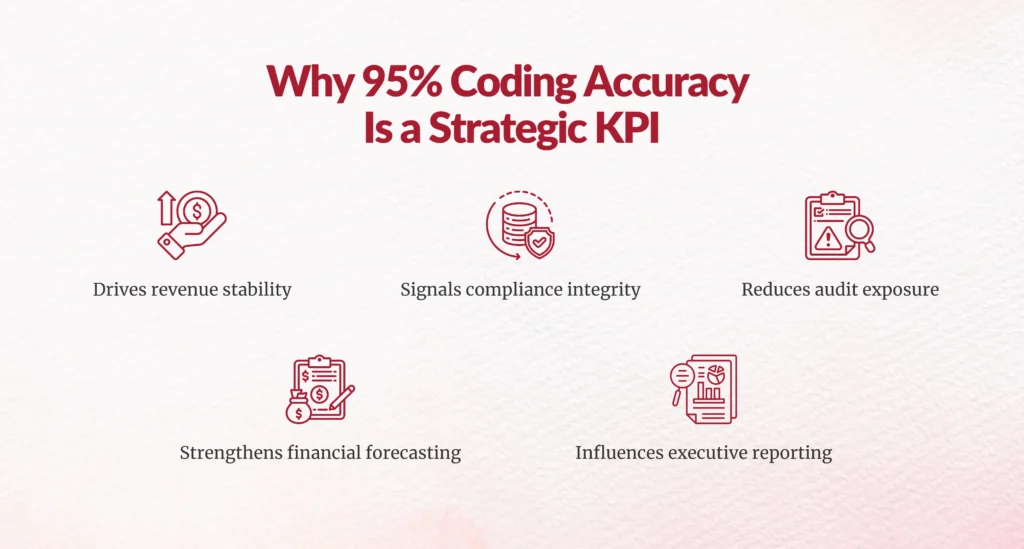
Why 95% Coding Accuracy Has Become a Leadership-Level Metric
Across hospitals, health systems, and large physician groups, 95% coding accuracy is no longer considered aspirational. It is the baseline expectation.
This metric now directly influences:
- Revenue predictability
- Audit preparedness
- Compliance confidence
- Board-level reporting
- Risk-adjustment performance
- Public quality reporting
Let’s examine why each of these areas depends heavily on sustained coding accuracy.
Revenue Predictability
Revenue predictability depends on consistent claim integrity. When coding accuracy fluctuates between 88% and 93%, revenue also fluctuates. Missed complications, under-coded severity, or unsupported diagnoses result in variable reimbursement.
CFOs cannot reliably forecast revenue when coding accuracy varies month to month. A stable 95%+ accuracy rate provides financial consistency, reduces unexpected adjustments, and improves cash flow reliability.
Audit Preparedness
Internal and external audits often use 95% as a benchmark threshold. Falling below that level increases scrutiny. Accuracy below 95% suggests systemic issues rather than isolated errors. Sustaining 95%+ demonstrates process control and reduces audit expansion risk.
Compliance Confidence
Unsupported diagnoses, vague documentation, or improper code assignment increase regulatory exposure. A 95%+ accuracy rate indicates that documentation supports medical necessity and coding compliance standards.Compliance programs rely on high accuracy as proof of documentation integrity.
Board-Level Reporting
Many organizations present coding accuracy metrics to executive leadership and boards. Sustained performance below 95% often triggers corrective action plans. Accuracy is no longer an HIM-only metric. It is a governance metric.
The Structural Ceiling of Retrospective Coding
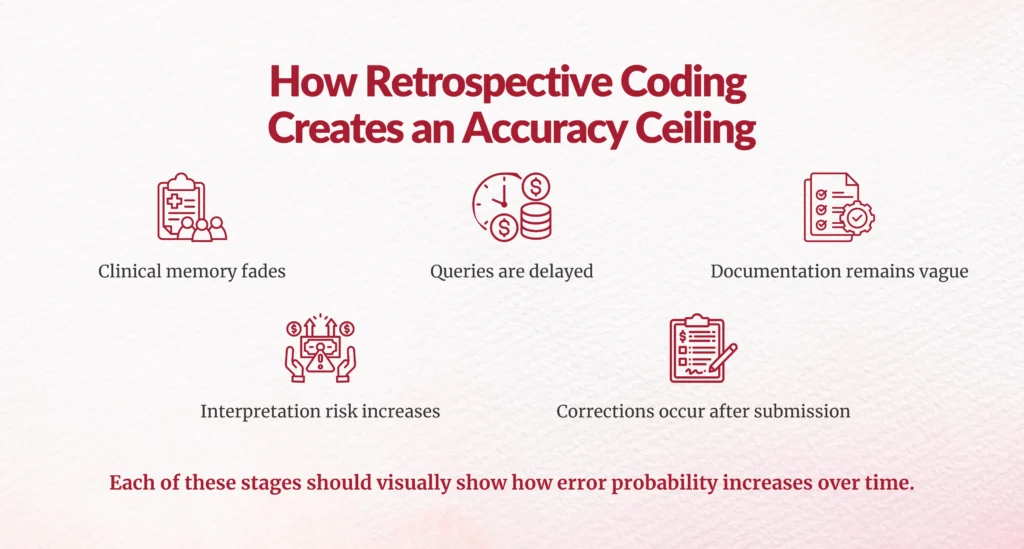
Most organizations still rely on retrospective coding workflows. Under this model:
The patient encounter occurs.The provider documents the visit.
The chart is closed.
Coding review occurs days or weeks later.
Queries are issued after documentation finalization.
While this workflow is common, it creates structural accuracy limitations.
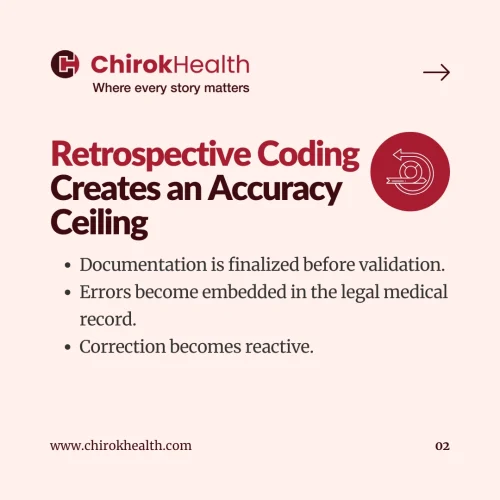
Documentation Is Finalized Before Validation
Once documentation is signed, it becomes part of the legal medical record. Coders reviewing finalized charts are validating information after clinical context has passed. If specificity is missing at the time of sign-off, it becomes harder to recover.
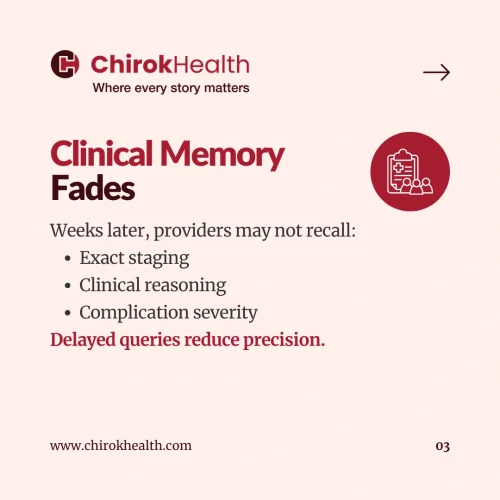
Clinical Recall Declines Rapidly
Providers manage dozens of patients daily. When a query arrives two weeks later asking whether acute respiratory failure was present or whether chronic kidney disease was stage 3 or stage 4, recall becomes imperfect.
Imperfect recall leads to cautious responses. Cautious responses often lead to under-coding.
Queries Become Operational Bottlenecks
Retrospective queries accumulate. They wait in provider inboxes. Some are answered late. Some remain unanswered. Some are clarified minimally.
This delay introduces workflow drag and increases turnaround time.
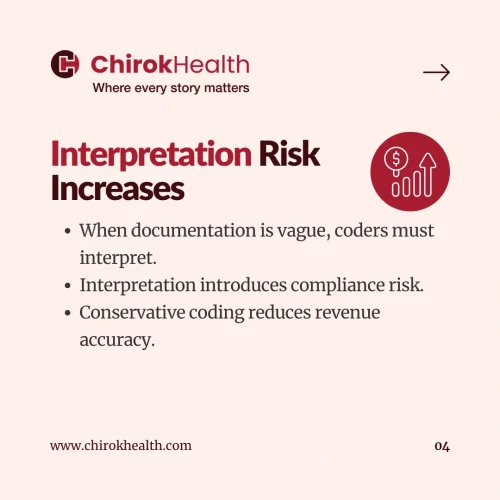
Interpretation Risk Increases
When documentation lacks clarity, coders must interpret clinical language. Interpretation increases risk. Risk leads to conservative coding. Conservative coding leads to under-representation of severity.
The result is an accuracy ceiling that is difficult to surpass. Most retrospective environments plateau between 90% and 93%, even with experienced teams.
Why Documentation Gaps Multiply in Retrospective Workflows
Retrospective coding does not merely delay validation; it compounds documentation issues. Let’s break down how.
Vague Diagnoses Remain Vague
If a provider documents “renal insufficiency” without staging chronic kidney disease, retrospective queries must clarify later. But if clarification never comes, the diagnosis remains incomplete.
This affects:
- Severity capture
- Risk scoring
- Reimbursement
- Clinical reporting
MEAT Criteria May Be Inadequately Demonstrated
Diagnoses must show evidence of being monitored, evaluated, assessed, or treated.
In retrospective models, coders must infer whether conditions were actively managed. If documentation does not explicitly show clinical engagement, diagnoses may be removed.
Laterality and Specificity Are Often Missed
Missing laterality (left vs right), acuity (acute vs chronic), or complication detail results in downgraded coding accuracy.
The longer the delay in clarification, the less likely it is to be corrected precisely.
These documentation gaps collectively prevent sustained 95%+ performance.
The Timing Advantage of Concurrent Coding
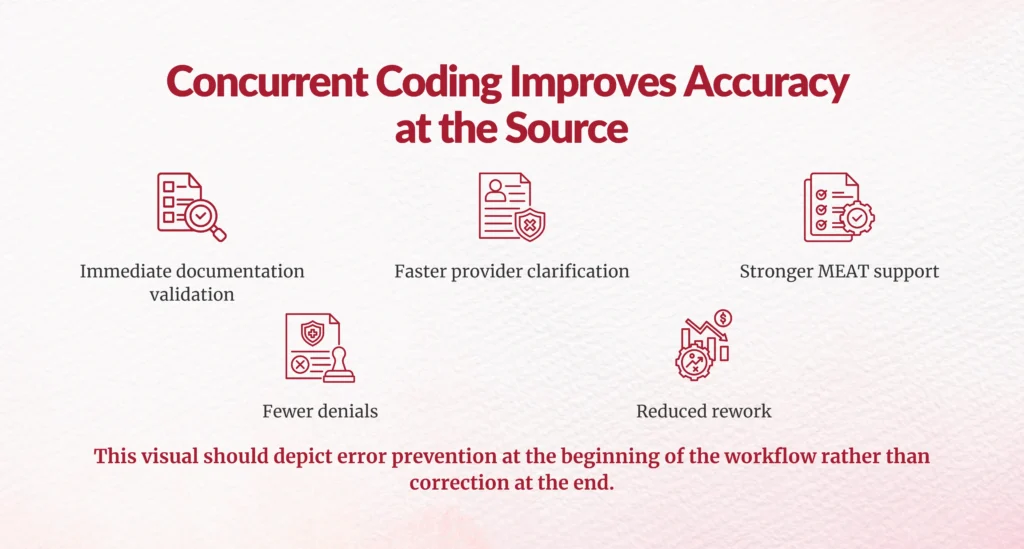
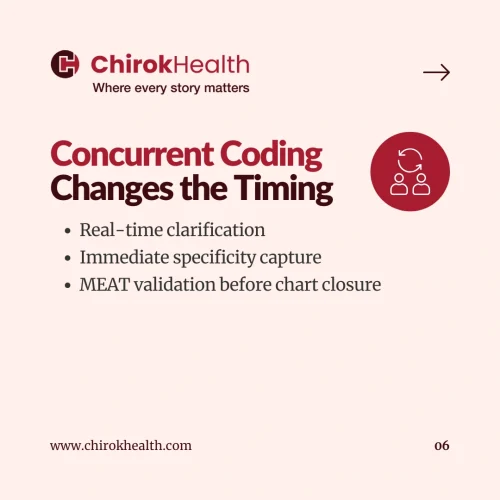
Concurrent coding fundamentally changes the timing of validation.
Instead of waiting until the chart is finalized, coding review occurs:
- During the patient encounter
- Immediately after documentation entry
- Before chart completion
This timing shift dramatically improves accuracy.
Real-Time Clarification Improves Precision
When clarification occurs on the same day:
Providers clearly remember clinical intent.
They can confidently confirm staging, acuity, complications, or causal relationships.
Accuracy improves because documentation reflects actual clinical reasoning rather than reconstructed memory.
Specificity Is Captured Before Closure
Concurrent coding identifies:
- Missing stages of disease
- Absent laterality
- Unspecified complications
- Incomplete procedural details
These are corrected immediately, preventing errors from reaching claims.
MEAT Criteria Are Confirmed at the Source
Concurrent review ensures that diagnoses coded are truly monitored, evaluated, assessed, or treated.
This strengthens audit defensibility and reduces the likelihood of retrospective deletion of diagnoses.
Financial Impact of Sub-95% Accuracy
Accuracy gaps directly affect financial performance.
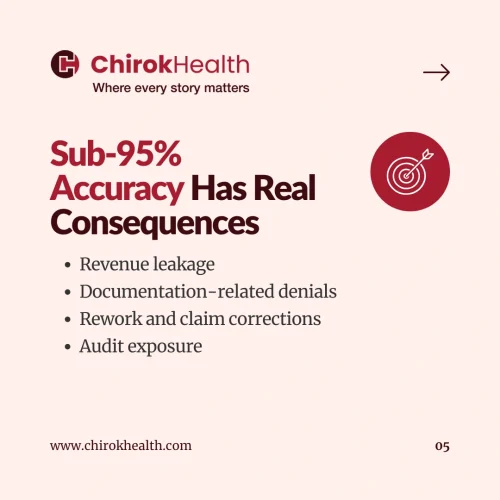
Revenue Leakage from Undercoding
When specificity is incomplete, higher-weighted diagnoses may be missed. Chronic conditions may not be fully represented.
Over thousands of encounters, this results in significant lost reimbursement.
Increased Denial Rates
Documentation-related denials consume resources. Staff must:
- Review charts
- Prepare appeals
- Communicate with payors
- Track outcomes
Each denial increases administrative cost.
Rework and Claim Corrections
Low accuracy increases corrected claims. Corrected claims delay reimbursement and complicate revenue reporting.
Cash Flow Instability
Inconsistent accuracy produces inconsistent reimbursement. Finance teams cannot forecast confidently when coding quality fluctuates.
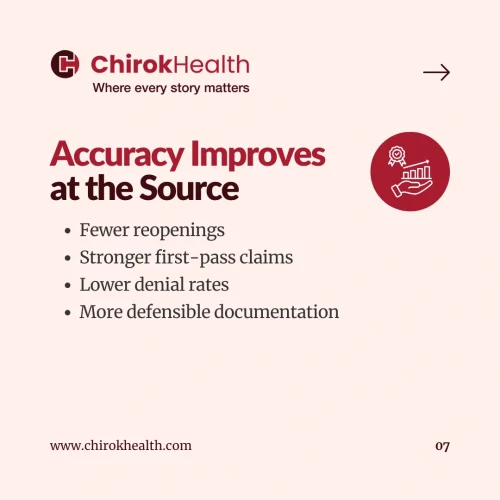
Concurrent coding reduces these financial inefficiencies by preventing errors rather than correcting them.
Compliance and Regulatory Implications
Audit scrutiny often focuses on:
- Unsupported diagnoses
- Overcoding
- Incomplete documentation
- Query patterns
Concurrent coding strengthens compliance because:
- Documentation is validated while clinical context is fresh.
- Queries are contemporaneous rather than retroactive.
- Edits are made before claim submission.
This reduces the perception of documentation manipulation.
In regulatory environments, timing matters. Documentation validated during care appears more credible than edits made weeks later.
Provider Behavior Transformation
Concurrent coding creates a powerful secondary effect: behavioral improvement.
When providers receive real-time feedback:
- They begin documenting with greater specificity from the start.
- They internalize best practices.
- They reduce recurring documentation gaps.
Over time, query volume declines because baseline documentation quality improves. Retrospective models rarely produce sustained behavioral change because feedback arrives too late to influence habit formation.
Why AI Alone Cannot Solve Accuracy Gaps?
AI coding systems can suggest diagnoses and flag inconsistencies. However, AI relies entirely on existing documentation.
- If documentation lacks specificity, AI cannot invent it.
- If documentation is vague, AI may recommend overly broad codes.
- If documentation is ambiguous, AI may introduce compliance risk.
AI amplifies documentation quality, good or bad. Without concurrent human validation, AI cannot independently achieve 95%+ sustained accuracy.
Operational Efficiency Improvements
Concurrent coding reduces operational waste in several ways:
Reduced Chart Re-Openings:
When documentation is clarified before closure, charts do not require reopening.
Improved Coder Productivity:
Coders spend less time chasing clarifications and more time validating accurate records.
Faster Claim Submission:
With fewer corrections needed, claims move through the revenue cycle faster. These efficiency gains compound over time.
Why 100% Accuracy Is Unrealistic but 95%+ Is Sustainable
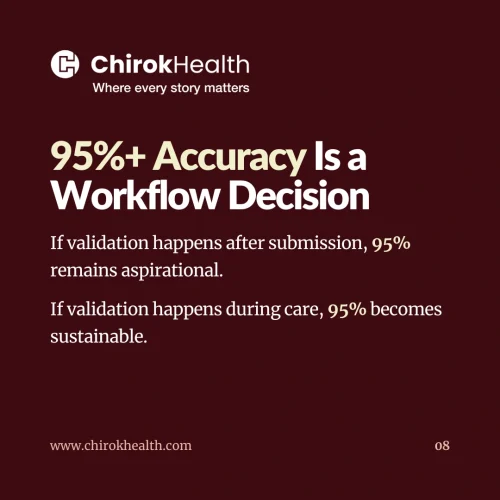
Healthcare documentation involves human complexity. Absolute perfection is unrealistic. However, 95%+ becomes sustainable when:
- Documentation is validated before finalization.
- Providers receive real-time feedback.
- Queries are resolved immediately.
- Coders collaborate clinically rather than interpret retroactively.
- AI is supervised within concurrent workflows.
The key difference between 92% and 95% accuracy is not incremental effort.It is workflow redesign.
Conclusion
If your organization cannot consistently sustain 95%+ coding accuracy, the issue is unlikely to be coder skill alone.The issue is timing. Retrospective workflows introduce memory decay, delayed clarification, and interpretation risk.Concurrent coding removes those structural barriers. Organizations that redesign coding workflows around real-time validation:
- Stabilize revenue
- Strengthen compliance
- Reduce denials
- Improve provider behavior
- Sustain 95%+ accuracy
Accuracy is not merely a performance metric.It is a function of when validation occurs. And without concurrent coding, 95%+ remains aspirational rather than operationally reliable.
FAQs
1. Why is 95%+ coding accuracy difficult to sustain in most organizations?
Because most organizations rely on retrospective workflows. When coding validation occurs after documentation is finalized, ambiguity, memory decay, and delayed clarification create structural barriers that limit sustained performance above 95%.
2. What is the biggest limitation of retrospective coding?
Timing. Documentation gaps are discovered too late. By the time queries are issued, providers may not recall clinical intent clearly, leading to incomplete clarification or conservative coding.
3. How does concurrent coding improve accuracy?
Concurrent coding validates documentation during or immediately after the patient encounter. Real-time clarification ensures specificity, staging, acuity, and MEAT criteria are captured before chart closure
4. Does concurrent coding reduce denial rates?
Yes. By preventing documentation-related errors before claim submission, concurrent coding improves first-pass accuracy and reduces denials caused by insufficient documentation.
5. Is 100% coding accuracy achievable?
In complex healthcare environments, sustained 100% accuracy is unrealistic. However, 95%+ becomes achievable when workflow design supports real-time validation rather than post-hoc correction.
6. Can strong coders alone achieve 95%+ accuracy?
Not consistently. Even highly skilled coders are limited by documentation quality and query timing. Accuracy depends on workflow design not just coder expertise.
7. How does concurrent coding affect compliance?
Concurrent workflows strengthen compliance by ensuring diagnoses are clinically supported at the time of care. This improves audit defensibility and reduces post-hoc documentation concerns.
8. Does concurrent coding increase provider workload?
When implemented effectively, it reduces long-term burden by minimizing retrospective queries and repeated clarifications. Over time, provider documentation habits improve.
9. Why can’t AI alone solve coding accuracy gaps?
AI tools analyze existing documentation. If documentation lacks specificity or clarity, AI cannot independently create clinical intent. AI performs best when paired with concurrent validation.
10. What is the executive takeaway from this blog?
If your organization struggles to sustain 95%+ coding accuracy, the issue is likely not skill it is timing. Without concurrent coding, structural workflow delays make elite accuracy difficult to maintain.
Author Bio:

Kanar Kokoy
CEO - Chirok Health
Healthcare CEO & CDI/RCM innovator. I help orgs boost accuracy, integrity & revenue via truthful clinical docs. I've led transformations in CDI, coding, AI solutions, audits & VBC for health systems, ACOs & more. Let's connect to modernize workflows.