





AI Isn’t Replacing Us. It’s Partnering With Us. Welcome to Collaborative Compliance in 2026.
Healthcare leaders are asking a very real question in 2026: Is AI increasing compliance risk, or redefining how we manage it responsibly?
Here’s the short answer, up front:
AI is not replacing clinical, coding, or financial judgment. It is amplifying it when humans stay in the loop.
An AI coding tool suggests a diagnosis that increases reimbursement by $2,400.
The documentation is complete. The keywords are there. The structure is clean.
A human reviewer pauses, applies clinical judgment, confirms medical necessity, or rejects it.
That’s not risk.
That’s responsible collaboration.
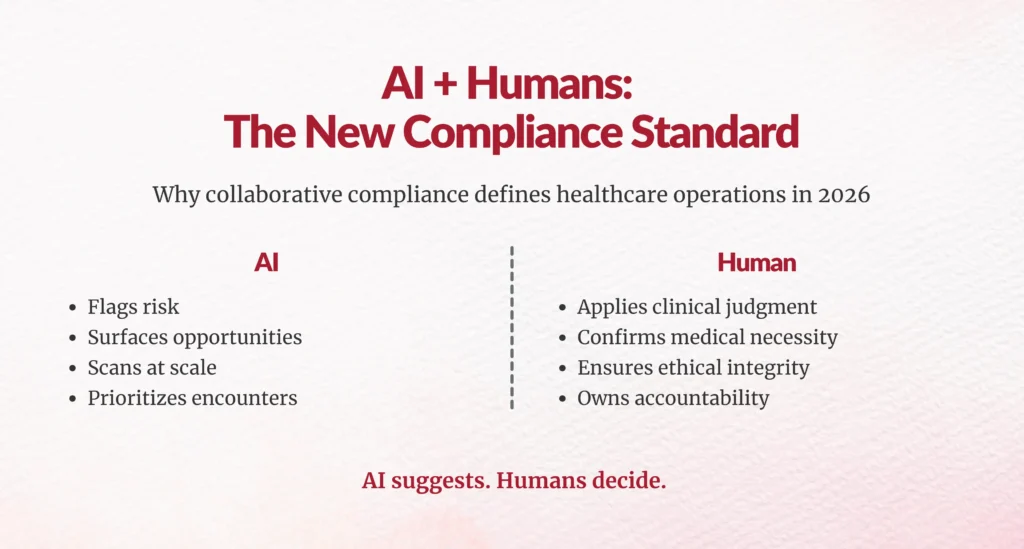
This is the foundation of collaborative compliance, a model where AI accelerates insight, but humans retain accountability. And it’s rapidly becoming the standard for CDI directors, HIM leaders, revenue cycle executives, and CFOs navigating 2026.
What Is Collaborative Compliance, and Why Does It Matter in 2026?
Collaborative compliance is the operating model where AI performs scale-based tasks and humans perform judgment-based decisions, with transparent oversight connecting the two.
In practical terms:
- AI surfaces opportunities and risks
- Humans validate appropriateness and intent
- Governance ensures traceability and accountability
This model matters because healthcare organizations are under simultaneous pressure:
- Rising audit activity (RADV, commercial payer post-pay reviews)
- Tighter documentation expectations
- Staffing shortages across CDI, HIM, and coding
- Increased scrutiny of AI-assisted workflows
Where Does AI Add Real, Defensible Value in Compliance Workflows?
AI’s value is strongest where volume, pattern recognition, and consistency matter more than nuance.
What AI Does Exceptionally Well
AI excels at:
- Identifying missing documentation elements
- Flagging potential denials before claims submission
- Highlighting coding and CDI opportunities for review
- Prioritizing high-risk encounters for human attention
Modern NLP-driven tools can scan thousands of encounters and surface patterns no human team could detect at scale.
A 2024 study published in JAMA Network Open found that AI-assisted documentation review improved detection of incomplete clinical documentation by up to 35% compared to manual review alone
This is not about automation replacing staff.
It’s about focus.
AI handles the noise.
Your teams handle the signal.
Why Human Judgment Still Defines Compliance Integrity
AI does not understand clinical context, ethical boundaries, or intent. Humans do.
Where Humans Complete the Loop
When AI suggests:
- Sepsis
- Malnutrition
- Acute respiratory failure
- Hierarchical condition category (HCC) escalation
The human reviewer decides whether the clinical story supports it.
This matters because regulators are increasingly clear:
Medical necessity is not algorithmic.
CMS has explicitly emphasized that AI tools must not replace clinical judgment in utilization management or documentation decisions
AI surfaces possibilities.
Humans confirm appropriateness.
That distinction protects:
- Patients
- Providers
- Organizations
How Does “Trust and Verify” Actually Work in Practice?
The strongest organizations are not asking, “Should we trust AI?”
They are asking, “How do we verify it consistently?”
What a Collaborative Compliance Workflow Looks Like
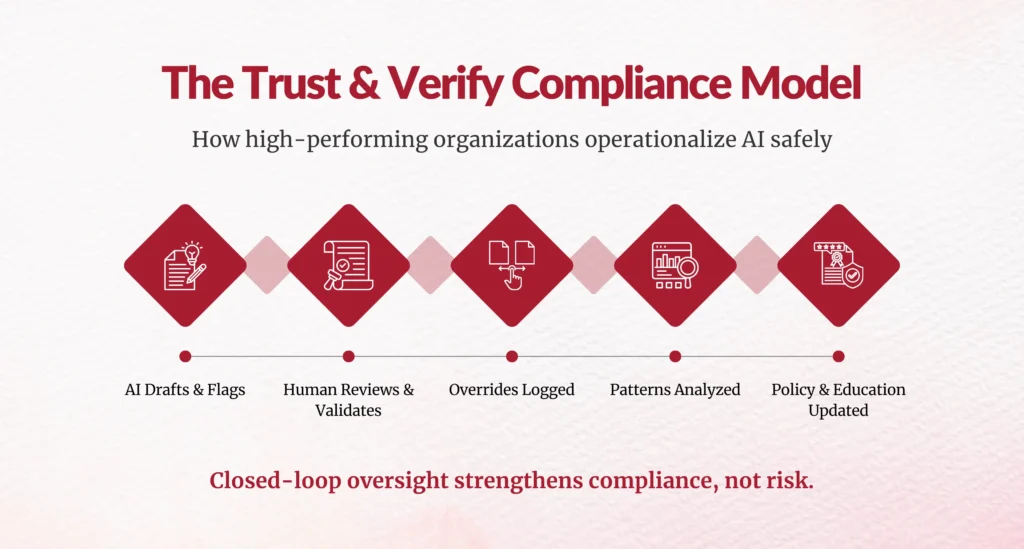
High-performing teams are designing workflows where:
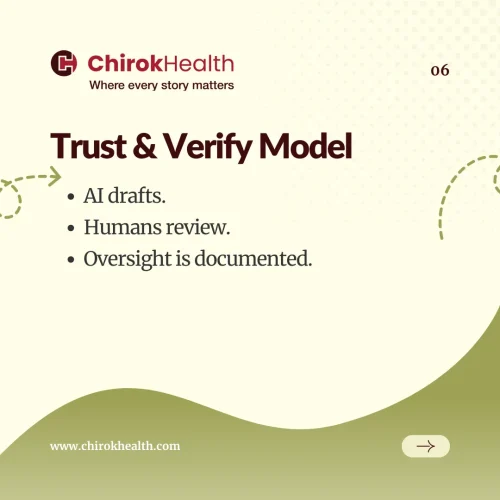
- AI drafts, flags, and prioritizes
- Humans review, validate, and attest
- Overrides and corrections are logged as learning signals
- Patterns inform education, policy, and model tuning
This creates a closed feedback loop.
Instead of slowing teams down, it:
- Improves AI accuracy over time
- Strengthens audit defensibility
- Creates evidence of oversight
According to Deloitte, organizations with structured human-in-the-loop AI governance report 30–40% lower compliance-related AI risk than those without formal review frameworks.
Why CDI Leaders Are Becoming the Strategic Bridge
If there is one role emerging as mission-critical in 2026, it’s Clinical Documentation Integrity.
How CDI Connects AI Efficiency With Clinical Reality
AI may identify a query opportunity.
CDI ensures it is:
- Clinically supported
- Ethically sound
- Compliant with payer policy
- Appropriate for provider engagement
This is how AI becomes a quality enabler, not a revenue shortcut.
For HIM directors and VPs of RCM, CDI now functions as:
- An AI quality control layer
- A clinical governance partner
- A risk mitigation function
The organizations seeing the most ROI from AI investments are those where CDI owns the interpretation layer, not just query volume.
Why Governance Enables Adoption, Not Fear
Many leaders hesitate on AI because they fear audits, headlines, or loss of control.
The reality is the opposite.
What Effective AI Governance Actually Includes
Strong governance frameworks focus on:
- Defined roles and approval pathways
- Training on the strengths and limitations of AI tools
- Transparency into model updates and logic
- Documentation that shows human oversight occurred
This doesn’t slow innovation.
It enables confident use.
The Office of Inspector General (OIG) has repeatedly emphasized that documentation showing process and oversight is a critical mitigating factor in enforcement actions.
What Should Healthcare Leaders Do Right Now?
You don’t need a massive AI overhaul to move forward safely.
Practical First Steps for 2026
- Start with small, focused audits of AI-assisted work
- Engage vendors as partners, not black boxes
- Track AI suggestions vs. human outcomes
- Share wins and corrections across teams
This builds trust internally and defensibility externally.
The Bottom Line for CDI, HIM, RCM, and Finance Leaders
AI doesn’t eliminate responsibility.
It redistributes work.
Away from manual tasks.
Toward informed judgment.
AI will suggest.
Humans will decide.
Together, they will define compliant, scalable, defensible care in 2026.
That’s not a risk model.
That’s a collaboration model, and it’s already here.
Is your organization using AI as a tool or as a partner?
FAQs
What is collaborative compliance and why is it important in healthcare for 2026?
Collaborative compliance pairs AI for scale tasks with human judgment for decisions, vital amid $265B admin costs, AI adoption, audits, ensuring defensible compliance.
How does collaborative compliance differ from full automation in AI workflows?
AI accelerates insights/patterns; humans verify clinical necessity/judgment, retaining accountability vs. full automation lacking context/ethics.
What compliance risks arise when AI operates without human review?
Risks include audit failures, improper payments, regulatory penalties as AI misses clinical context, medical necessity per CMS/OIG rules.
Where in the compliance workflow does AI add the most defensible value?
AI excels at volume tasks: pattern detection, documentation scans (35% better per JAMA), query suggestions, freeing humans for signal.
Why is human judgment still necessary in AI-assisted clinical documentation decisions?
Humans assess clinical context, necessity, ethics; CMS mandates judgment over algorithms for utilization/documentation.
How can organizations structure governance to safely use AI in compliance work?
Use "trust and verify": AI flags, humans review, feedback loops, policies on explainability/oversight for 30–40% lower risk per Deloitte.
What practical first steps should healthcare leaders take to implement collaborative compliance?
Pilot AI-documentation workflows with CDI review, build feedback loops, train on governance, start small for trust/defensibility.
How does collaborative compliance improve audit readiness and risk mitigation?
Transparent oversight/process documentation mitigates OIG enforcement; shifts from manual noise to verified judgment.
What roles do CDI, HIM, and RCM teams play in collaborative compliance?
CDI bridges AI suggestions to clinical reality/queries; HIM/RCM oversee verification, analytics, ensuring compliant revenue.
Can collaborative compliance reduce documentation waste and operational costs?
Yes, AI cuts admin waste ($265B issue), humans focus on value, enabling efficient, quality-driven care.
Author Bio:

Kanar Kokoy
CEO - Chirok Health
Healthcare CEO & CDI/RCM innovator. I help orgs boost accuracy, integrity & revenue via truthful clinical docs. Led transformations in CDI, coding, AI solutions, audits & VBC for health systems, ACOs & more. Let’s connect to modernize workflows.