


















How CMS G2211 Created a $1.7M Opportunity Without Adding a Single Patient Visit?
The Hidden $1.7M Opportunity Inside Visit Complexity Capture
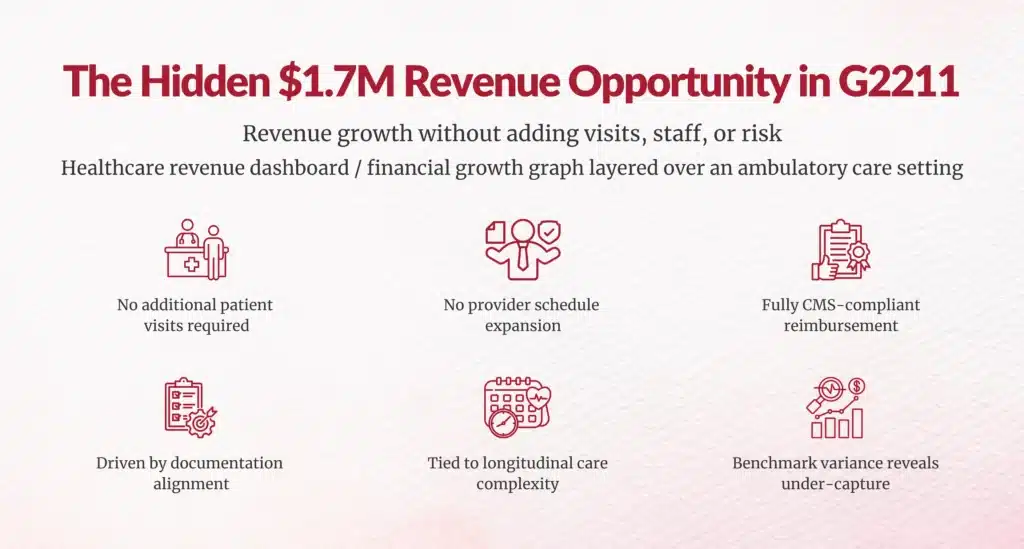
Healthcare financial leaders are under relentless pressure to grow revenue without expanding provider schedules, adding FTEs, or increasing operational risk. CMS’s introduction and reimbursement activation of the HCPCS add-on code G2211 (Visit Complexity) has quietly unlocked exactly that opportunity.
By aligning documentation and coding practices to national benchmarks for G2211, health systems can capture substantial incremental reimbursement tied to the inherent complexity of longitudinal care, without scheduling a single additional patient visit.
Benchmark variance analysis in a health system across major specialties shows that organizations under-capturing G2211 relative to national utilization rates may be leaving up to $1.7M in compliant, CMS-aligned revenue on the table annually.
This is not about upcoding. It’s about an accurate representation of cognitive workload, care coordination, and longitudinal patient management already being delivered.
What Is CMS G2211 and Why Did It Create New Revenue?
- Enhanced medical decision-making
- Care coordination across settings
- Increased documentation burden
- Greater accountability for outcomes
How Did G2211 Translate Into a $1.7M Opportunity?
Benchmark modeling comparing customer capture rates vs. national utilization reveals significant underperformance.
Key variance drivers:
- Low documentation specificity
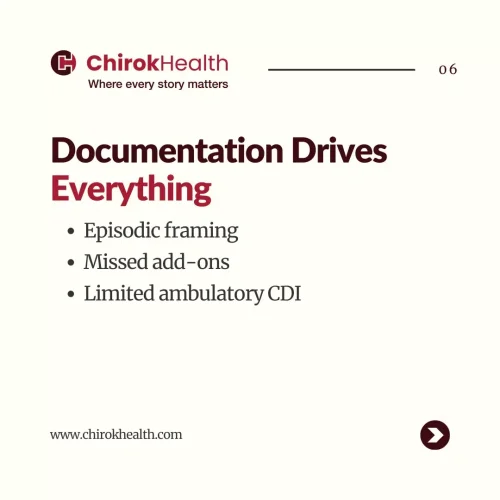
- Missed add-on reporting
- Lack of CDI involvement in ambulatory settings
- Provider education gaps
- EHR workflow misalignment
Illustrative specialty opportunity analysis:
| Specialty | Capture Variance | Annual Opportunity |
|---|---|---|
| Family Medicine | +43% potential improvement | $792,310 |
| Dermatology | +38% | $201,130 |
| Internal Medicine | +20% | $159,674 |
| Cardiology | +45% | $150,524 |
| Oncology | +73% | $115,438 |
| Endocrinology | +28% | $103,528 |
| OB/GYN | +22% | $99,734 |
| Gastroenterology | +37% | $82,227 |
Why Are Organizations Under-Capturing G2211 Today?
Despite CMS activating payment for G2211 in 2024, adoption remains inconsistent.
Documentation Does Not Reflect Longitudinal Complexity
Providers manage chronic disease progression, medication titration, and multi-specialty coordination, but documentation often reads like episodic care.
Without longitudinal framing, coders cannot append G2211 compliantly.
Ambulatory CDI Is Still Maturing
Most CDI programs remain inpatient-focused.
Yet CMS complexity recognition is heavily ambulatory.
AHIMA reports that outpatient CDI adoption is still evolving across U.S. systems.
Coding Workflows Lack Real-Time Support
- Care continuity
- Risk monitoring
- Treatment escalation
- Coordination burden
Provider Education Has Lagged Policy
- When G2211 applies
- Documentation thresholds
- Longitudinal care definitions
- Compliance guardrails
Which Specialties See the Highest G2211 Impact?
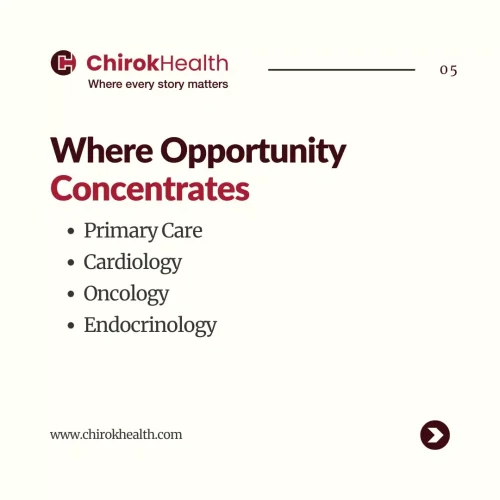
G2211 applies broadly, but financial lift concentrates where longitudinal care intensity is highest.
Primary Care
Family Medicine and Internal Medicine drive the largest volume opportunity.
CMS notes that primary care physicians manage most chronic disease pathways.
Cardiology & Endocrinology
High comorbidity burden, medication management, and risk monitoring elevate complexity.
Oncology
Treatment planning, toxicity management, and multidisciplinary coordination justify high G2211 utilization.
Gastroenterology & OB/GYN
Chronic GI disorders and high-risk pregnancy management create longitudinal oversight complexity.
What Documentation Elements Support Compliant G2211 Use?
CMS emphasizes that G2211 reflects the relationship and responsibility inherent in ongoing care.
Longitudinal Care Indicators
- Continuous condition management
- Treatment adjustments over time
- Monitoring disease progression
- Preventing exacerbations
Coordination Activities
- Specialist collaboration
- Referral management
- Care plan alignment
- Post-visit follow-up responsibility
Cognitive Workload
- Risk stratification
- Medication complexity
- Social determinant considerations
- Comorbidity interplay
How Can CDI and HIM Leaders Close the Capture Gap?
Revenue realization requires operational, not just coding, transformation.
Expand CDI Into Ambulatory Settings
- Real-time documentation clarification
- Complexity framing
- Provider query support
Embed Complexity Prompts in the EHR
- Continuity of care
- Disease management intensity
- Coordination scope
Align Coding & Compliance Education
- CMS intent
- Appropriate use criteria
- Audit defensibility
Monitor Benchmark Utilization
- Specialty capture rates
- Provider variance
- National comparisons
Is Capturing G2211 Compliance-Safe?
- Is not restricted to specific diagnoses
- Reflects visit relationship complexity
- Must be medically necessary
- Cannot be reported with certain procedural overlaps
- Audit trails
- Documentation policies
- Coding governance reviews
What Operational Model Maximizes G2211 Revenue?
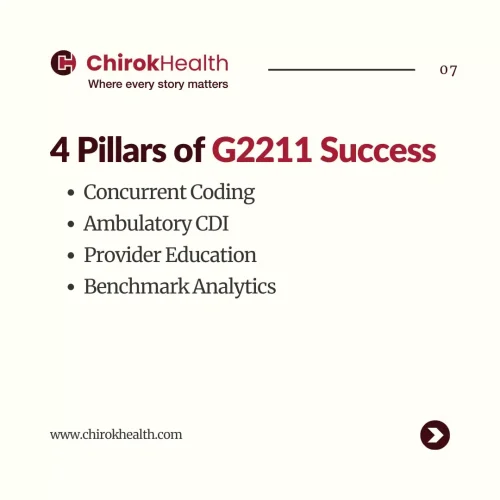
High-performing systems deploy a four-pillar model:
1. Concurrent Coding
Captures complexity before claim submission.
2. Ambulatory CDI
Clarifies longitudinal care documentation.
3. Provider Education
Builds compliant utilization confidence.
4. Analytics & Benchmarking
Identifies under-capture variance.
What Financial Impact Can CFOs Expect?
- 15–45% complexity capture lift
- 3–7% ambulatory E/M revenue increase
- Six- to seven-figure annual gains (mid-large systems)
- No added visits
- No staffing expansion
- No schedule changes
Why Is Acting on G2211 Urgent Now?
Three converging forces make delay costly:
CMS Is Shifting Toward Complexity-Based Reimbursement
- Longitudinal care accountability
- Chronic disease management
- Risk ownership
Margin Compression Is Accelerating
Hospital operating margins remain thin post-pandemic.
The American Hospital Association reports continued financial strain across U.S. systems.
Denials & Audit Scrutiny Are Rising
- Downcoding
- Medical necessity denials
- Post-payment risk
How Should Revenue Cycle Leaders Get Started?
A practical activation roadmap:
Step 1: Benchmark Current Capture
Compare internal utilization vs. national rates by specialty.
Step 2: Audit Documentation
Assess longitudinal care representation.
Step 3: Educate Providers
- When to use G2211
- Documentation phrasing
- Compliance guardrails
Step 4: Deploy Concurrent CDI
Support documentation before coding finalization.
Step 5: Monitor Financial Lift
Track reimbursement improvement monthly.
The Strategic Takeaway for HIM & RCM Executives
- No operational expansion required
- Fully compliance-aligned
- Benchmark validated
- Specialty scalable

Revenue Already Earned, But Not Yet Captured
You are already delivering complex, longitudinal care.
Your physicians are managing chronic disease progression, coordinating across specialties, and carrying outcome accountability.
G2211 ensures that work is recognized financially.
The $1.7M opportunity in one health system is not hypothetical; it exists in documentation gaps, workflow misalignment, and underutilized coding pathways.
The question is no longer whether the revenue exists.
It’s whether your organization is operationally positioned to capture it, compliantly, defensibly, and at scale.
FAQs
How does CMS G2211 create additional revenue without increasing patient volume?
G2211 is an add-on code that captures the inherent complexity of longitudinal care delivered during E/M visits. By aligning documentation and coding with CMS criteria and national utilization benchmarks, organizations can generate incremental reimbursement without scheduling new visits, hiring staff, or expanding clinic hours.
2. What documentation is required to bill G2211 compliantly?
To report G2211, documentation must reflect longitudinal care responsibility, including chronic condition management, treatment adjustments, care coordination, and ongoing accountability for patient outcomes. It should demonstrate cognitive workload beyond episodic visit care.
3. Which specialties see the highest financial impact from G2211 capture?
Primary care specialties such as Family Medicine and Internal Medicine typically see the largest opportunity due to chronic disease management volume. Cardiology, Oncology, Endocrinology, Gastroenterology, and OB/GYN also show strong financial lift due to high care complexity and coordination intensity.
4. Why are healthcare organizations underutilizing G2211 today?
Under-capture is driven by documentation gaps, lack of ambulatory CDI programs, missed add-on coding, limited provider education, and retrospective coding workflows that fail to reflect longitudinal care complexity.
5. Is billing G2211 compliance-safe and audit defensible?
Yes, when supported by proper documentation. CMS recognizes G2211 as a legitimate representation of visit complexity. Organizations must maintain medical necessity, documentation integrity, and coding governance to ensure audit defensibility.
6. What operational steps help health systems maximize G2211 reimbursement?
High-performing organizations deploy concurrent coding, ambulatory CDI support, provider education programs, and benchmark analytics to identify under-capture and improve compliant utilization.
Author Bio:

Kanar Kokoy
CEO - Chirok Health
Healthcare CEO & CDI/RCM innovator. I help orgs boost accuracy, integrity & revenue via truthful clinical docs. Led transformations in CDI, coding, AI solutions, audits & VBC for health systems, ACOs & more. Let’s connect to modernize workflows.