

















Clinical Documentation Improvement Services for Medicare Advantage Practices That Want Accurate Risk Scores
If you’re evaluating clinical documentation improvement services for a Medicare Advantage practice, you’re past the question of whether documentation accuracy matters. The OIG has completed multiple audit series on risk adjustment data validation. CMS extrapolates RADV findings starting with payment year 2018. The question now is which CDI program will actually close the gap.
The differences between CDI vendors are often invisible until they’re not. Six questions can surface those differences before you commit.
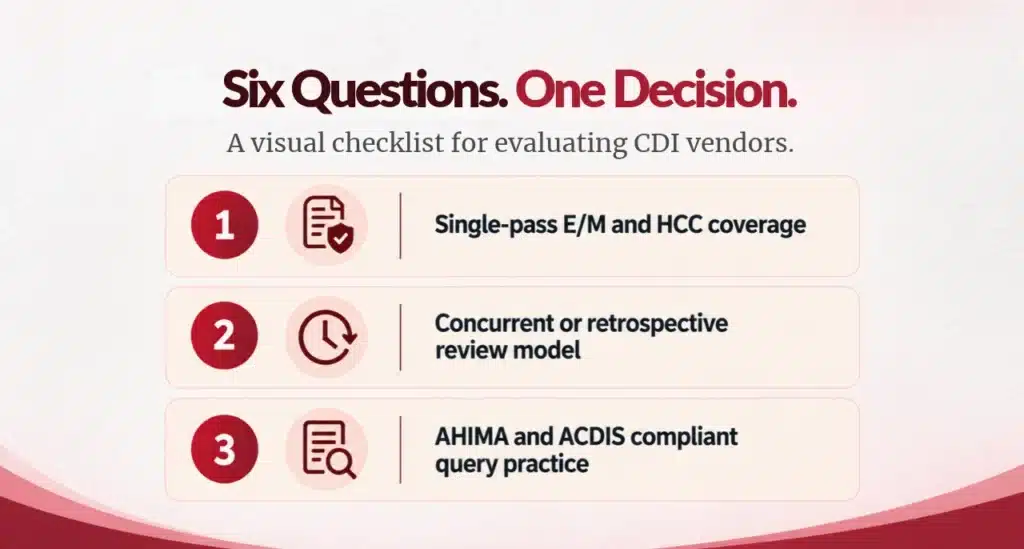
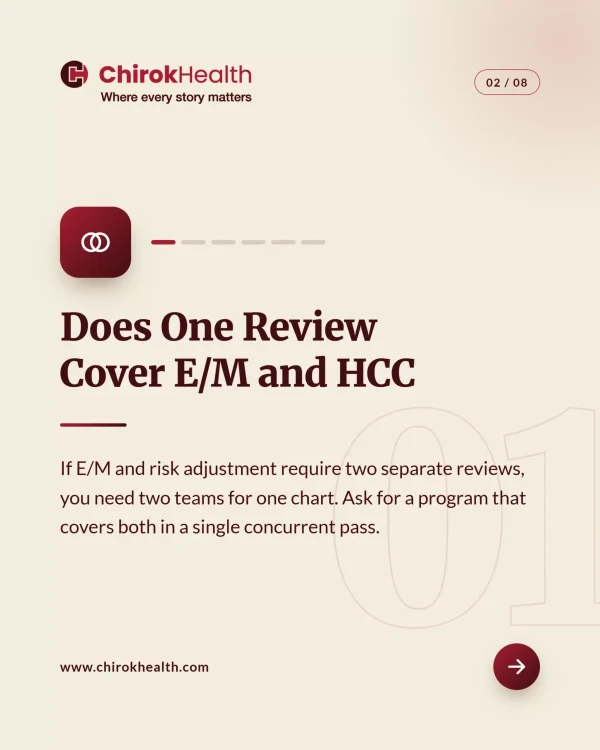
Question 1: Does the Review Cover Both E/M and Risk Adjustment in a Single Pass
Most CDI programs are built around one objective: either E/M coding accuracy for fee-for-service billing, or HCC capture for risk adjustment. Practices serving Medicare Advantage patients need both. A program that covers only one means the other gap remains, and a second vendor or a separate internal review is required to address it. Ask specifically whether one review team, working from one chart, produces findings for both E/M accuracy and HCC capture in the same review cycle.
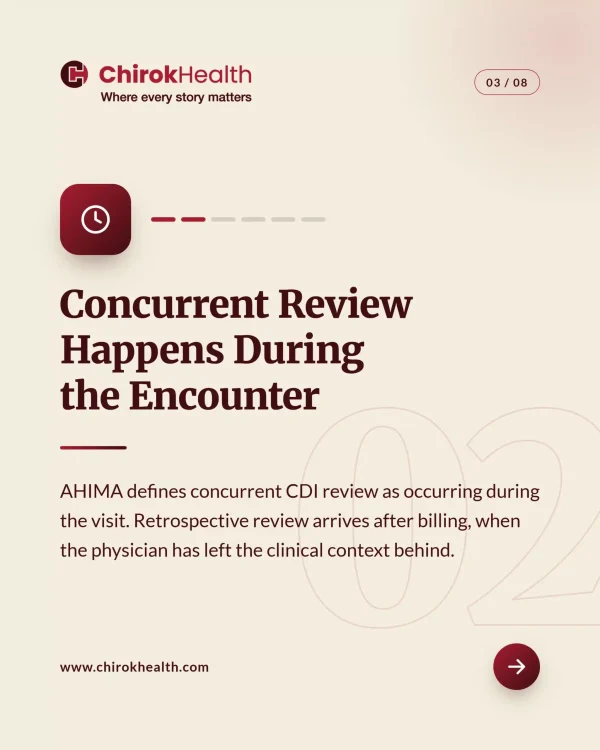
Question 2: Is the Review Concurrent or Retrospective
A concurrent review occurs during the encounter or visit. A retrospective review occurs after discharge or billing. AHIMA’s guidance on CDI review standards defines concurrent review as occurring during the encounter. That timing matters: a physician who receives feedback during the visit can address a documentation gap before the record is finalized. A retrospective query, sent after billing, asks the physician to reconstruct clinical context they no longer have immediate access to.
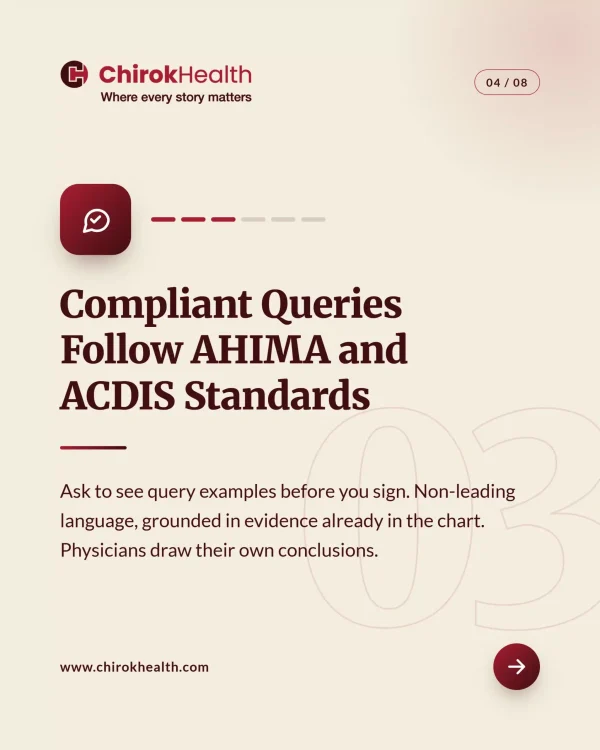
Question 3: How Does the Vendor Handle Physician Queries
The joint AHIMA and ACDIS guidelines for compliant query practice require queries to use non-leading language and be grounded in clinical evidence already present in the chart. A vendor whose queries direct physicians toward specific diagnoses, or that resends queries until a preferred code is entered, is not operating within that standard. Ask to see query examples. Ask how the vendor documents and measures physician response rates.
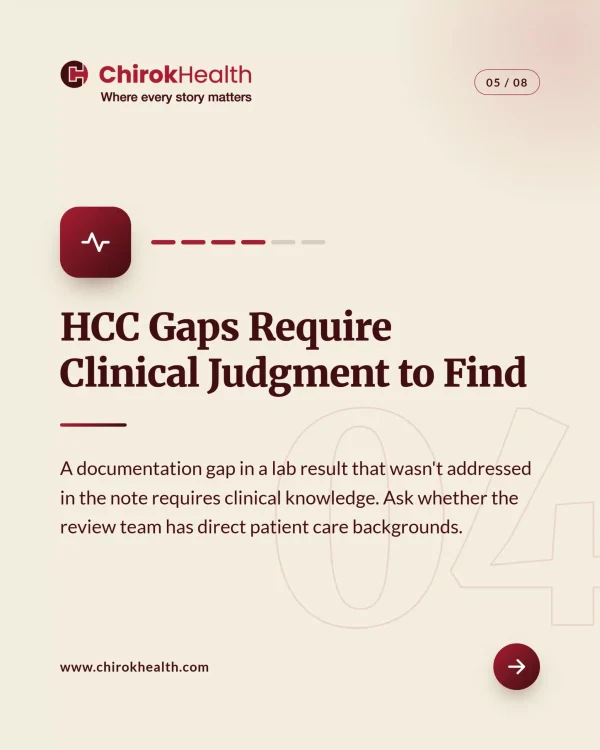
Question 4: Does the Review Team Have Both Clinical and Coding Credentials
An HCC capture gap is often a clinical documentation gap, not just a coding gap. Identifying that a patient’s diabetic nephropathy is present in lab results but not addressed in the visit note requires clinical judgment alongside coding knowledge. A review team with both credentials reads the chart more completely than one with only one. Ask what certifications the review team holds, and whether clinical staff with direct patient care backgrounds are involved in the review process.
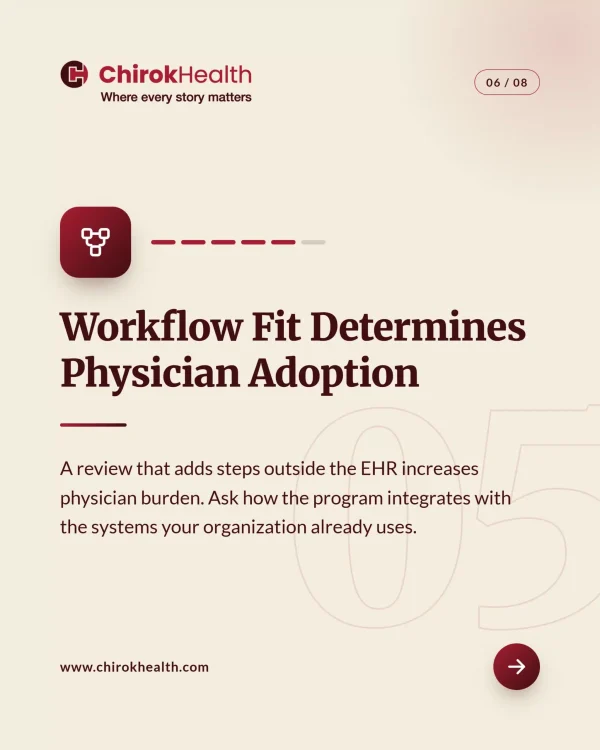
Question 5: How Does the Vendor Work Inside Your Existing EHR and Workflow
A CDI program that requires a separate platform, a parallel documentation step, or a workflow outside the EHR adds burden to physicians. Ask specifically how the vendor’s review process integrates with the EHR your organization uses. Chirok Health’s concurrent coding services are built to work inside existing encounter workflows, adding less friction than programs that require additional steps outside the EHR. Physician adoption tracks directly with workflow fit.
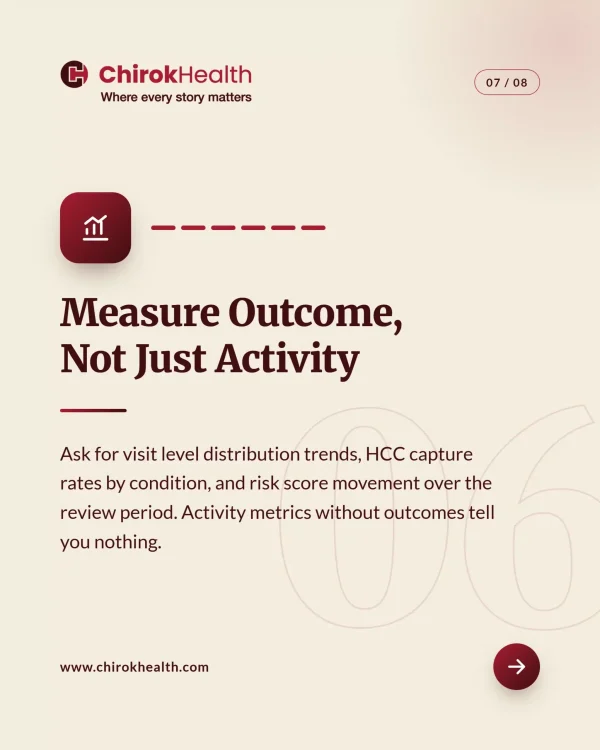
Question 6: How Does the Vendor Measure Risk Adjustment Accuracy Over Time
A CDI program’s value for a Medicare Advantage panel is whether risk scores more accurately reflect patient complexity over time. Ask the vendor how they measure that. Ask whether visit level distribution is tracked against national benchmarks. Ask whether HCC capture rates are reported by condition category. Ask what the trend looks like across the review period. A program that measures only activity, not outcome, cannot tell you whether your risk scores are moving.
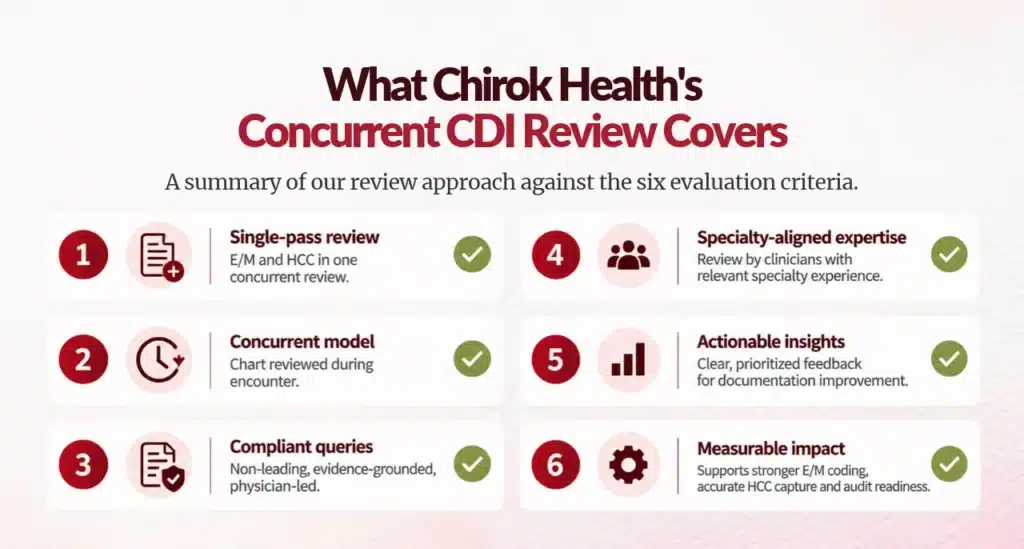
What Chirok Health's CDI Program Covers
Chirok Health’s clinical coders review charts concurrently, inside the provider’s existing workflow, covering both E/M accuracy and HCC capture in a single pass. One team, one review. Feedback reflects what the record shows. Physicians draw their own clinical conclusions. The program works across fee-for-service and value-based care, so practices managing Medicare Advantage panels don’t need separate programs for each payment model.
Does Your Current CDI Program Answer All Six Questions
If your practice already has a CDI program but isn’t seeing movement in visit level distribution or risk score accuracy, one of these six areas is likely where the gap sits.
Chirok Health offers a CDI program review to identify where your current process leaves E/M and HCC gaps open, and what concurrent coverage would close.
Contact Chirok Health to Evaluate Your CDI Program
The evaluation examines your current documentation workflow, review coverage, physician query process, and risk score trend across your Medicare Advantage panel.
Evaluation covers:
- Whether current review covers both E/M and HCC in one pass
- Review type (concurrent versus retrospective)
- Query compliance with AHIMA and ACDIS standards
- Team clinical and coding credentials
- EHR workflow integration
- Risk score trend and HCC capture measurement methodology
The Right CDI Program Answers More Than One Question
A clinical documentation improvement program that covers only fee-for-service accuracy or only HCC capture is answering one question at a time. Practices serving Medicare Advantage patients need a program that sees the full chart, works during the encounter, and produces findings for both payment systems in one pass. The six questions above identify whether a program does that before you commit.
Frequently Asked Questions
1. What Are Clinical Documentation Improvement Services for Medicare Advantage?
Clinical documentation improvement services for Medicare Advantage are programs that review clinical records to ensure documentation accurately reflects the health status of enrolled patients for both fee-for-service billing and risk-adjusted payment. In Medicare Advantage, accurate documentation supports both E/M code selection and HCC submissions that determine a beneficiary's risk score.
2. What Is the Difference Between Concurrent and Retrospective CDI Review?
Concurrent CDI review occurs during the encounter or visit, while the patient is present and the physician can still address documentation gaps. Retrospective review occurs after discharge or billing. AHIMA defines the concurrent model as the standard approach for inpatient CDI. In outpatient settings serving Medicare Advantage patients, concurrent review is more effective because it allows feedback to reach physicians before records are finalized.
3. What Does a Compliant Physician Query Look Like?
Under the joint AHIMA and ACDIS guidelines for compliant query practice, a compliant query presents the physician with clinical evidence already present in the chart and asks for clarification. It does not suggest a specific diagnosis or code, does not use leading language, and is not resent until a preferred response is received. Compliant queries are documented in an auditable way and are consistent across providers.
4. Why Do Medicare Advantage Practices Need Both E/M and HCC Coverage?
Medicare Advantage practices operate across two payment systems simultaneously: fee-for-service E/M billing for the visit and risk adjustment for the plan's monthly capitation. E/M undercoding can reduce appropriate fee-for-service reimbursement. HCC gaps can understate the risk score, affecting the plan's funding and the practice's case for managing complex patients in value-based arrangements. A CDI program that covers only one leaves the other gap open.
5. What Is a RADV Audit and How Does CDI Reduce That Risk?
A Risk Adjustment Data Validation audit is CMS's primary mechanism for verifying that submitted HCC diagnoses are supported by medical record documentation. CMS finalized a rule in February 2023 to extrapolate RADV audit findings beginning with payment year 2018, meaning a documentation error found in a sample can be extrapolated to the full population. A CDI program that ensures documentation supports every submitted HCC before billing helps reduce that risk by closing gaps at the source.
6. How Quickly Can a CDI Program Affect Risk Score Accuracy?
Risk score accuracy in Medicare Advantage depends on conditions documented across the full calendar year for each enrollee. Improvements in documentation completeness and concurrent review coverage affect HCC submissions for that plan year. The timeline for visible change in risk scores varies by panel complexity, review coverage rate, and physician query response rates. A CDI program that tracks HCC capture rates and visit-level distribution over time provides the measurement needed to assess progress.
Author Bio:

Brandy Kerby
CGO - Chirok Health
Brandy Kerby is Chief Growth Officer at Chirok Health, a clinician-led medical coding, CDI, and revenue cycle organization. She works with health systems, providers, plans, and risk-bearing organization leaders on a question most are now facing: not whether to adopt coding automation, but how to govern it. Her work centers on the operational evidence behind that decision, including the encounter-level analysis presented in this briefing.