



















Build vs Outsource: Comparing Retrospective Review Programs for VBC Payors
Should VBC Payors Build or Outsource Retrospective Review Programs?
If you’re leading CDI, HIM, Revenue Cycle, or finance inside a value-based care (VBC) organization, here is the direct answer:
Most VBC payors achieve faster financial impact, stronger audit defensibility, and lower operational risk by outsourcing retrospective review programs unless they already have mature risk adjustment infrastructure, stable expert staffing, and scalable technology in place.
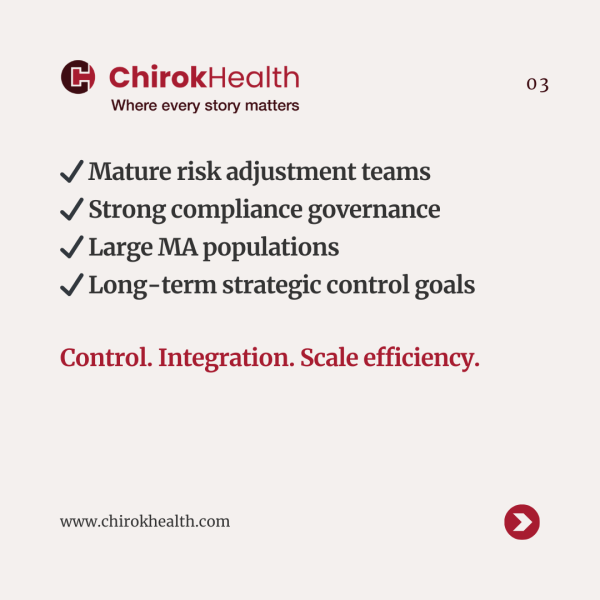
Building internally offers long-term control and potential cost advantages at scale.
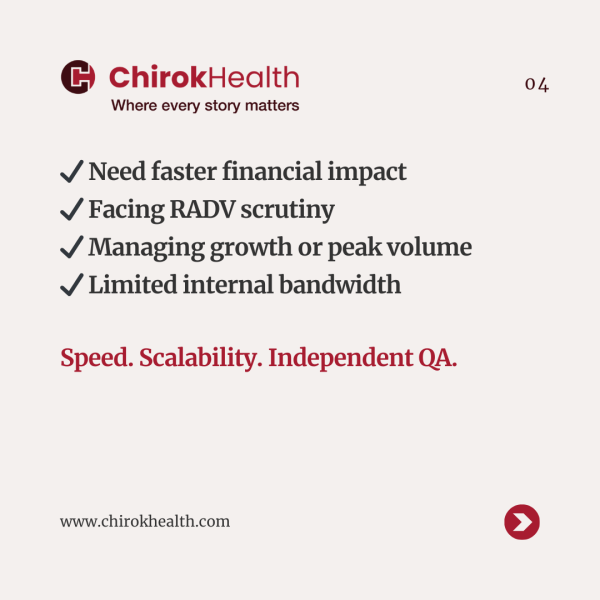
Outsourcing offers speed, scalability, and specialized compliance depth.
The right decision depends on:
- Size of your Medicare Advantage (MA) or risk-based population
- Internal risk adjustment expertise
- RADV audit exposure
- Technology maturity
- Speed-to-ROI expectations
As MA enrollment continues to grow surpassing 30 million beneficiaries according to the Centers for Medicare & Medicaid Services risk adjustment accuracy has become a board-level priority.
This is no longer a documentation exercise.
It is a revenue protection strategy.
Let’s examine the comparison in depth.
What Is a Retrospective Review Program in Value-Based Care?
- Accurate HCC capture
- Complete diagnosis documentation
- ICD-10-CM coding integrity
- Compliance with CMS risk adjustment rules
- Audit readiness
- Documented in a face-to-face encounter
- Supported by MEAT criteria (Monitored, Evaluated, Assessed, Treated)
- Reported annually
Why Does the Build vs Outsource Decision Matter Financially?
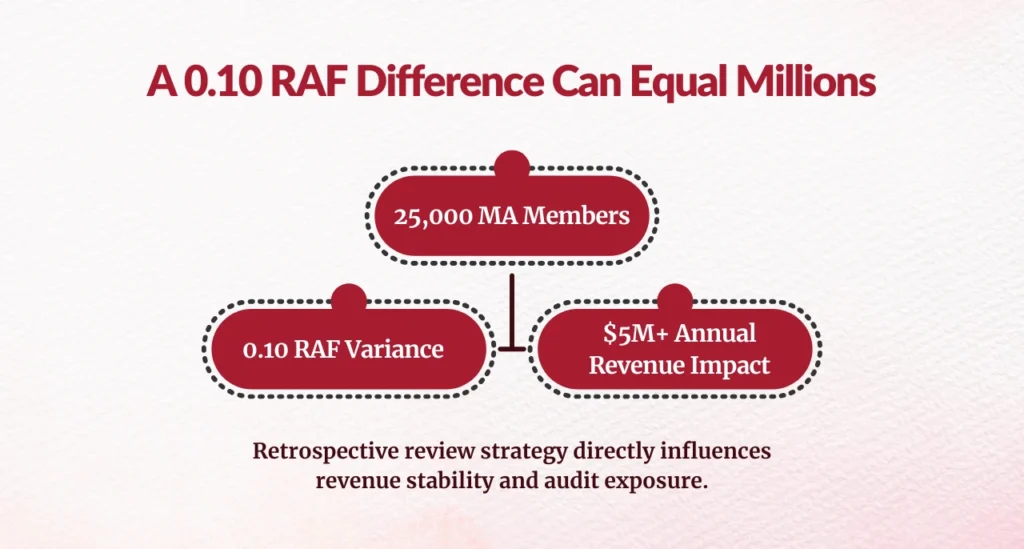
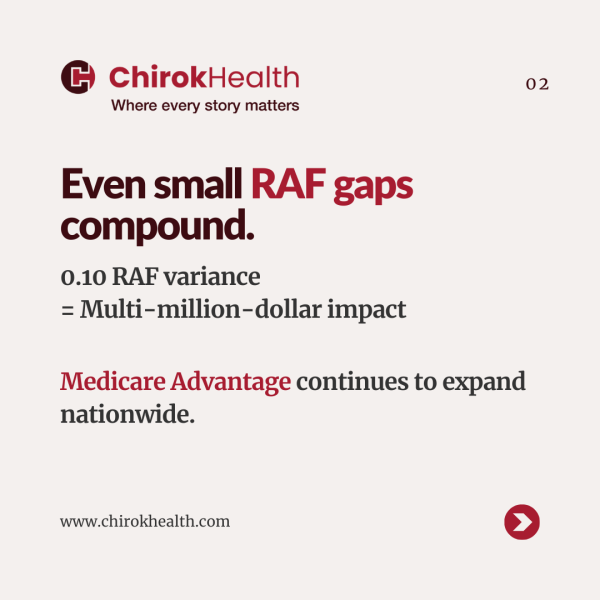
Even small RAF variances compound significantly.
A 0.10 RAF difference can translate to several hundred dollars per member per year. Across 25,000 lives, that variance can exceed $5 million annually.
Additionally:
- Medicare Advantage spending now exceeds $400 billion annually (CMS data)
- The Medicare Payment Advisory Commission (MedPAC) continues to highlight risk score growth and coding intensity concerns
- The Office of Inspector General (OIG) regularly audits risk adjustment submissions
This environment demands precision.
The decision to build or outsource affects:
- Revenue stability
- Audit defensibility
- Staffing burden
- Scalability during contract growth
What Does Building an Internal Retrospective Review Program Require?
If your organization builds internally, you must invest in four pillars.
1. Specialized Risk Adjustment Talent
Internal teams must include:
- Certified Risk Adjustment Coders (CRC)
- Experienced CDI professionals
- Clinical validation oversight
Risk adjustment coders command competitive salaries due to market demand. Recruiting and retaining experienced professionals remains a national challenge.
Turnover risk directly affects review continuity and inter-rater reliability.
2. Technology Infrastructure
Internal programs require:
- Secure chart abstraction systems
- Risk stratification analytics
- Audit tracking tools
- Reporting dashboards
- QA monitoring frameworks
Without predictive targeting tools, teams often review low-yield charts, reducing ROI.
3. Compliance Governance
Building internally shifts full compliance responsibility to your organization.
That includes:
- Independent QA review
- RADV-aligned documentation validation
- Audit trail preservation
- Escalation pathways for unsupported diagnoses
Without strict governance, internal confirmation bias may increase audit exposure.
4. Operational Leadership and Bandwidth
Internal programs require cross-functional ownership:
- HIM
- Revenue Integrity
- Population Health
- Compliance
Unclear governance often leads to duplication, misalignment, or stalled performance improvement.
What Are the Advantages of Building Internally?
If executed correctly, internal programs provide:
Greater Operational Control
You determine review methodology, prioritization, and internal reporting structure.
Cultural Alignment
Internal reviewers understand provider documentation habits and clinical workflows.
Long-Term Cost Efficiency at Scale
Large payors managing 75,000+ risk-based lives may realize economies of scale after initial investment stabilization.
For mature organizations, building can become a strategic asset.
What Are the Risks of Building Internally?
However, building carries measurable risks.
Slower Time to ROI
Hiring, onboarding, and infrastructure development may delay measurable RAF improvement by 12–18 months.
Staffing Volatility
Loss of experienced risk coders disrupts performance consistency.
Technology Gaps
Vendors often invest heavily in AI-driven chart prioritization. Internal programs may lag in predictive targeting capabilities.
Increased Compliance Exposure
Internal QA must remain independent and rigorous to prevent over-capture or unsupported diagnoses.
What Does Outsourcing a Retrospective Review Program Offer?
Outsourcing transfers operational complexity to a specialized partner.
Established vendors provide:
- Dedicated risk adjustment coding teams
- Physician clinical validation
- QA layers with inter-rater reliability tracking
- AI-assisted chart targeting
- Scalable staffing during peak cycles
For VBC payors experiencing membership growth, outsourcing reduces ramp-up risk.
What Are the Advantages of Outsourcing?
1. Faster Implementation
Vendor teams can begin within weeks, accelerating RAF impact.
2. Scalability During Growth
As MA enrollment increases, vendor capacity expands without additional hiring.
3. Independent Compliance Oversight
Third-party validation adds defensibility during audits.
4. Predictable Financial Modeling
Many vendors structure pricing tied to chart volume or performance yield.
Organizations leveraging Chirok Health’s retrospective review expertise often accelerate risk score accuracy while reducing internal strain.
What Are the Risks of Outsourcing?
Outsourcing is not without trade-offs.
Vendor Dependence
Over-reliance may limit internal knowledge development.
Data Security Concerns
PHI exchange requires robust cybersecurity safeguards and Business Associate Agreements (BAAs).
Variable Cost Structure
Per-chart pricing can fluctuate with volume spikes.
Cultural Distance
External reviewers may require onboarding to understand documentation nuances.
How Should Leaders Compare Financial ROI Between Both Models?
Consider total cost of ownership.
Internal Build Cost Components
- 5–10 FTE salaries
- Benefits and training
- Technology licensing
- IT integration
- QA oversight staff
Estimated annual baseline: $800,000–$1.8M depending on size.
Outsource Cost Components
- Per-chart abstraction fees
- QA validation costs
- Technology access fees
ROI must account for:
- Incremental RAF lift
- Avoided RADV recoupments
- Reduced internal staffing burden
- Scalability during growth
For many mid-sized payors, outsourcing produces positive net financial impact within the first performance year.
When Does a Hybrid Model Make Strategic Sense?
Increasingly, sophisticated organizations adopt hybrid strategies.
Outsource for:
- Rapid RAF stabilization
- Peak season volume
- RADV preparation cycles
Internalize for:
- Long-term governance
- Provider education integration
- Strategic risk management
This phased approach reduces transition risk while building institutional capability.
How Does RADV Expansion Change the Decision?
CMS’s expanded RADV extrapolation authority raises repayment risk significantly.
Unsupported diagnoses identified in audit may extrapolate across contract populations.
That reality increases the value of:
- Independent validation
- Rigorous QA frameworks
- Clinical defensibility
Organizations lacking robust QA oversight may face amplified financial risk.
What Questions Should Revenue Leaders Ask Before Deciding?
As a CDI Director, HIM leader, or CFO, consider:
- What is our current RAF variance trend year over year?
- How prepared are we for RADV scrutiny?
- Do we maintain independent QA validation?
- Can our team scale 20% membership growth without delay?
- How quickly do we need measurable ROI?
The answers will clarify your path.
Side-by-Side Strategic Comparison
| Metric | Build Internally | Outsource |
|---|---|---|
| Speed to ROI | Slower | Faster |
| Staffing Risk | High | Low |
| Operational Control | High | Moderate |
| Scalability | Limited by hiring | Flexible |
| Compliance Independence | Internal | External QA |
| Technology Investment | High upfront | Included |
| Long-Term Cost at Large Scale | Potentially lower | Variable |
Final Thoughts for HIM and Revenue Leaders
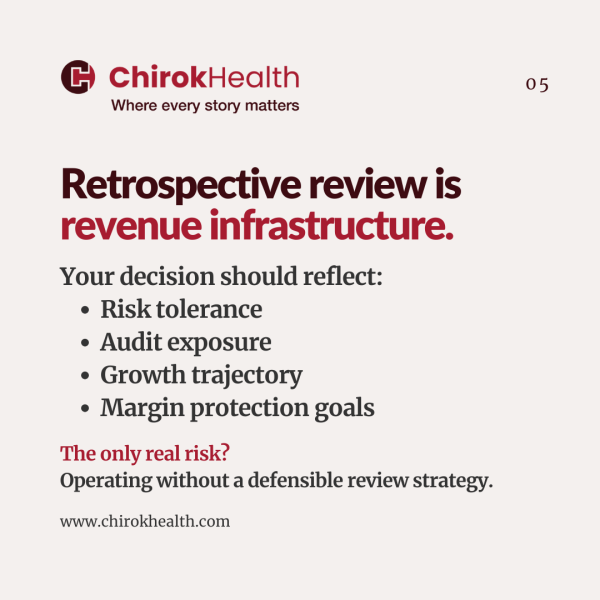
Retrospective review programs in VBC are no longer optional safeguards.
They are core financial infrastructure.
If your organization values:
- Immediate revenue stabilization
- Audit defensibility
- Scalable operations
- Lower operational strain
Outsourcing often provides the most efficient path.
If your organization prioritizes:
- Long-term internal expertise
- Direct governance control
- Strategic CDI integration
Building may align with your maturity level.
The decision is not about preference.
It is about risk tolerance, scalability, and margin protection.
In today’s regulatory climate, retrospective accuracy is directly tied to executive accountability.
The only unacceptable option?
Operating without a structured, defensible review strategy.
FAQs
1. Is outsourcing retrospective reviews more cost-effective than building internally?
For mid-sized VBC payors, outsourcing often delivers faster ROI due to reduced hiring, training, and technology investment costs. Large systems may achieve cost efficiency internally at scale.
2. Does outsourcing reduce RADV audit risk?
Outsourcing can improve audit defensibility when vendors provide independent QA validation and clinical review processes aligned with CMS requirements.
3. When should payors build internal review programs?
Building makes sense when organizations manage large MA populations, possess experienced risk adjustment teams, and have mature compliance infrastructure.
4. Can organizations use both models together?
Yes. Hybrid models allow payors to outsource during growth or audit preparation while building long-term internal capabilities.
5. What is the biggest risk of not investing in retrospective reviews?
Inaccurate RAF calibration and unsupported diagnoses increase repayment exposure, suppress revenue, and elevate executive compliance risk.
Author Bio:

Kanar Kokoy
CEO - Chirok Health
Healthcare CEO & CDI/RCM innovator. I help orgs boost accuracy, integrity & revenue via truthful clinical docs. Led transformations in CDI, coding, AI solutions, audits & VBC for health systems, ACOs & more. Let’s connect to modernize workflows.