





















18 Ways How Audit-Defensible Coding Reviews Protect Revenue While Meeting CMS and Payer Standards
Even small documentation gaps can lead to significant consequences. Missed diagnoses may result in underpayment, while unsupported diagnoses may trigger denials, repayment demands, or regulatory scrutiny. As reimbursement models grow more complex, healthcare leaders must ensure that coding practices are both accurate and defensible.
This growing scrutiny has elevated coding review processes from routine administrative tasks to critical revenue protection mechanisms.
Audit-defensible coding reviews evaluate completed medical records to confirm that diagnoses, procedures, and documentation meet coding standards and regulatory expectations. These reviews go beyond verifying code selection. They assess whether documentation truly supports the reported codes and whether those codes align with payer requirements and official guidelines.
In this article, we examine 18 ways audit-defensible coding reviews protect healthcare revenue while ensuring alignment with CMS and payer standards.
What Are Audit-Defensible Coding Reviews?
Audit-defensible coding reviews are structured evaluations of coded medical records to ensure that all reported diagnoses and procedures are:
- Correctly coded
- Supported by clinical documentation
- Aligned with payer guidelines
- Defensible during audits
These reviews are typically performed by certified coding professionals who analyze clinical documentation and validate whether the assigned codes accurately reflect the patient encounter.
The goal is not simply to confirm that a code was chosen correctly. Instead, reviewers evaluate whether the documentation itself supports the reported diagnosis or procedure in a way that would withstand regulatory scrutiny.
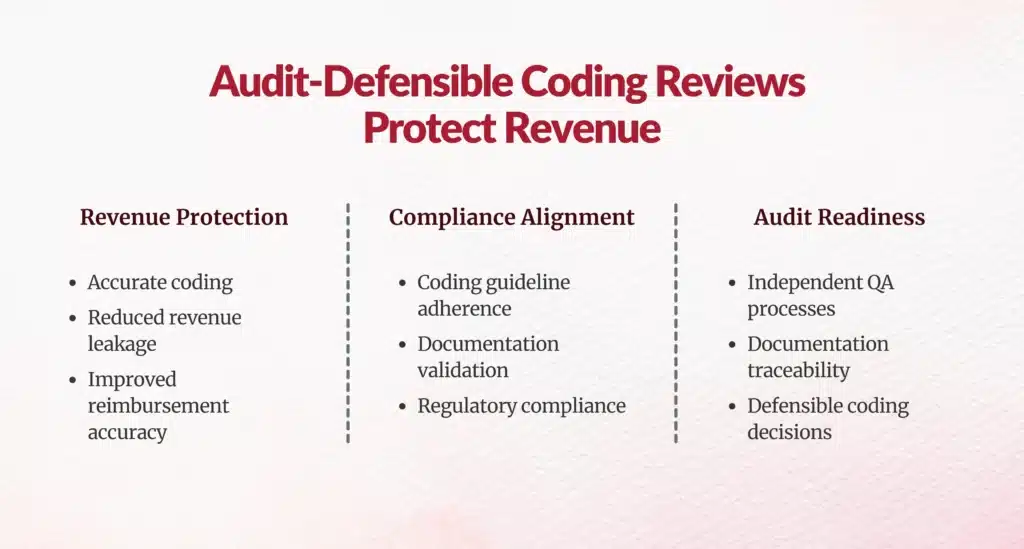
- Clinical validation
- Coding accuracy verification
- Independent quality assurance
- Documentation traceability
- Regulatory alignment
Together, these elements ensure that coding decisions remain both accurate and defensible.
Why Coding Reviews Are Increasingly Important?
Healthcare reimbursement has become significantly more complex over the past decade. Payment models now rely on detailed documentation and accurate coding to determine reimbursement levels.
Regulatory agencies and payers closely monitor coding practices to identify potential inaccuracies or unsupported diagnoses.
The Centers for Medicare & Medicaid Services reported billions in improper payments across federal healthcare programs annually, with documentation and coding issues among the most common causes.
As a result, healthcare organizations face increasing pressure to ensure coding integrity.
- Revenue leakage
- Increased claim denials
- Audit penalties
- Compliance violations
- Financial instability
Audit-defensible coding reviews help mitigate these risks while improving revenue accuracy.
18 Ways Audit-Defensible Coding Reviews Protect Revenue
1. Improves Coding Accuracy
2. Reduces Missed Diagnoses
Documentation gaps often lead to missed diagnoses that should have been captured during coding. When these diagnoses are not reported, reimbursement may be significantly lower than appropriate. Coding reviews help identify conditions documented in the medical record but not coded in the claim. By capturing these missed diagnoses, organizations ensure reimbursement reflects the full complexity of patient care.
3. Prevents Unsupported Diagnoses
Just as missed diagnoses create underpayment, unsupported diagnoses create compliance risk.Coding reviews verify whether documentation supports the reported diagnosis according to coding guidelines and clinical evidence. Removing unsupported diagnoses helps organizations avoid audit findings and repayment demands.
4. Strengthens Documentation Quality
Coding reviews frequently reveal documentation gaps that prevent accurate code assignment. When reviewers identify unclear or incomplete documentation, feedback can be provided to clinicians to improve documentation practices. Over time, this feedback strengthens overall documentation quality and reduces coding ambiguity.
5. Improves Claim Accuracy
Claim denials often occur because diagnosis or procedure codes do not align with payer requirements. Coding reviews ensure claims contain accurate and supported codes before submission or during retrospective analysis. Improved claim accuracy reduces administrative rework and accelerates reimbursement timelines.
6. Reduces Claim Denials
Denials represent a significant administrative and financial burden for healthcare organizations. Coding errors and documentation issues are among the most common causes of claim denials. Audit-defensible coding reviews identify these issues early, helping organizations reduce denial rates and improve payment success.
7. Protects Risk Adjustment Accuracy
Risk adjustment models rely heavily on accurate diagnosis coding to calculate patient acuity levels. Incomplete or inaccurate coding may reduce risk adjustment scores and lower reimbursement. Coding reviews ensure that risk-adjusted diagnoses are properly documented and coded, improving the accuracy of risk scores.
8. Supports Regulatory Compliance
Healthcare organizations must follow strict coding guidelines established by regulators and payers. Coding reviews ensure coding practices remain aligned with these standards and regulatory expectations. Compliance oversight is particularly important for organizations participating in federally funded healthcare programs.
9. Improves Audit Readiness
Audits are an inevitable part of healthcare reimbursement oversight. Organizations with structured coding review programs are significantly better prepared for audit scrutiny. Coding reviews create documented evidence that coding practices follow established standards.
10. Strengthens Clinical Validation
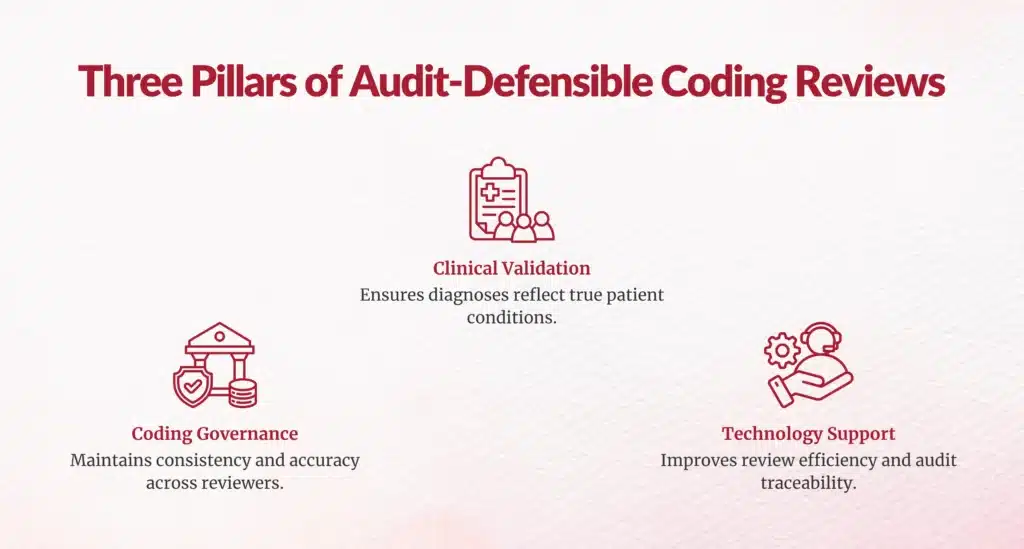
Clinical validation ensures that reported diagnoses reflect the patient’s true clinical condition. Coding reviews evaluate whether diagnoses are supported by clinical indicators within the documentation. This validation helps prevent inaccurate reporting and improves overall coding integrity.
11. Enhances Inter-Rater Consistency
Coding variability between reviewers can create inconsistent reporting patterns. Structured review programs include quality assurance processes that monitor inter-rater reliability. Improving reviewer consistency ensures coding decisions remain standardized across the organization.
12. Supports Revenue Integrity Programs
13. Improves Financial Forecasting
Accurate coding directly influences financial projections.Organizations that implement strong coding review processes generate more reliable revenue data. This improves financial forecasting and budget planning.
14. Reduces Compliance Risk
Unsupported diagnoses and inaccurate coding can lead to regulatory penalties.Coding reviews reduce compliance exposure by ensuring coding practices remain defensible during regulatory reviews. This protection is especially important in risk-adjusted payment models.
15. Enhances Provider Education
Coding review findings can be used to educate clinicians on documentation best practices. When providers understand how documentation affects coding accuracy, they are better equipped to support compliant coding practices. Provider education improves documentation quality across the organization.
16. Improves Operational Efficiency
Coding errors often trigger administrative rework, appeals, and payment delays. Coding reviews reduce these inefficiencies by identifying issues before they escalate into operational problems. This helps revenue cycle teams operate more efficiently.
17. Strengthens Payer Relationships
18. Protects Long-Term Financial Stability
Ultimately, audit-defensible coding reviews protect long-term financial performance. Accurate coding ensures appropriate reimbursement while minimizing compliance risk. Organizations that invest in strong coding governance are better positioned to maintain financial stability in a complex reimbursement environment.
Conclusion
Healthcare reimbursement systems depend heavily on accurate coding and reliable clinical documentation. As regulatory scrutiny continues to increase, organizations must ensure that their coding practices remain both accurate and defensible.
Audit-defensible coding reviews provide a structured framework for validating coding decisions, strengthening documentation quality, and ensuring compliance with regulatory and payer expectations.
By identifying coding errors, preventing unsupported diagnoses, and improving documentation practices, these reviews help organizations reduce financial risk while protecting revenue accuracy.
For healthcare leaders responsible for revenue cycle management, compliance oversight, and financial performance, implementing audit-defensible coding reviews is no longer optional. It is a critical component of a sustainable revenue integrity strategy.
Organizations that prioritize coding governance today will be better equipped to navigate the evolving regulatory landscape and maintain long-term financial stability.
FAQs
1. What are audit-defensible coding reviews?
Audit-defensible coding reviews are structured evaluations of medical records to confirm that diagnoses and procedures are accurately coded and supported by clinical documentation.
2. Why are coding reviews important for healthcare revenue?
Coding reviews help identify errors, missed diagnoses, and unsupported codes, ensuring reimbursement reflects the true complexity of patient care.
3. How do coding reviews reduce compliance risk?
By verifying documentation support and coding accuracy, coding reviews help organizations avoid regulatory penalties and audit repayment demands.
4. Who performs coding reviews?
Coding reviews are typically conducted by certified coding professionals with expertise in medical coding standards and clinical documentation requirements.
5. Do coding reviews improve documentation quality?
Yes. Coding reviews identify documentation gaps and provide feedback that helps clinicians improve documentation practices.
Author Bio:

Kanar Kokoy
CEO - Chirok Health
Healthcare CEO & CDI/RCM innovator. I help orgs boost accuracy, integrity & revenue via truthful clinical docs. I've led transformations in CDI, coding, AI solutions, audits & VBC for health systems, ACOs & more. Let's connect to modernize workflows.