






















How AI Adoption Is Reshaping Healthcare Costs, And Why the BCBS Study May Be Missing the Point
Some conversations are worth having, and this is one of them.
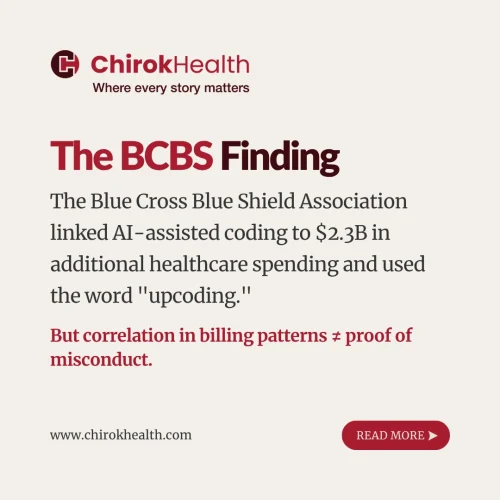
The Blue Cross Blue Shield Association recently released findings linking AI-assisted coding to an estimated $2.3 billion in additional healthcare spending. It’s a number designed to spark reaction, and it has. Across finance, compliance, and policy circles, the narrative is already forming: AI is driving up costs.
But that framing deserves a closer look.
Because the more important story here isn’t just about AI adoption. It’s about how we interpret what AI is revealing.
The Language Around AI Matters More Than We Think
What the Data Actually Shows?
At the center of the study is a pattern: diagnoses are becoming more detailed, and in some cases, more complex. A commonly cited example is maternity care, where hospitals reported an increase in diagnoses like acute posthemorrhagic anemia without a corresponding rise in transfusions.
On the surface, that raises questions.
But clinical reality is rarely that linear.
Under ICD-10-CM guidelines, a diagnosis doesn’t depend on a single intervention. It can be supported by evaluation, monitoring, diagnostic work, or increased care intensity. A transfusion is one possible response, not the defining threshold for whether a condition exists.
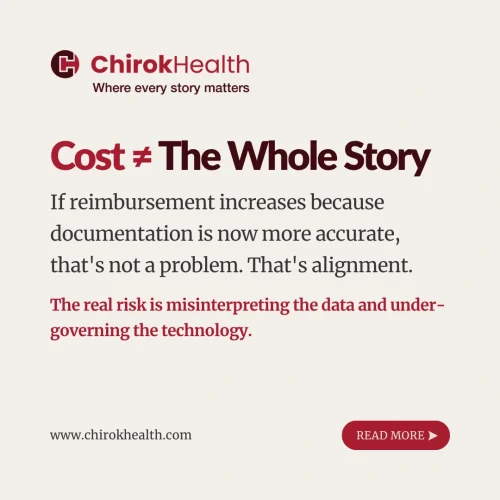
So when documentation becomes more precise, reimbursement models respond accordingly. That doesn’t necessarily mean the system is being manipulated. It may mean the system is finally capturing what was always there.
AI isn’t Just Changing Workflows; it’s Changing Visibility
The Question We Should Be Asking
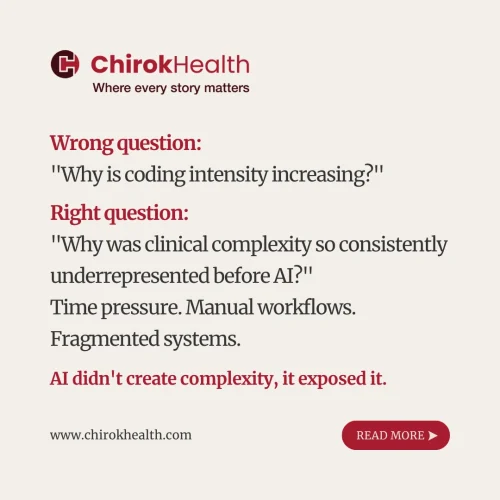
The conversation today is focused on why coding intensity is increasing.
But that may not be the most important question.
A more meaningful one is:
Why was clinical complexity so consistently underrepresented before?
For years, healthcare organizations operated within constraints that limited documentation accuracy. Time pressures, manual workflows, and fragmented systems often meant that only the most obvious conditions were captured. Subtle comorbidities, secondary diagnoses, and nuanced clinical indicators were frequently missed.
AI hasn’t created complexity.
It has exposed it.
And that exposure is now colliding with reimbursement models that were built around less detailed inputs.
Where AI Alone Falls Short?

Reframing the Narrative Around Cost
The Bottom Line
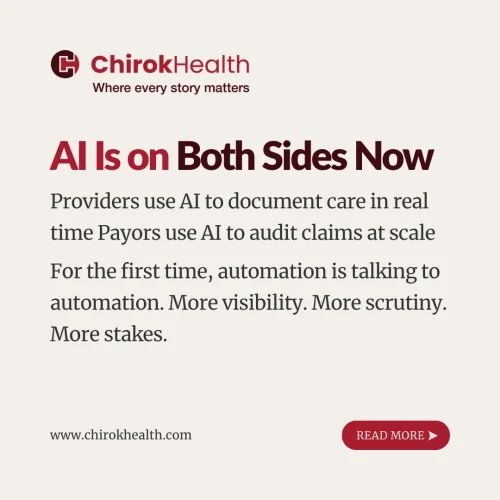
AI is no longer experimental in healthcare. It’s operational. It’s embedded. And it’s influencing how care is documented, coded, and reimbursed at scale.
What happens next won’t be defined by how quickly organizations adopt AI, but by how effectively they interpret and govern its outputs.
Because the real risk isn’t that AI is changing the system.
It’s that we might misunderstand what those changes actually mean.
And in a revenue cycle increasingly shaped by automation on both sides, that misunderstanding can be just as costly as any coding error.
FAQs
1. Is AI actually increasing healthcare costs?
Not necessarily. AI is often improving the accuracy and completeness of clinical documentation, which can lead to higher reported costs. However, this may reflect previously underreported patient complexity rather than true cost inflation.
2. Does more detailed coding always mean higher reimbursement?
Often, yes. Many reimbursement models are tied to the documented severity and complexity of a patient’s condition. When AI improves documentation accuracy, reimbursement may increase accordingly.
3. How does AI impact clinical documentation?
AI tools such as ambient listening and automated coding assistants help capture clinical interactions in real time and suggest relevant diagnoses. This reduces missed information and enhances documentation completeness.
4. Does increased coding intensity always indicate fraud or misuse?
No. Increased coding intensity can result from better documentation rather than intentional inflation. It’s important to distinguish between improved accuracy and inappropriate coding practices.
5. What role does Clinical Documentation Integrity (CDI) play in an AI-driven environment?
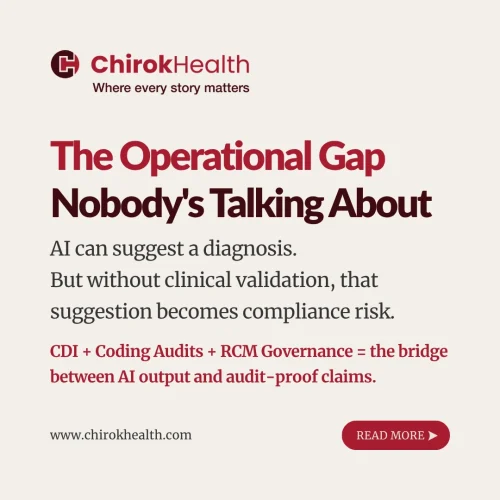
CDI ensures that all documented and coded diagnoses accurately reflect clinical care. It acts as a safeguard, validating AI-generated insights before they impact billing and reimbursement.
Author Bio:

Kanar Kokoy
CEO - Chirok Health
Healthcare CEO & CDI/RCM innovator. I help orgs boost accuracy, integrity & revenue via truthful clinical docs. Led transformations in CDI, coding, AI solutions, audits & VBC for health systems, ACOs & more. Let’s connect to modernize workflows.