


















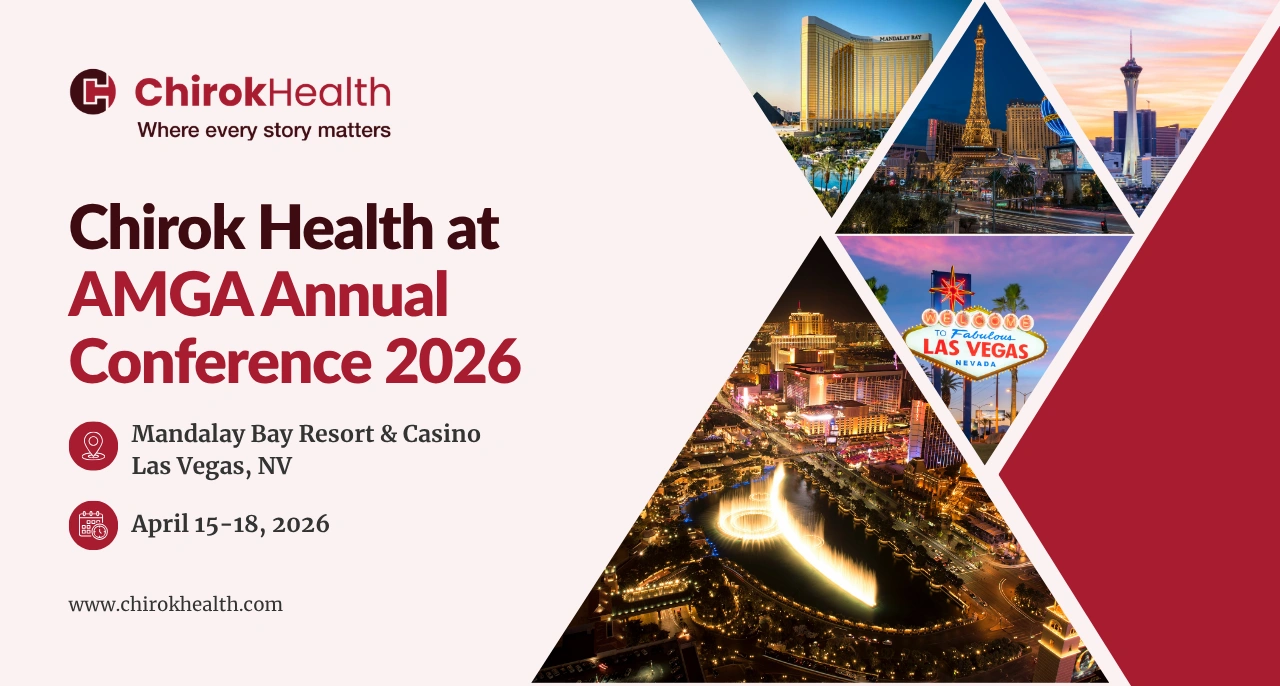
AMGA Annual Conference 2026
April 15-18, 2026 | Mandalay Bay Resort & Casino | Las Vegas, NV
Most medical group leaders have already invested in the answer. They are still waiting for the result.
The Structural Problem
The organizations attending AMGA are not struggling with basic operational challenges. They have built CDI programs, invested in RCM platforms, and engaged vendors. They are still seeing revenue volatility, RAF gaps, and denial rates that should not exist at their level of maturity. The problem is not what they have built. It is that their documentation strategy is not structurally aligned across fee-for-service and value-based care simultaneously.
Why Investment Has Not Solved It
Most solutions in the market were built for one model or the other. FFS optimization tools do not account for risk adjustment. VBC programs do not integrate with daily coding workflows. The result is fragmentation: two separate strategies, two separate teams, and a revenue model that underperforms in both directions. Documentation integrity cannot be a tactic applied to one side of the equation.
What Chirok Is Doing at AMGA
Chirok Health will be at AMGA 2026. We are not looking for a meeting. We are looking for the right conversation. The most valuable exchanges at a conference like this rarely start with a calendar invite. We have also put together a downloadable framework for organizations navigating dual-model revenue integrity, and we welcome questions about it, reactions to it, and honest feedback on whether it reflects what you are actually seeing in the market. If any of that resonates and you will be in Las Vegas, let us know. We will find each other.
Performance
Over 3 Years
Beyond AI-Assisted Coding
Closure Improvement
These results reflect outcomes from Chirok Health engagements with hospitals, health systems, and physician enterprises operating across fee-for-service, value-based care, and quality measure performance. wRVU improvement was measured within 90 days of concurrent coding deployment with no disruption to existing clinical workflows. RAF score progression reflects compounding year-over-year improvement across three consecutive contract years, not a single-year lift. AI opportunity uplift reflects additional HCC and coding opportunities identified by clinical coders following AI-assisted coding review, not a replacement of AI tools but a measure of what clinical judgment captures beyond them. HEDIS gap closure improvement reflects documentation abstraction changes integrated at the point of care across active quality measure contracts. Individual client results vary based on organization size, specialty mix, payer contract structure, and baseline documentation maturity.
Access Insights Before, During, or After AMGA
Whether you connect with our team at the conference, download the framework before you arrive, or follow up afterward, you have access to:
- Diagnostic questions across three phases that surface where structural misalignment between your FFS and VBC workflows is producing revenue volatility your current programs cannot explain
- Warning signals organized by phase so your leadership team can recognize patterns of misalignment that are already present and compounding, not just hypothetically possible
- A direct view into how Chirok Health addresses each gap category, so you understand what closing those gaps looks like in practice before committing to a conversation
- A structured self-assessment your leadership team can work through independently and use to build an internal case for change before any external engagement
- Perspective from organizations that engaged Chirok Health after completing this assessment, with real outcome data on wRVU lift, RAF score improvement, charge capture, and TCM reporting
- A natural starting point for a conversation with Chirok Health, whether that happens at AMGA, after the conference, or entirely on your own timeline

Team Members


Something to Take Into Your Next Internal Conversation
Most revenue integrity programs were built for a single payment model. This self-assessment helps your leadership team identify where structural misalignment between fee-for-service and value-based care is producing revenue volatility, and what closing those gaps looks like in practice.
Built for medical groups, integrated delivery networks, ACOs, and health system-owned physician enterprises managing both FFS and value-based care, this three-part self-assessment covers:
- Phase 1: Documentation Infrastructure Assessment. Diagnostic questions and warning signals to evaluate whether your documentation workflows are structurally aligned across both FFS and VBC simultaneously
- Phase 2: Revenue Exposure Analysis. A structured lens for examining whether your organization can quantify the financial cost of documentation gaps across both payment models
- Phase 3: Dual-Model Alignment Roadmap. An assessment of whether your organization has a sequenced, accountable plan to close the gaps identified across both payment models
We Will Be at AMGA. Let Us Know You Will Too.
Use the form to let us know you will be at AMGA. We are always looking to connect with people navigating the same environment we work in every day. If you have questions about the Dual-Model Revenue Integrity Framework, want to share what you are seeing in your own organization, or are simply open to an exchange of perspectives, we welcome all of it. Whether that conversation happens between sessions, over coffee, or after the conference entirely, we look forward to it.