






















Why Specialty Medical Groups Miss 20–30% of Legitimate Revenue Without Concurrent Coding?
Revenue rarely collapses overnight in specialty medicine. Instead, it erodes gradually.
Claims are submitted. Payments arrive. Dashboards show stability. Denials feel manageable. Leadership sees predictability.
And yet, beneath that apparent stability, legitimate revenue is often being suppressed.
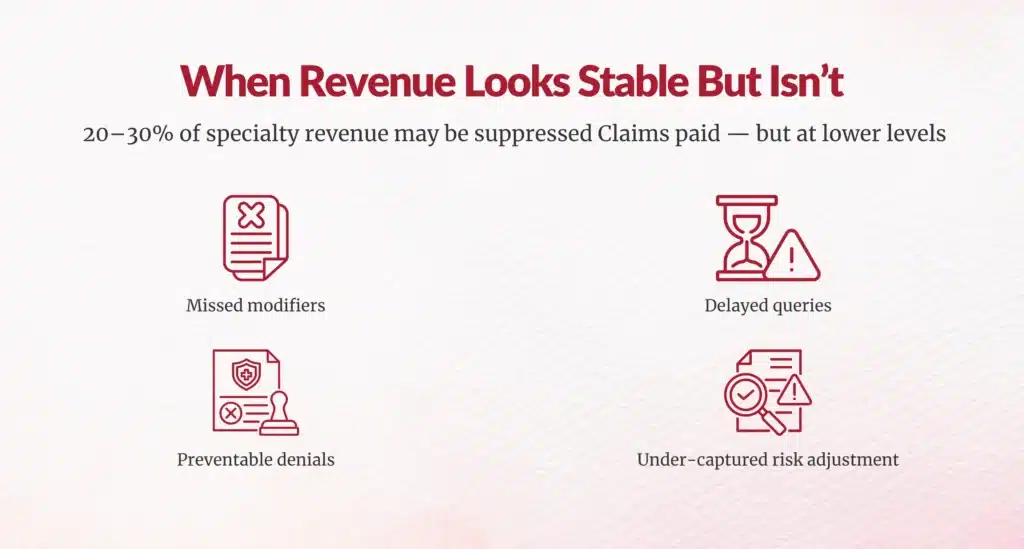
Without concurrent coding, specialty medical groups can quietly miss 20–30% of legitimate reimbursement due to delayed documentation clarification, conservative E/M leveling, modifier omissions, preventable denials, and under-captured risk adjustment. None of these issues independently feel catastrophic. Together, they compound across thousands of encounters.
This is not a revenue cycle failure. It is structural underperformance. In specialty care, timing determines reimbursement.
How Does the Absence of Concurrent Coding Quietly Suppress 20–30% of Legitimate Revenue?
Concurrent coding means reviewing documentation and assigning codes during or immediately after the patient encounter. Retrospective coding occurs days or weeks later, after documentation has aged and clinical recall has diminished.
That difference in timing drives financial outcomes.
When coding is delayed, documentation gaps often remain unresolved at submission. Queries are sent long after the encounter. Providers respond with limited context. Coders default to conservative E/M levels when clarity is insufficient. Modifier opportunities are missed. Addenda may appear reactive rather than contemporaneous.
Most organizations do not immediately recognize the financial impact because claims are still paid. The revenue suppression occurs inside the reimbursement level not through visible denials.Over time, incremental underperformance becomes normalized.
Why Coding Timing Matters More in Specialty Care?
Specialty reimbursement is complexity-driven.
Procedural specialties rely heavily on modifier precision, add-on code capture, and accurate global surgical period designation. Cognitive specialties depend on clearly documented medical decision-making and total time. Risk-bearing arrangements require complete chronic condition documentation under CMS-HCC models.
In these environments, small documentation omissions have disproportionate financial consequences.
Retrospective coding introduces delay between care delivery and code assignment. That delay reduces the likelihood of meaningful clarification. Concurrent coding aligns documentation review with the active clinical narrative. Questions are resolved in real time. Specificity is added before submission. Claims leave optimized rather than corrected later.
The distinction is structural, not cosmetic.
Where Does the 20–30% Revenue Leakage Actually Occur?
Revenue suppression in specialty groups is cumulative. It emerges across multiple touchpoints in the documentation and billing lifecycle.
E/M Under-Coding After 2021 Guideline Changes
Following the 2021 E/M updates, reimbursement is primarily driven by medical decision-making complexity and total time. In specialty practices, risk factors are often implied but not explicitly documented. Chronic conditions influencing decisions may not be clearly linked. Total physician time may be underreported.
When documentation lacks explicit clarity, coders assign lower levels to reduce compliance risk.
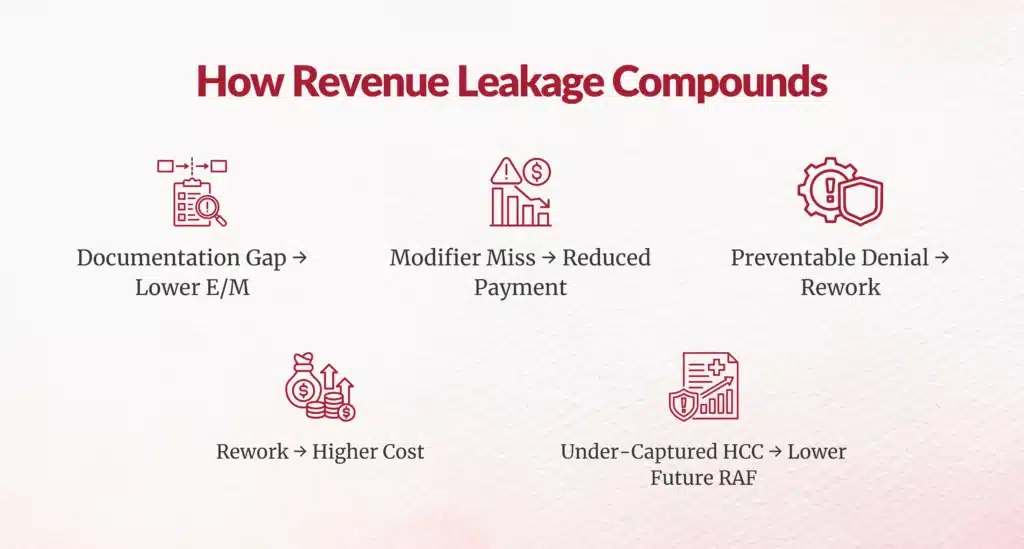
A $30 under-leveling variance per visit across 40,000 encounters annually equals $1.2 million in suppressed revenue. The claim is paid just at a lower level. No denial appears. The suppression becomes embedded in baseline performance. This is silent revenue loss.
Modifier and Add-On Code Suppression
Specialty reimbursement frequently depends on modifier accuracy. Modifier -25 usage, distinct procedural service modifiers, add-on codes, laterality specificity, and global period designation all require clear documentation support.
If documentation does not explicitly justify these elements, reimbursement is reduced rather than denied.
Reduced reimbursement rarely appears in denial reports. Repeated across providers and service lines, modifier omissions produce substantial financial variance.
Concurrent coding ensures modifier validation before submission rather than after remittance.
Preventable Denials and Rework Expansion
Denials create more than delayed payment. They create operational drag.
Preventable denials require appeals, documentation review, rebilling, and staff time. Each reworked claim increases cost to collect and extend accounts receivable timelines. Cash flow predictability declines.
Concurrent coding shifts correction upstream. Documentation insufficiencies are addressed before submission. First-pass yield improves. Rework volume declines. Denial prevention is margin protection.
Risk Adjustment Under-Capture
Under CMS-HCC models, chronic conditions must be documented annually with specificity and evidence of active management. Specialists often prioritize the acute presenting issue and omit documentation of comorbidities influencing care decisions.
Over time, RAF scores decline. Future reimbursement decreases. No denial is issued. The financial impact becomes visible only in aggregate forecasting.
Concurrent documentation review supports complete chronic condition capture before the encounter closes.
Why Leadership Often Fails to Detect Suppression?
Revenue leakage persists because performance appears acceptable.
An 86% clean claim rate may feel stable internally, yet high-performing organizations operate at 93–95%. A 10% denial rate may feel manageable, yet peer benchmarks may be lower.
Siloed accountability compounds the issue. CDI sees documentation gaps. HIM monitors coding. RCM manages denials. Finance sees margin compression. Without integrated, concurrent visibility, no function sees the full suppression curve.
Revenue leakage thrives in operational handoffs.
Financial Modeling: How 20–30% Becomes Plausible
Consider a conservative scenario:
- 45,000 annual specialty encounters
- $300 average reimbursement
- 10% E/M under-leveling variance
- 5% modifier suppression
- 5% preventable denial impact
These incremental inefficiencies compound toward 20% revenue at risk.
On $13.5 million in revenue, that equals $2.7 million suppressed or delayed. On $150 million, exposure reaches $30 million.
This is not extreme modeling. It reflects repeated micro-inefficiencies across complex encounters.
How Does Concurrent Coding Change the Equation?
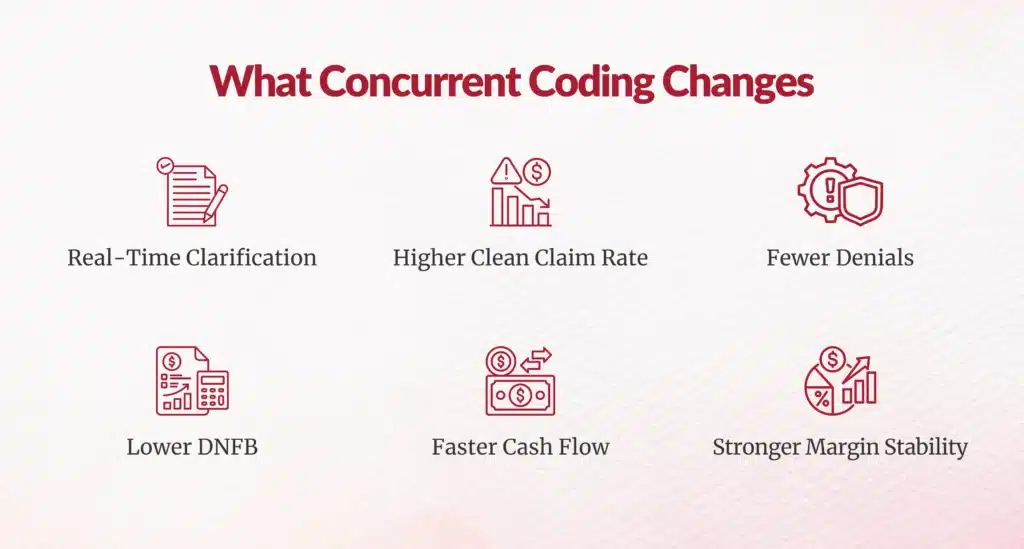
Concurrent coding intervenes before revenue leaves the organization.
Clean Claim Rate
Real-time documentation validation increases first-pass resolution. Claims are more complete and defensible at submission, reducing payer back-and-forth and administrative rework.
Denial Prevention
Upstream clarification prevents documentation-related denials. Reduced denial volume shortens A/R cycles and lowers appeal workload.
DNFB & Cash Flow
Faster coding reduces Discharged Not Final Billed days. Claims are submitted sooner. Revenue posts faster. Cash flow becomes more predictable.
Cost to Collect
Rework, appeals, and repeated documentation reviews increase cost to collect. By reducing preventable errors, concurrent coding lowers operational expense and preserves margin.
Final Thoughts
The issue is not whether specialty medical groups experience revenue leakage. The issue is timing. Most suppression does not originate in catastrophic billing mistakes. It begins in delayed clarification, conservative leveling, incomplete specificity, modifier omission, and preventable denial patterns that feel routine.
Concurrent coding changes the sequence. It aligns documentation accuracy with reimbursement before claim submission. It converts reactive revenue recovery into proactive revenue protection.
For specialty organizations operating in narrow-margin environments, that shift is strategic. The question is no longer whether leakage exists. It is whether leadership is measuring it or absorbing it.



FAQs
Why is 20–30% revenue leakage realistic in specialty groups?
Because suppression accumulates across E/M under-coding, modifier gaps, preventable denials, delayed queries, and risk adjustment under-capture. Individually small variances scale across thousands of encounters.
Isn’t retrospective coding sufficient?
Retrospective coding identifies issues after submission. Concurrent coding prevents suppression before claims are finalized.
Does concurrent coding disrupt workflow?
When integrated within EHR workflows, concurrent coding improves documentation clarity while reducing future query burden.
How quickly can impact be measured?
Most organizations observe measurable clean claim rate and denial improvements within 60–90 days.
Author Bio:

Kanar Kokoy
CEO - Chirok Health
Healthcare CEO & CDI/RCM innovator. I help orgs boost accuracy, integrity & revenue via truthful clinical docs. I've led transformations in CDI, coding, AI solutions, audits & VBC for health systems, ACOs & more. Let's connect to modernize workflows.