






















Sample Comprehensive Coding Accuracy (CCA) Analysis Report
A real-world example of how national coding benchmarks surface compliant reimbursement opportunities across specialties and services.
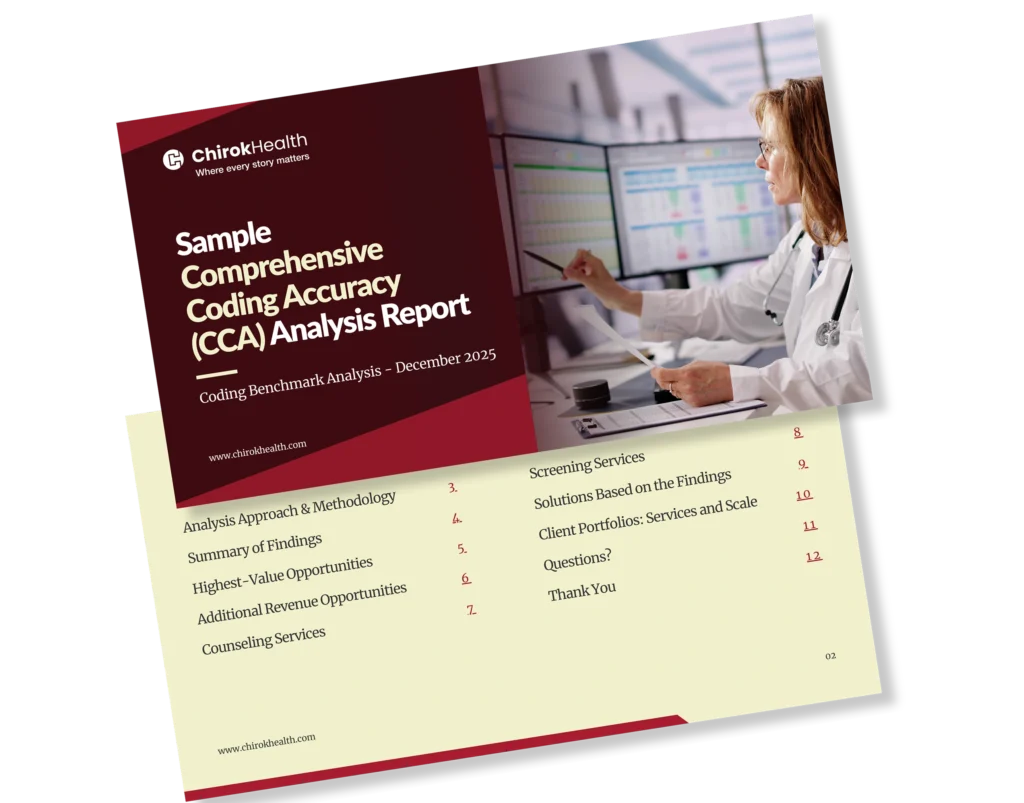
Why This Sample Analysis Was Created?
Healthcare leaders are often shown topline opportunity numbers without visibility into how those conclusions are reached. That lack of transparency makes it difficult to evaluate credibility, compliance posture, or real-world applicability.
This sample analysis exists to show how a national coding benchmark review is actually constructed, from data normalization to variance identification to conservative financial modeling, before any recommendations or actions are taken.
What You’ll See in This Sample Analysis?
This sample provides a structured view of how Comprehensive Coding Accuracy (CCA) Analysis. is performed, including:
- Application of national utilization benchmarks by specialty and service
- Identification of under-utilization variance without implying incorrect billing
- Translation of variance into estimated opportunity using payer-aligned assumptions
- Validation of findings through documentation review and quality controls
Who This Sample Analysis Is For?
- Revenue Cycle Directors and VPs
- Health Information Management (HIM) Leaders
- Clinical Documentation Improvement (CDI) Directors
- Compliance and Audit Stakeholders
It assumes familiarity with coding fundamentals and is designed for executive review and decision support.
How to Use This Sample?
This sample analysis should be used as a reference and evaluation tool. It demonstrates how benchmark variance can inform documentation improvement, coding governance, and financial prioritization, while remaining compliant with payer and regulatory expectations.
It is not a forecast, guarantee, or audit, only a transparent example of how benchmark intelligence is generated and applied.
Compliance as a Foundational Design Principle
A sample Comprehensive Coding Accuracy (CCA) Analysis. grounded in compliance and validation controls.



Download the Sample Now!
Got Questions?
We’ve Got Answers!
The sample includes a real-world illustration of national benchmark methodology, showing how coding utilization is compared by specialty and service, how variance is identified, and how potential opportunity is conservatively modeled.
No. The sample does not represent guaranteed revenue or expected outcomes. All figures shown are illustrative estimates derived from benchmark variance and are contingent on appropriate documentation and payer-specific rules.
No. This is not an audit, nor does it assert incorrect billing. The sample demonstrates how benchmark variance can be identified and evaluated without implying non-compliance or inappropriate coding.
The sample should be used as a reference framework to understand:
- How benchmark intelligence is generated
- How to interpret variance responsibly
- Where deeper documentation or governance review may be warranted
It is designed to support decision-making, not immediate action.
The sample illustrates benchmark variance across E/M services and selected additional service categories, highlighting where opportunity often concentrates when compared against national utilization patterns.
No. The sample is designed to demonstrate compliance-first methodology, emphasizing documentation support, conservative modeling, and audit defensibility throughout the analysis process.