






















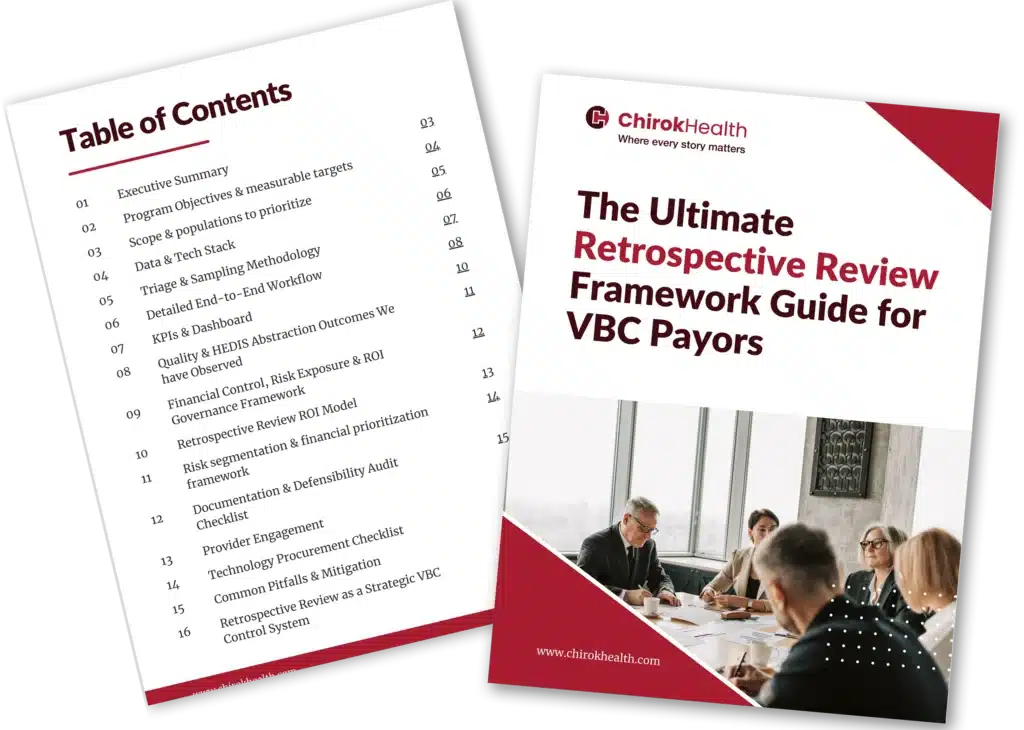
The Ultimate Retrospective Review Framework Guide for VBC Payors
A governance-driven guide for VBC payors to balance risk capture, payment integrity, and provider alignment.
The Strategic Role of Retrospective Review in VBC Oversight
Retrospective review has evolved beyond chart validation and post-payment correction. For Value-Based Care payors, it now directly influences risk score accuracy, capitation integrity, regulatory exposure, and provider trust.
This framework exists to help executive leaders design retrospective review programs that deliver measurable outcomes, without devolving into aggressive recoupment tactics or provider abrasion. It positions retrospective review as a controlled, defensible, and provider-aligned governance function.
What Executive Leaders Will Learn From This Framework?
This executive guide lays out a complete retrospective review framework purpose-built for Value-Based Care, including:
- How to structure retrospective review around risk capture, payment integrity, and quality improvement
- Where claims-only approaches fall short, and how analytics and NLP close the gap
- Defensible triage, sampling, and workflow methodologies
- Operational KPIs, financial control bands, and ROI governance models
- Provider engagement strategies that preserve relationships while improving documentation accuracy
The focus is on framework design, decision thresholds, and executive oversight, not tactical chart review instructions.
Leadership Roles This Framework Is Built For
This guide is written for senior leaders responsible for VBC financial accuracy, regulatory confidence, and provider network performance, including:
- Directors and VPs of Risk Adjustment
- Directors and VPs of Provider Network Management
- VBC Operations and Performance Leaders
- Compliance and Payment Integrity Leadership
It assumes familiarity with Value-Based Care models and is designed to support enterprise-level decision-making, not day-to-day review execution.
Retrospective Review as a Long-Term VBC Control System
When governed correctly, retrospective review is not a recovery function; it is a strategic control system that shapes future performance, stabilizes risk scores, and reduces regulatory exposure.
This framework gives VBC payors the structure needed to operate retrospective review programs with discipline, defensibility, and long-term value, rather than short-term financial noise.
Compliance Built Into the Retrospective Review Framework
Designed to support regulatory defensibility, audit readiness, and payer oversight in Value-Based Care.



Download the Ebook Now!
Got Questions?
We’ve Got Answers!
Clear answers to the questions VBC payor leaders ask before governing retrospective review programs.
No. This guide positions retrospective review as a governance and control system, not a recoupment engine. It emphasizes risk accuracy, defensible payment integrity, and long-term provider alignment over short-term recoveries.
No. The framework is designed to reduce regulatory exposure by enforcing defensible sampling, documented methodologies, audit trails, and clear escalation controls aligned with CMS and state expectations.
Traditional audits focus on isolated chart findings. This framework focuses on end-to-end program governance, including analytics-driven triage, statistically valid sampling, workflow controls, and executive-level financial guardrails.
Yes. While Medicare Advantage is often the starting point due to regulatory sensitivity, the framework extends to downside-risk ACOs, bundled payments, and commercial VBC contracts with appropriate segmentation.
Provider alignment is a core design principle. The guide outlines non-punitive communication models, joint case reviews, education-first escalation paths, and shared performance metrics to avoid provider abrasion.
The framework is intended for Directors and VPs of Risk Adjustment, Provider Network Management, VBC Operations, and Compliance, with executive oversight extending beyond operational throughput to financial and regulatory outcomes.
Yes. The guide includes risk capture benchmarks, financial control bands, operational KPIs, quality metrics, and ROI governance thresholds to support objective executive decision-making.