
















How Concurrent Coding Increases E/M and Procedure Volume by 26%
Does Concurrent Coding Really Increase E/M and Procedure Volume by 26%?
In simple terms:
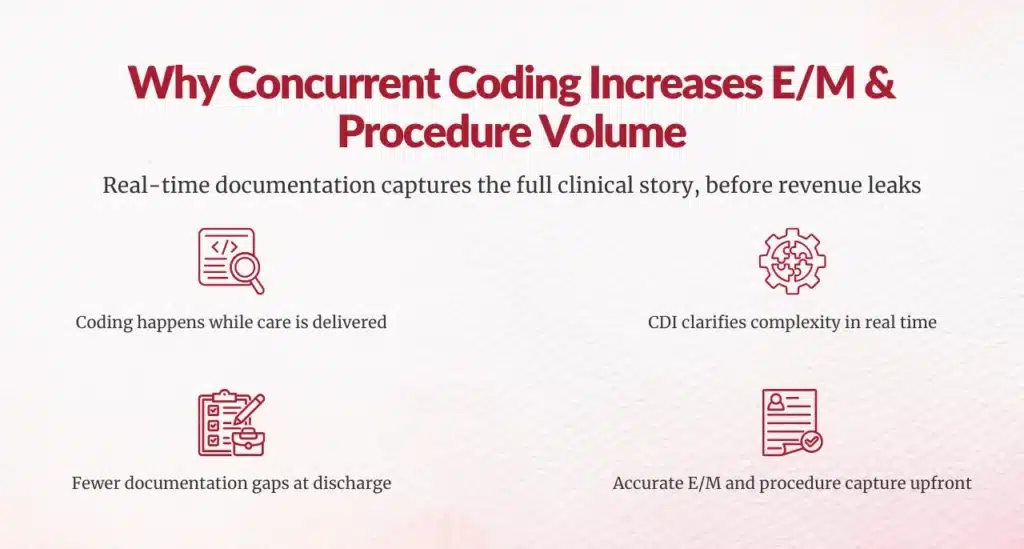
When coding happens while care is still happening, less revenue leaks out.
This is why concurrent coding has become a strategic priority for CDI, HIM, and RCM leaders focused on sustainable margin improvement not short-term gains.
Why Does Timing Matter So Much in Coding and CDI?
If you’ve been in revenue cycle leadership long enough, you’ve seen this pattern play out repeatedly.
Documentation is completed under pressure.
Details are implied but not stated.
Complexity is clinically obvious but not codified.
- Providers have moved on
- Context is lost
- Queries become harder to answer accurately
That single shift in timing is what unlocks higher E/M and procedure volume compliantly.
How Exactly Does Concurrent Coding Increase E/M Volume?
It captures complexity that retrospective coding often misses
- Medical decision-making (MDM)
- Risk to the patient
- Clinical judgment
- Allowing CDI teams to clarify MDM in real time
- Supporting providers while documentation is still editable
- Reducing assumptions and coder interpretation
Real-time documentation review significantly improves E/M accuracy and reduces under-coding caused by unclear clinical intent
Why Does Procedure Volume Increase with Concurrent Coding?
Procedures aren’t missed, they’re clarified
- Details are split across multiple notes
- Laterality or approach isn’t explicit
- Supporting documentation is incomplete
- Immediate identification of missing elements
- Clarification before operative notes are finalized
- Confirmation of billable procedures while documentation is fresh
What Are Other Organizations Actually Seeing After Implementation?
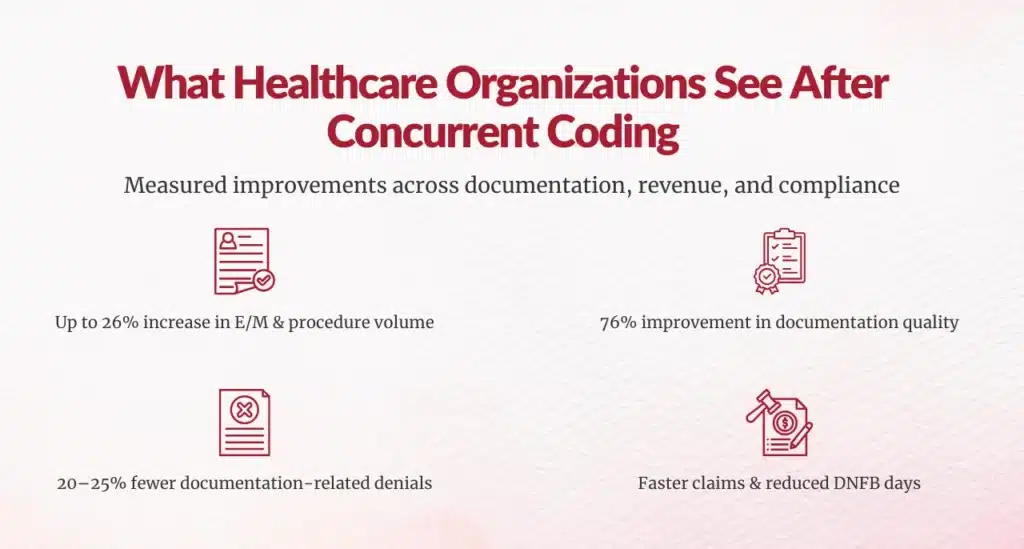
Measurable documentation and revenue cycle improvements
- Up to 76% improvement in documentation quality
- 20–25% reduction in documentation-related denials
- Faster claim submission and reduced DNFB days
- More predictable revenue
- Lower cost to collect
- Fewer downstream surprises
Does Concurrent Coding Create Compliance Risk?
In practice, it often reduces risk
- Strengthens documentation before claim submission
- Reduces retrospective queries that feel “leading”
- Improves audit defensibility with clearer clinical narratives
Because documentation and coding are aligned before billing, organizations are often better positioned during payer audits than those relying heavily on retrospective correction.
Concurrent coding doesn’t push codes higher it makes them defensible.
What Role Does Technology Play in Making This Sustainable?
- AI-assisted documentation gap detection
- NLP-driven chart prioritization
- EHR-embedded CDI and coding workflows
These tools help teams focus on high-impact encounters, improving productivity without increasing staff burden.
According to multiple health IT analyses, AI-supported concurrent coding improves first-pass accuracy and reduces chart review time, both critical for sustained performance improvement
Is Concurrent Coding a “Nice-to-Have” or a Strategic Priority?
- Flat E/M yield despite rising acuity
- Increasing payer scrutiny
- Provider frustration with late queries
- Margin pressure without room to cut care
- Revenue integrity
- Compliance confidence
- Provider collaboration
How Real-Time Clinical Storytelling Drives Sustainable Revenue Integrity
- E/M levels rise appropriately
- Procedures are captured accurately
- Revenue aligns with care delivery
That’s how organizations achieve a 26% increase in E/M and procedure volume, not through aggressive coding, but through better timing, collaboration, and documentation.
And that’s not a tactical fix.
That’s a leadership decision.
Author Bio:

Kanar Kokoy
CEO - Chirok Health
Healthcare CEO & CDI/RCM innovator. I help orgs boost accuracy, integrity & revenue via truthful clinical docs. I've led transformations in CDI, coding, AI solutions, audits & VBC for health systems, ACOs & more. Let's connect to modernize workflows.