






















What Is HCC Coding in Medicare Advantage and Why It Affects Your Value-Based Revenue
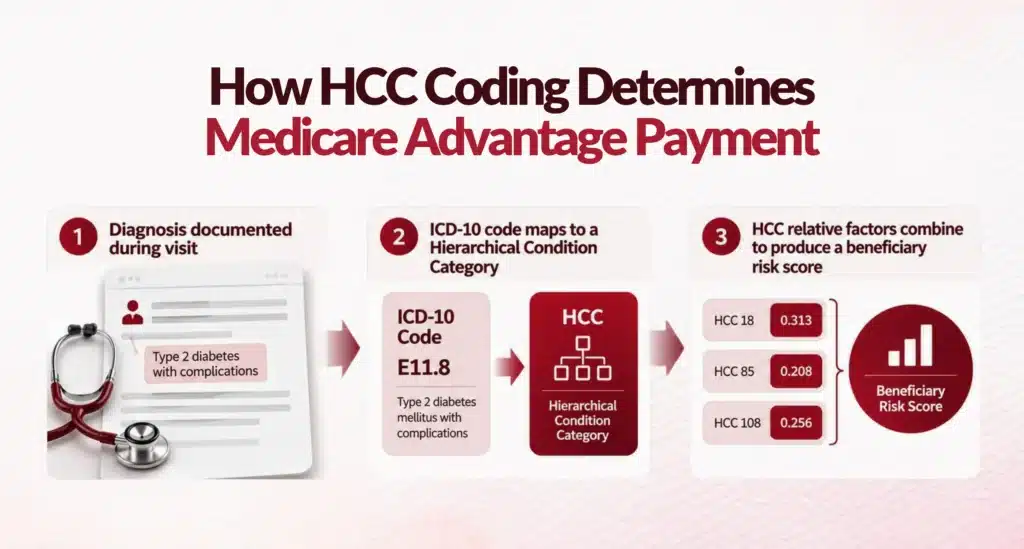
HCC coding is the process by which CMS maps patient diagnoses to Hierarchical Condition Categories to calculate risk-adjusted payments to Medicare Advantage plans. Qualifying conditions your practice documents and submits map to one of 115 payment HCCs in the current model. Those categories combine to produce a beneficiary’s risk score, and that score determines how much the plan receives to cover that patient’s care.
For primary care physicians serving Medicare Advantage patients, that connection runs directly through your charts. When documentation doesn’t reflect the full burden of a patient’s conditions, the risk score understates that patient’s complexity. The practice has delivered the care, but the record doesn’t show it. Chirok Health’s clinical documentation integrity services address E/M accuracy and HCC capture in a single concurrent review.
How the CMS-HCC Model Calculates Risk Scores
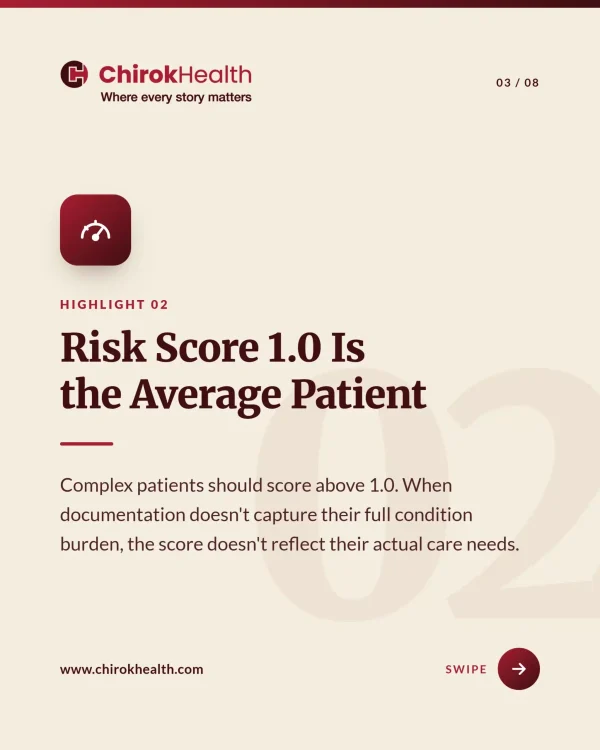
For payment year 2026, CMS completed its three-year phase-in and calculates risk scores using 100% of the 2024 CMS-HCC model (Version 28). Per the CMS 2024 Rate Announcement, the 2024 version maps diagnoses to 115 payment HCCs, up from 86 in the prior version. Each HCC carries a relative factor that contributes to a patient’s overall risk score, where 1.0 represents an average Medicare beneficiary. Patients with multiple serious chronic conditions should score above 1.0, reflecting the higher expected cost of managing their care.
Which Conditions Map to Payment HCCs
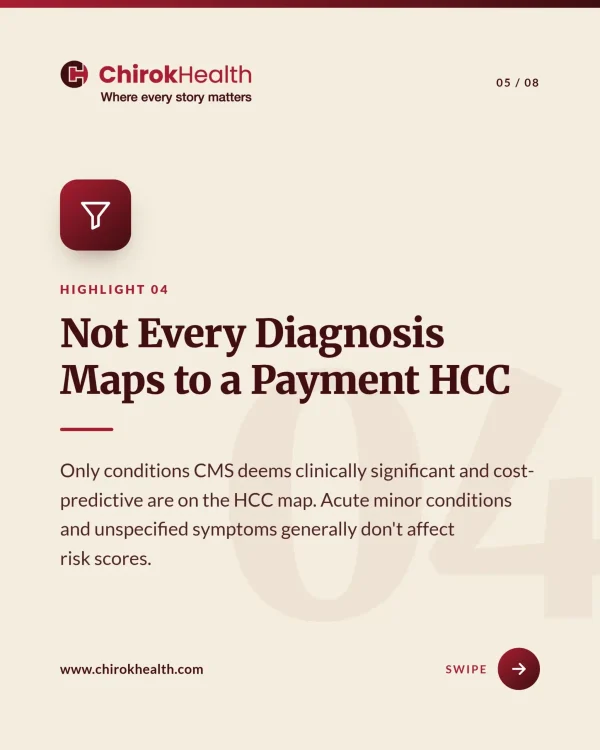
Not every ICD-10 code maps to a payment HCC. CMS includes only conditions it has determined to be clinically significant and financially predictive. Conditions like diabetes, congestive heart failure, and major depression each carry their own relative factors. Acute minor conditions, routine preventive care, and symptoms without clinical specificity generally don’t map to payment HCCs. A chart that captures acute complaints but leaves chronic conditions underdocumented will produce a lower risk score than the patient’s actual health status warrants.
How Documentation Gaps Become Payment Gaps
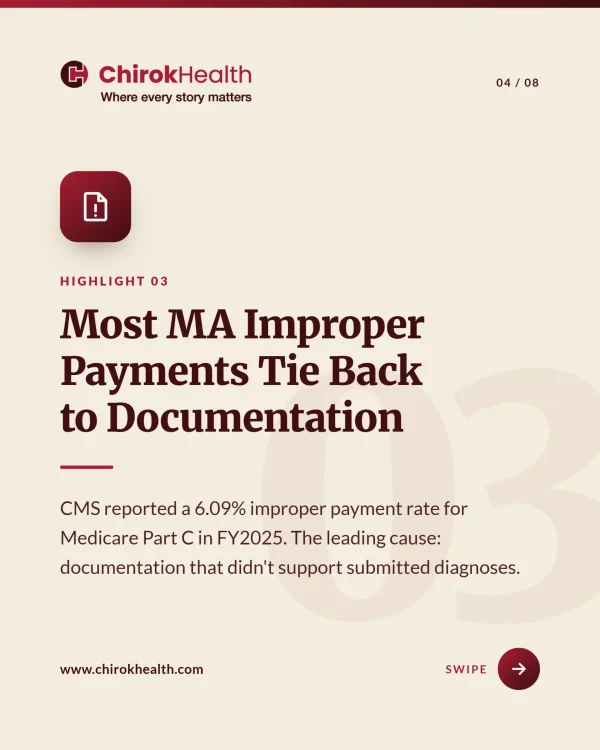
CMS’s fiscal year 2025 improper payment data reported a Part C error rate of 6.09%, totaling $23.67 billion. CMS identified that most of these improper payments occurred because documentation did not support the diagnosis data submitted for payment. The HHS Office of Inspector General has documented similar patterns across multiple audit series: medical record documentation does not always support the diagnoses Medicare Advantage organizations submit to CMS for risk score calculations.
Documentation gaps work in both directions. If a submitted diagnosis isn’t supported by the record, CMS can recover the payment through a Risk Adjustment Data Validation audit. If a legitimate chronic condition isn’t documented at all, the risk score stays lower than it should, and practices in value-based contracts absorb that gap without realizing it.
What Your Documentation Needs to Show
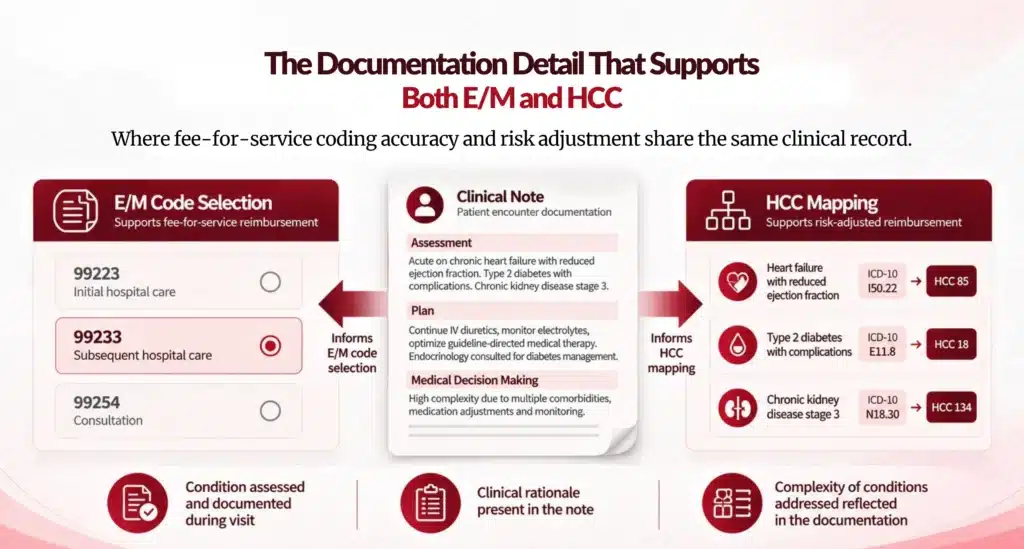
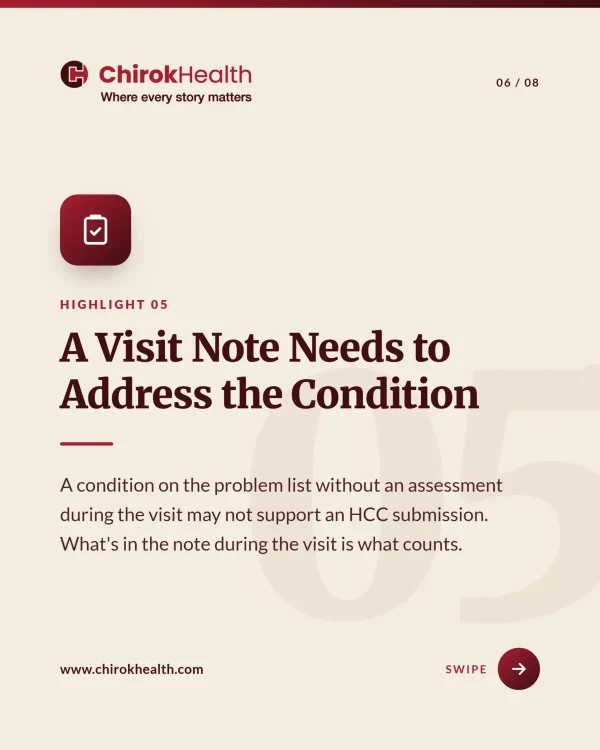
For a diagnosis to support a risk-adjusted HCC payment, the medical record must show that the condition was assessed or addressed during the visit, documented by a qualified provider, and supported by the clinical record. A chronic condition that appears on a problem list but isn’t addressed in the visit note may not meet CMS evidentiary standards in a RADV review. Missing clinical rationale or a condition carried forward without a current assessment creates gaps that are visible during audit. Starting with payment year 2027, CMS also stopped counting diagnoses from audio-only telehealth visits and from chart reviews that aren’t linked to an actual encounter.
How E/M Visit Level Connects to Risk Accuracy
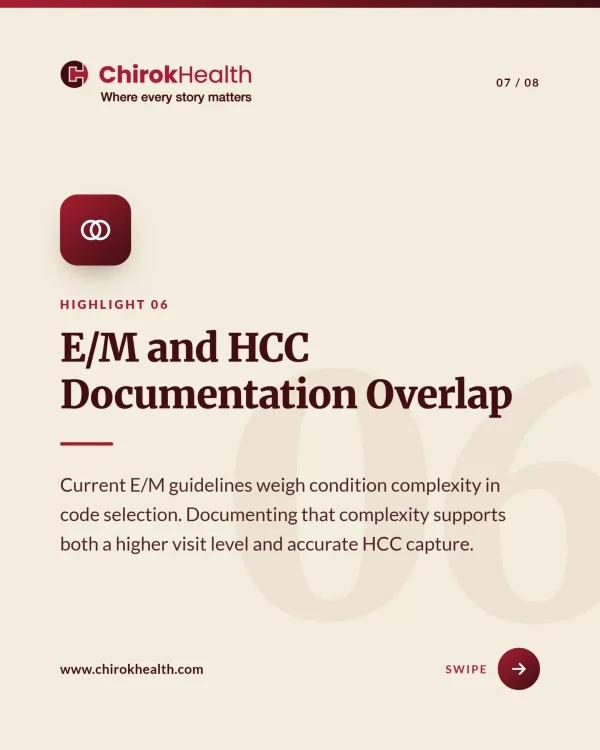
Since 2021 for office visits, and 2023 for most other settings, the AMA CPT E/M guidelines allow practitioners to document most visits using either medical decision making or total time. The complexity of conditions being managed is a key factor in code selection. A visit where a physician addresses multiple chronic conditions can support a higher-level E/M code when the documentation reflects that clinical work. The same documentation detail that supports a higher E/M level provides the clinical evidence that anchors HCC capture.

How Accurate Are Your Risk Scores Right Now
If your practice serves a Medicare Advantage panel with significant chronic disease burden, the gap between your patients’ actual complexity and what your risk scores reflect can be substantial. A documentation review that covers both E/M accuracy and HCC capture shows you where that gap sits.
Chirok Health’s clinical coders work inside your existing workflow to review charts concurrently, covering both fee-for-service accuracy and risk adjustment in a single pass. Physicians receive feedback on what the record shows and draw their own clinical conclusions.
Request a Documentation Gap Assessment
The assessment examines documentation patterns, visit level distribution, and HCC capture rate across your Medicare Advantage panel.
Assessment covers:
- Visit level distribution versus national benchmarks
- Time documentation gaps affecting E/M support
- Chronic conditions present clinically but absent from risk-adjusted submissions
- HCC mapping gaps by condition category
- Concurrent review workflow fit
Documentation Is the Foundation of Risk Accuracy
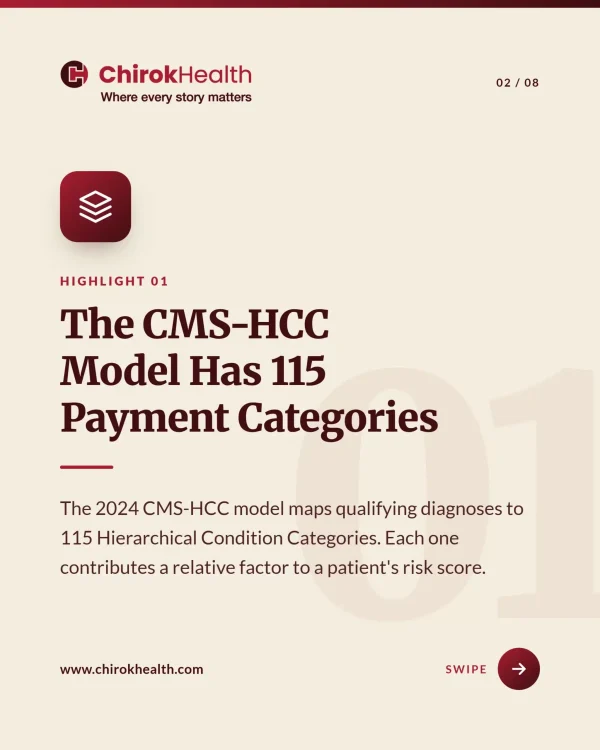
In Medicare Advantage, a patient’s documented conditions are the basis for everything that follows: the risk score, the plan’s funding, and the practice’s case for managing complex patients. The 2024 CMS-HCC model maps diagnoses to 115 payment HCCs, each tied to the expected cost of care. When the chart reflects that complexity, the risk score follows. When it doesn’t, the gap is silent but financially significant.
Frequently Asked Questions
1. What Is HCC Coding in Medicare Advantage?
HCC coding is the process CMS uses to map patient diagnoses to Hierarchical Condition Categories for risk adjustment. Each mapped HCC contributes a relative factor to a beneficiary's risk score, which CMS uses to calculate monthly payments to Medicare Advantage plans. For payment year 2026, CMS uses the 2024 CMS-HCC model at 100%.
2. How Does a Risk Score Affect What a Practice Receives?
Risk scores don't pay practices directly in fee-for-service. They affect what the Medicare Advantage plan receives to fund coverage for that enrollee. When a plan receives more accurate funding for high-complexity patients, that influences its ability to support care coordination and the value-based contract terms that practices negotiate.
3. What Happens If a Chronic Condition Is Not Documented During a Visit?
If a chronic condition isn't assessed and documented during a visit, it typically can't support an HCC submission for that year. Under the CMS-HCC model, chronic conditions generally need to be documented at least once per year to carry into the risk score for that payment year. A condition that is clinically active but absent from the record will not be mapped.
4. Do All ICD-10 Codes Map to an HCC?
No. The 2024 CMS-HCC model maps to 115 payment HCCs. Only ICD-10 codes that CMS has determined to be clinically significant and financially predictive are included. Many common codes, including those for acute minor conditions and symptoms without specificity, do not map to payment HCCs and do not affect risk scores.
5. What Is a RADV Audit?
A Risk Adjustment Data Validation audit is CMS's primary mechanism for verifying that diagnosis codes submitted by Medicare Advantage organizations are supported by medical record documentation. CMS's final rule published in February 2023, which applied extrapolation to RADV findings starting with payment year 2018, was vacated by a federal court in September 2025, and CMS has appealed. CMS can recover overpayments when submitted diagnoses lack documentation support. The OIG conducts compliance audits with similar objectives and has found documentation deficiencies across multiple organizations.
6. How Do the Current E/M Guidelines Relate to HCC Capture?
Since 2021 for office visits, and 2023 for most other settings, the AMA CPT E/M guidelines base code selection on medical decision making or total time, with condition complexity as a central factor. Thorough documentation of the conditions being managed supports both a higher-level E/M code and the HCC submissions tied to those conditions. The two reviews address the same underlying documentation record, which is why concurrent coverage of both is more complete than separate audits.
Author Bio:

Brandy Kerby
CGO - Chirok Health
Brandy Kerby is Chief Growth Officer at Chirok Health, a clinician-led medical coding, CDI, and revenue cycle organization. She works with health systems, providers, plans, and risk-bearing organization leaders on a question most are now facing: not whether to adopt coding automation, but how to govern it. Her work centers on the operational evidence behind that decision, including the encounter-level analysis presented in this briefing.