






















Why Cardiologists Under-Code Their Hospital Work, and What It Costs Health Systems
Cardiologists manage some of the sickest patients in the hospital: decompensated heart failure, new arrhythmias, post-procedure complications, patients on drug therapy that needs close monitoring. The documentation usually reflects that complexity. The code selected often does not.
When we compared the codes cardiologists selected against the codes billed after clinical coder review at a large health system cardiology program, the gap was widest where the care was most complex: in the hospital. The pattern is consistent, and it is rarely about missing documentation. More often, the record supports a higher level of service than the provider chose.
What the Data Shows
Comparing provider-selected codes with codes billed after review:
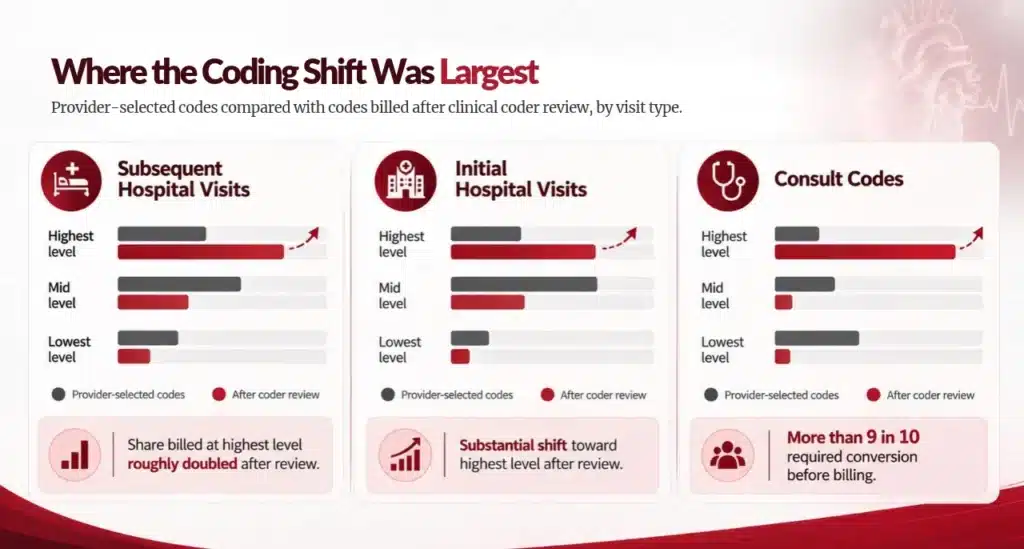
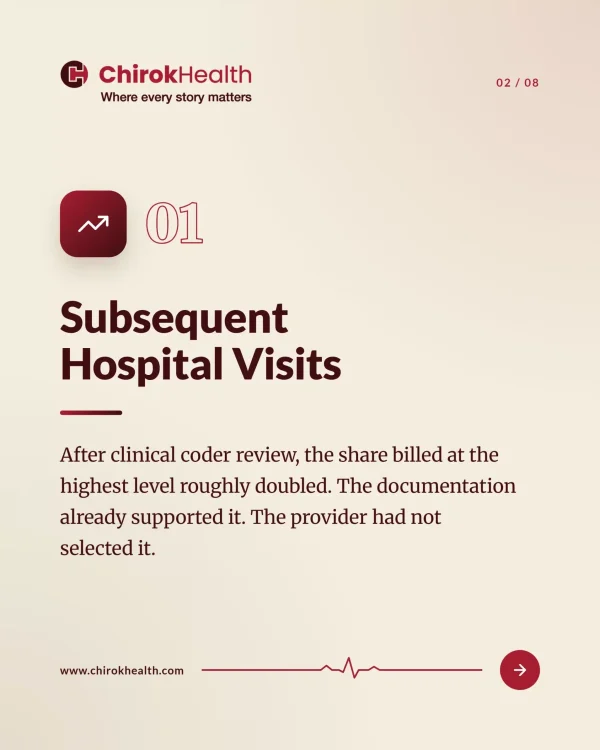
- Subsequent hospital visits: the share billed at the highest level rose from about 4 in 10 to nearly 8 in 10.
- Initial hospital visits: the highest level went from under half to nearly two-thirds.
- Consult codes: more than 95% of provider-selected consult codes had to be converted to visit codes before billing. Medicare hasn't recognized consult codes since 2010, and payer policies vary, so many organizations convert consults by default.
The same pattern shows up in the clinic:
- New patient office visits: the share at the two highest levels rose from about 80% to over 90%.
- Established office visits: the highest level rose from about 1 in 6 to 1 in 5.
In every case, the final code reflected what the documentation already supported.
Three Traps in Cardiology Hospital Coding
- Defaulting to the Middle on Follow-Up Visits
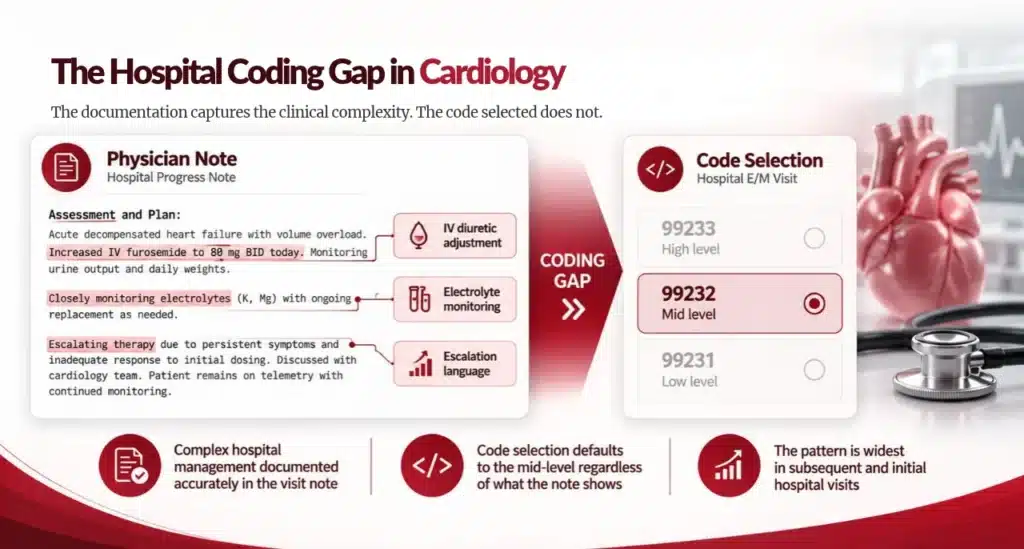
Subsequent hospital care is where habit takes over. A provider rounding on a patient with acute decompensated heart failure, adjusting IV diuretics and watching renal function and electrolytes, is often doing high-complexity medical decision making. But the mid-level code becomes the default because it feels safe. Since 2023, hospital visit levels can be supported by either medical decision making or total time on the date of service. Many cardiology notes clearly meet the higher threshold on one or the other.
- Under-Leveling the Admission
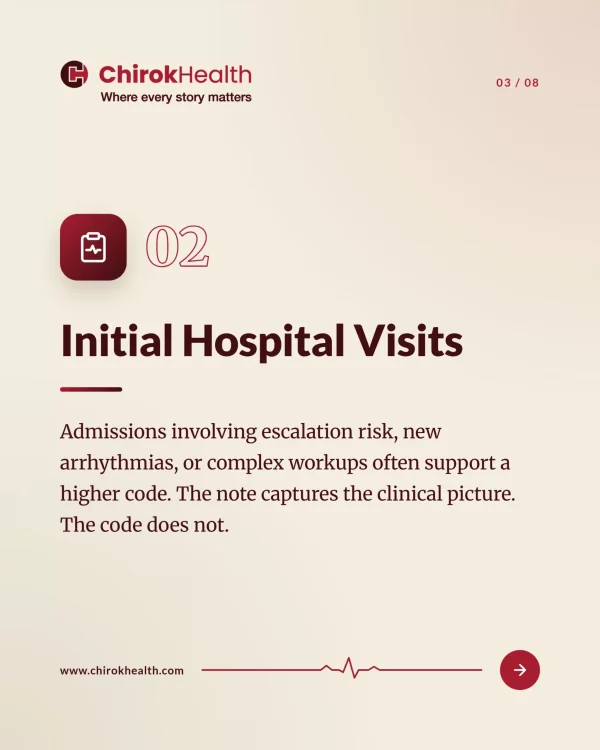
Initial hospital visits follow the same pattern. An admission for a new arrhythmia, chest pain with a concerning workup, or a patient who may need escalation of care often involves high-risk management decisions. When the documentation captures that risk and the code does not, the work goes unrecognized.
- Reaching for Consult Codes That Will Not Be Paid
Medicare stopped paying consultation codes in 2010, and some commercial payers have followed. Providers still select them out of habit, especially for inpatient consults. Each one has to be converted to the correct initial hospital or office visit code. If that conversion is missed, the claim is denied or delayed. This is a compliance and cash flow problem, not just a revenue one.
Why It Happens
The causes are rarely about knowledge. They are about pressure:
- Time. Code selection happens at the end of a long rounding list, when the fastest choice wins.
- Habit. Codes chosen years ago, including consult codes, stay in muscle memory.
- Audit anxiety. Many providers code conservatively on purpose, believing a lower code is the safer code. But a code that does not match the documentation is inaccurate in either direction.
For health systems, the cost adds up quickly: lost wRVUs that affect provider compensation and productivity benchmarks, denied consult claims, and documentation that undersells the acuity of the patients these programs actually treat.
The Fix: Clinical Coder Review Before the Claim Goes Out
The answer is not asking cardiologists to become coding experts. It is putting a clinical coder between the note and the claim.
In a pre-bill review model, the provider still makes the code selection. A clinical coder, typically a physician or pharmacist, reviews the encounter before it is billed and is accountable for code accuracy. When the documentation and the code do not match, the coder points to what the record shows, using non-leading queries, and the provider draws the conclusion. The final code reflects the care that was documented, whether that means a higher level, a lower one, or a corrected code.
What sets this approach apart is the provider experience. There is no new technology to learn and no new workflow. Providers get targeted education and dashboards that show their own patterns over time, so the gap between what they document and what they select narrows on its own.

The Takeaway
Cardiologists are not over-documenting or under-working. They are under-selecting. The care is complex, the notes usually say so, and the code too often lands in the middle anyway. Closing that gap is not about pushing codes higher. It is about making sure the code tells the same story the record already tells.
Talk with our team about what your documentation already supports.
Author Bio:

Brandy Kerby
CGO - Chirok Health
Healthcare CEO & CDI/RCM innovator. I help orgs boost accuracy, integrity & revenue via truthful clinical docs. I've led transformations in CDI, coding, AI solutions, audits & VBC for health systems, ACOs & more. Let's connect to modernize workflows.