






















Why Academic Medical Centers Carry Two Documentation Risks, and Why Most CDI Programs Only Cover One
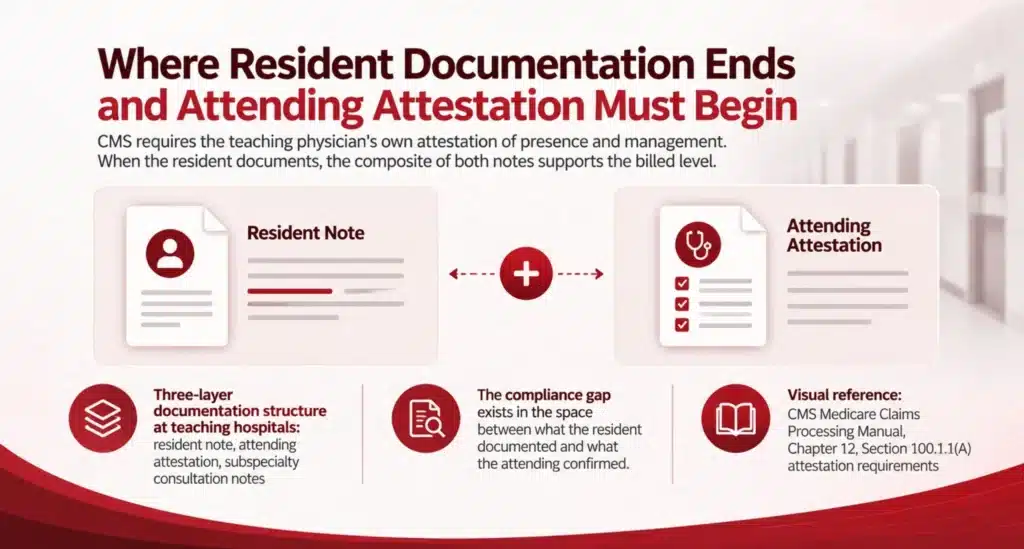
Under the CMS Medicare Claims Processing Manual, Chapter 12 and CMS MLN006347, a teaching physician who bills Medicare for a resident-involved E/M service must personally document presence during the critical or key portion of the service and participation in the patient’s management. When the resident documents the service, the composite of the attending’s note and the resident’s note must support the billed level. That rule governs the professional claim under the Physician Fee Schedule. The same resident note also feeds the hospital’s facility claim, where MS-DRG assignment and clinical validation follow a different rulebook. Academic medical centers carry both risks from a single chart, and most CDI programs are built to see only the second.
What Makes Teaching Hospital Coding Different from Other Hospitals?
In a community hospital, one physician documents and signs. At a teaching hospital, a resident may write the primary note before the attending reviews the case. CMS MLN006347 and MLN006764 require the medical record to demonstrate the teaching physician was present during the critical or key portions of the service and participated in the management of the patient. Under the CY 2026 Physician Fee Schedule final rule, that presence may be virtual, through real-time audio and video, only when the service itself is furnished virtually. For in-person services, physical presence still applies.
What Does CMS Require in a Teaching Physician Attestation for Medicare Billing?
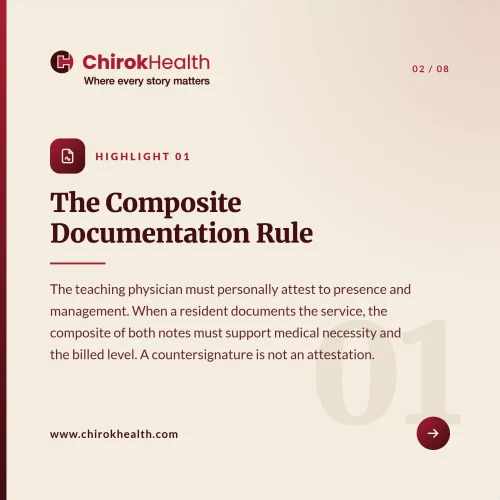
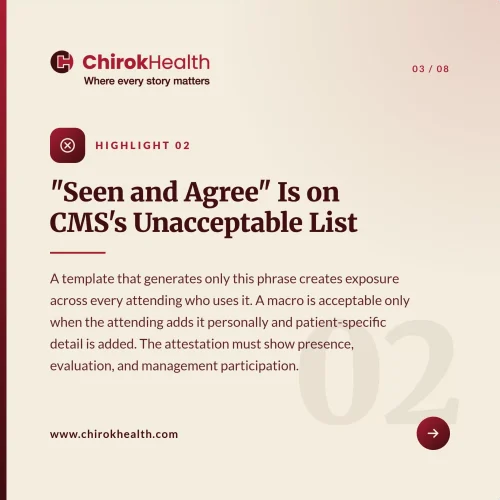
Under CMS Medicare Claims Processing Manual, Chapter 12, Section 100.1.1(A), the teaching physician must personally document presence for the critical or key portion of the service and participation in management. The teaching physician’s own note can carry the bill on its own. When the resident documents the service, the composite of the two notes must support medical necessity and the billed level, and the attending’s entry should reference the resident’s note. CMS explicitly identifies “agree with above,” “seen and agree,” and “patient seen and evaluated” followed by countersignature as unacceptable attestations. Under the primary care exception, MDM is the only permitted basis for visit level selection, and when total time is used to select a level elsewhere, only the teaching physician’s presence time counts.
Why Does Resident Documentation Create Professional Fee Compliance Risk at Teaching Hospitals?
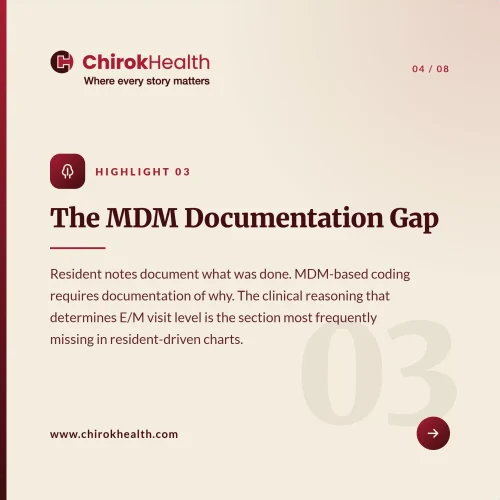
Three AMC audit patterns recur: copy-forward documentation creating inconsistency between attending updates and static resident notes; the MDM gap, because residents document actions rather than the clinical reasoning that E/M level selection has required since the 2023 guideline changes; and generic attestation phrases such as “Agree with above” and “Seen and agree” that the CMS Medicare Claims Processing Manual, Chapter 12, Section 100.1.1(A) explicitly identifies as unacceptable. A macro is acceptable if the teaching physician adds it personally in a secured system and either the resident or the attending adds patient-specific detail. Two macros with nothing patient-specific is not.
The gap is measurable. In a one-month Chirok review of 40,211 encounters at an academic medical center, spanning two facilities, the documented E/M level was raised in 14% of encounters, lowered in 10%, and the service type corrected in 8% after coder review. The 10% lowered is the compliance number: those are levels the documentation did not support as billed. This is documentation accuracy, not reimbursement, and it is the pro-fee exposure the teaching physician rules exist to police.
Two Claims, One Chart: Where the Professional Fee Risk Ends and the Facility Risk Begins
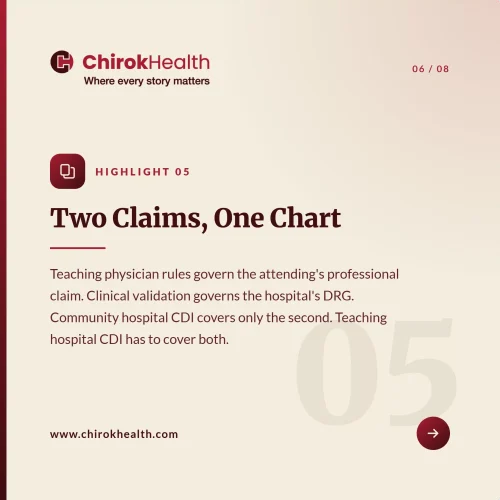
Teaching physician rules decide whether the attending’s professional claim is payable under the Physician Fee Schedule. Clinical validation and MS-DRG rules decide whether the hospital’s facility claim survives a payer audit. They are enforced by different contractors against different criteria, and they fail in different ways: an unacceptable attestation costs the professional fee for that visit, while an unsupported MCC costs the DRG for the stay. Both begin in the same resident note. A CDI program built for a community hospital watches the facility claim and never sees the attestation. That is the structural gap at academic medical centers.
How Are Payer Audits Targeting Facility Documentation Gaps at Academic Medical Centers?
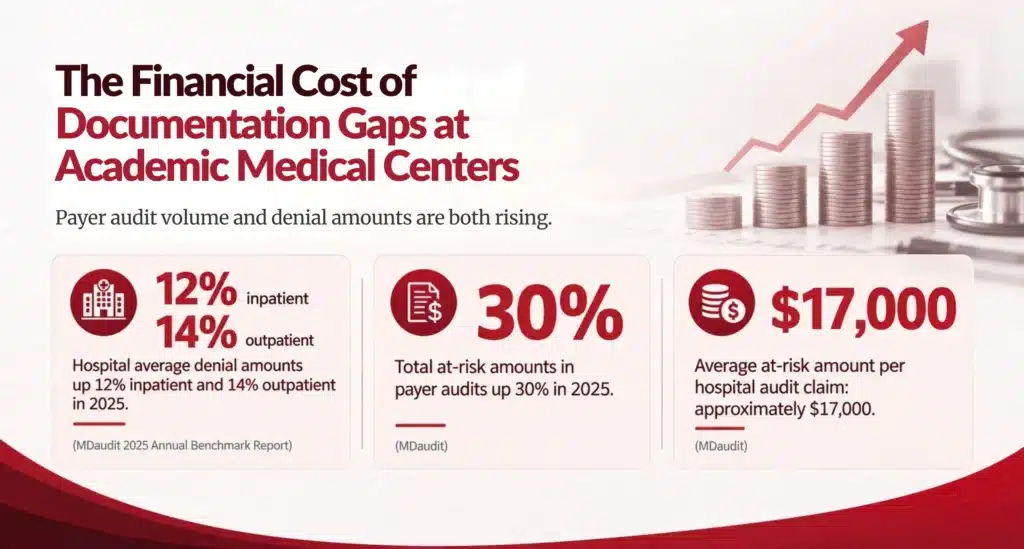
The MDaudit 2025 Annual Benchmark Report shows hospital average denial amounts up 12% for inpatient and 14% for outpatient claims in 2025, total at-risk audit amounts per organization up 30%, and the average at-risk amount per hospital audit claim at approximately $17,000. The HHS Office of Inspector General reported in February 2021 that stays at the highest MS-DRG severity level increased nearly 20% from FY2014 through FY2019, that 54% of those stays reached the top level on a single MCC, and that the most frequently billed MS-DRG was 871, sepsis with MCC. OIG recommended that CMS target those patterns, and audit activity concentrates on sepsis (870-872), heart failure (291-293), and acute MI (280-282).
Which Clinical Conditions and CDI Program Structures Drive Documentation Risk at Teaching Hospitals?
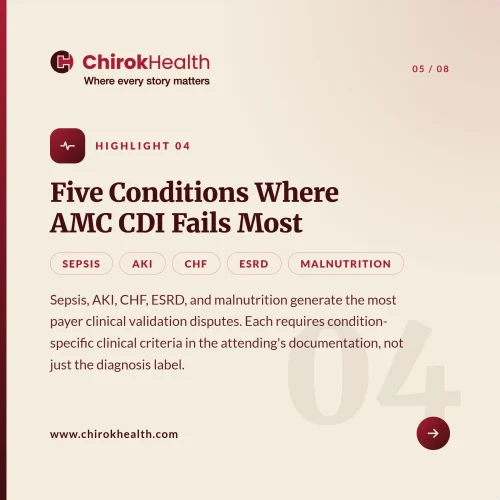
Five inpatient conditions generate the most payer clinical validation disputes: sepsis, acute kidney injury, ESRD, heart failure, and malnutrition. Sepsis is the clearest example: a payer applying Sepsis-3 criteria can deny a claim documented to Sepsis-2 criteria unless the clinical indicators are in the record. At AMCs where subspecialty notes hold the clinical evidence, CDI workflows must reach the full team to capture it. Community hospital CDI programs query one attending. Teaching hospital programs must span residents, fellows, and subspecialty consultants, and the same program has to cover the attending’s attestation on the professional side, which community hospital CDI never touches.
Where Does Your AMC's CDI Program Stand Against CMS Compliance Standards?
Request a CDI Program Readiness ReviewThe Documentation Compliance Gap Most AMC CDI Programs Have Not Fully Closed
Neither risk is new. Teaching physician rules have governed the professional claim for decades, and clinical validation has governed the facility claim since payers began auditing DRGs. What is new is the consistency of payer audit, and the fact that both risks now start in the same resident note. Community hospital CDI was built for the facility claim alone. What closes both gaps is concurrent CDI built for the teaching hospital environment, covering the attending’s attestation and the clinical evidence behind the DRG.
FAQs
What Is the Difference Between Teaching Physician Documentation Requirements and Standard Inpatient E/M Documentation?
Standard E/M requires the billing physician's own documentation. Teaching physician billing adds a personal attestation of presence and management participation, and when a resident documents the service, the composite of both notes must support medical necessity and the billed level. Where the attending's entry contradicts or fails to reference the resident's note, the professional claim is at risk.
What Makes a Teaching Physician Attestation Non-Compliant Under CMS Rules?
CMS lists "agree with above," "seen and agree," and "patient seen and evaluated" followed by countersignature as unacceptable in the Medicare Claims Processing Manual, Chapter 12, Section 100.1.1(A), along with "Rounded, Reviewed, Agree," "Discussed with resident. Agree," and a countersignature alone. None establish physician presence, patient evaluation, or management participation. A personally added macro is acceptable only when patient-specific detail is added by the attending or the resident.
What Is Clinical Validation and Why Does It Matter Specifically for Academic Medical Centers?
Clinical validation confirms a coded diagnosis is supported by clinical evidence, not just a documented label. At AMCs, that evidence often lives in subspecialty notes. When it does not reach the coded record, the diagnosis is in the chart but fails a payer audit. Clinical validation applies to the facility claim. It is a separate test from the teaching physician attestation, which governs the professional claim.
How Do OIG and RAC Reviews Target High-Severity Stays at Academic Medical Centers?
RAC reviews target high-severity MS-DRG stays with single MCC diagnoses and shorter-than-expected lengths of stay. The HHS Office of Inspector General reported in February 2021 that stays at the highest severity level increased nearly 20% from FY2014 through FY2019, with sepsis (870-872), heart failure (291-293), and acute MI (280-282) among the highest-scrutiny DRGs.
Author Bio:

Kanar Kokoy
CEO - Chirok Health
Healthcare CEO & CDI/RCM innovator. I help orgs boost accuracy, integrity & revenue via truthful clinical docs. I've led transformations in CDI, coding, AI solutions, audits & VBC for health systems, ACOs & more. Let's connect to modernize workflows.